Millard Fillmore Quotes
We have reached a crises in the history of this country when no man, however humble his rank or limited his influence, has a right to stand neutral..
He was of course not the President then. But the stands that politicians took with respect to the rebellion of the South often determined their political futures. See {640752} for another future President’s quotation on the subject.
Millard Fillmore, 1800-1874, 13th President of the United States (Whig, NY), Speech the day after President Lincoln had called for troops to cope with the Southern attack on Ft. Sumter, Metropolitan Theater, Buffalo, NY, 1861
Sourced by: Eigen's Political and Historical Quotations

He was of course not the President then. But the stands that politicians took with respect to the rebellion of the South often determined their political futures. See {640751} for another future President’s quotation on the subject.


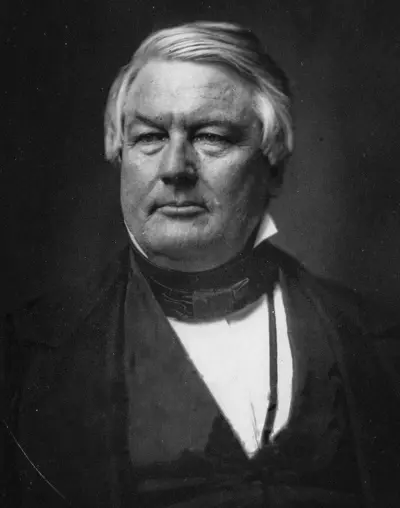
Millard Fillmore was the 13th president of the United States, serving from 1850 to 1853, the last to be a member of the Whig Party while in the White House. A former member of the U.S. House of Representatives from Upstate New York, Fillmore was elected as the 12th U.S. Vice President in 1848, and succeeded to the presidency in July 1850 upon the death of U.S. President Zachary Taylor. Fillmore was instrumental in the passing of the Compromise of 1850, a bargain that led to a brief truce in the battle over the expansion of slavery. He failed to win the Whig nomination for president in 1852 but gained the endorsement of the nativist Know Nothing Party four years later and finished third in the 1856 presidential election.
