Freedmen's Bureau Quotes
A majority of the freedmen to whom this subsistence has been furnished are undoubtedly able to earn a living if they were removed to localities where labor could be procured. The necessity for issuing rations to this class of persons results from their accumulation in large numbers in certain places where the land is unproductive and the demand for labor is limited.… the civil authorities refuse to provide for the able-bodied, and are unable to care for the helpless and destitute among them, owing to their great number and the fact that very few are residents of the counties in which they have congregated during the war. The necessity for the relief extended to these people, both able-bodied and helpless, by the Government, will continue as long as they remain in their present condition, and while rations are issued to the able-bodied they will not voluntarily change their localities to seek places where they can procure labor.
Ever since the Civil War, there has been an imbalance between the areas of the country with large unemployed populations and those areas where jobs were available. Even in 1870, the authorities were trying to get the unemployed to relocate but this was a hard thing to do at the time—physically, economically, and psychologically. It was not until the 2nd World War when huge numbers of Blacks migrated from areas of poor economic prospects in the South to areas of opportunity in the North. Also, note the classic welfare dilemma expressed whereby if humanitarian assistance is provided, people will not be desperate enough to move to areas with better opportunities.
Freedmen’s Bureau, Report on Virginia, "Reports of Generals Steedman and Fullerton on the condition of the Freedmen's Bureau in the Southern States”, ~1869
Sourced by: Eigen's Political and Historical Quotations

This marvelous quotation gives us a picture of the essence of the conflict in conception of freedom between Southern whites and negroes. There was no way to change the large majority of whites’ opinions and it is easy to see why Jim Crow and Southern discrimination evolved as it did. The emancipated Blacks had insufficient power or resources and there was not enough effort or success at changing white attitudes and no where near enough law enforcement to impose the view on the majority of the Southern white population.

For more about the Bureau. See {629185}.and {629187}.


Henry Ford had more than doubled the market wages of workers and shortened the work day. In his young years he hired Negroes to work on the Assembly line with whites. In his older years he would not when he had become a Hitler and Fascist admiring racist. This was of the Black migrations to Detroit to work in the Auto industry. See {642361} for Ford’s wage announcement.


Julian, the chemist who developed the industrial process of producing human steroids from soybeans, was the most famous and accomplished African American chemist at the time and the first Black laboratory director in America.


Newsletter of the United Sons of Confederate Veterans


This idea has been rejected by American Blacks from before the Civil War. There were many Black families that have been in America longer than Rockwell who always had the choice to go back to where they cam from if they were unhappy with America but they never did.
Realizing that as a mulatto she was subject to claims of slavery in New Mexico, she tool the precaution of getting this affidavit to protect her freedom. An interesting side note is that she states that she is “not bound by marriage or slavery.” For a woman the state of marriage meant the loss of most of her civil rights and was even then put in a similar category to slavery.


There was a huge amount of racial interbreeding during the early slavery times of America. Some was consensual as people will be people, but much was the rape of Black slaves my white masters—a concept that was never considered rape by law as one cannot commit a crime against one’s own property. The result after time was every possible combination of white/black mixture. There were names for many of the combinations: Quadroons were one fourth Negro. Octaroons, one-eighth. During and after reconstruction, for purposes of discriminatory law, who was a Negro? The Louisiana “one drop rule” said that if there was ANY trace of Negro ancestry, that person was a Negro and would be discriminated against. Of course, what would happen was that many mixed race children were light skinned and looked white and many were black and all shades in between. It was relatively easy for the lighter skinned “one drop” Negroes to pass as white especially if the left the state. But if anyone accused them of being Negro, they would have been guilty of committing crimes. Some in modern times have little comprehension of how the white plantation slave owners and other whitrd could condemn their own children to a second class life of vicious discrimination, but that is exactly what they did. The great irony here lies with the modern KKK, Nazi, and other White Supremacy Groups. They still hold to the “one drip rule for their viciousness. However, under the one drop rule, almost all of them would be Negroes if they went back far enough, and ALL ARE BLACK under the one drop rule as with modern DNA and genetic analysis, we now know that every human alive today emanated from a Black woman in Africa.

The NAACP official magazine

This quotation illustrates the Catch 22 dilemma that faces a minority. Black slaves were not allowed to marry and have formal families. After the Civil War racists warned against Blacks who had no respect for marriage monogamy end civil family life. See {619099} But when the slaves were freed and the ex slaves attempted to formalize and solemnize their marriages, they were castigated for that – acting like white people.
He was a realist who foresaw that even though the South had been militarily defeated, there were those who would persist in their efforts to retain slavery or a de facto form where freedom is the form but subjugation was the substance. It would be Jim Crowe and terrorism in the form of the KKK and a successor to Lincoln who was very sympathetic to the aims and culture of the Southern Rebels.

The reason for secession was the threat to slavery, which was a great threat to the slave-owners of the South. However, the non slave-owners had a very strong vested interest in maintaining slavery in that most Southerners had been brought up with such a negative view of Blacks that they were paranoid of Black equality or even worse some Blacks in positions of authority over whites. At the time, it was the Republican Party that was the advocate for minority equality and the Democratic Party embraced the racists. The parties would flip flop after the Civil Rights Act of 1964 ending legal segregation was passed by a Democratic President and a Democratic Majority Congress.

Wilson, a history and government professor and college president before politics, was has been accused of being one of the most racist Presidents since Reconstruction. Prior to his Presidency, the Federal Government had been making steady progress in hiring African Americans. Under Wilson there was a wholesale firing of a large proportion of them. Some apologists argue that his League of Nations and other major aspirations required the votes and cooperation of Southern Senators who insisted that many of the blacks be terminated. At the same time, the KKK was near the zenith of its membership and political power and was an intimidating force. Wilson’s home state of New Jersey not only had a large KKK membership but there were lynching of Blacks in his own state and when Governor and President he never asked for any anti-lynching legislation.

Lincoln was worried about Louisiana reverting back to the slavery era. He was right to be worried, and led the fight to pass the 13th Amendment outlawing slavery forever. So the white racist elements of Louisiana used Jim Crowe discrimination instead.

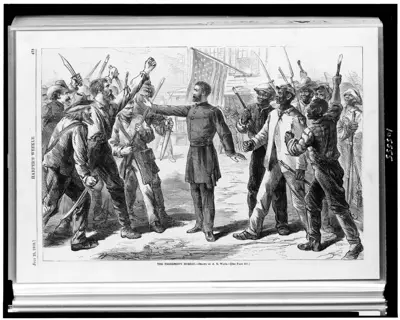
The Bureau of Refugees, Freedmen, and Abandoned Lands, usually referred to as simply the Freedmen's Bureau, was an important agency of early Reconstruction, assisting freedmen in the South. It operated briefly as a U.S. government agency, from 1865 to 1872, after the American Civil War, to direct "provisions, clothing, and fuel...for the immediate and temporary shelter and supply of destitute and suffering refugees and freedmen and their wives and children".
