Muhammad Ali Jinnah Quotes
We are different beings. There is nothing in life which links us together. Our names, our clothes, our foods–they are all different; our economic life, our educational ideas, our treatment of women, our attitude towards animals .... We challenge each other at every point of the compass.
Muhammad Ali Jinnah, 1876-1948, Founder of Pakistan and First Governor General, Opining on the difference between his Moslems and the Hindus of India, Quoted in Nisid Hajari, Midnight's Furies: The Deadly Legacy Of India's Partition
Sourced by: Eigen's Political and Historical Quotations

Arguments against the Partition of India at the time centered around the poor economic viability of a separate Muslim state. However Iqbal and others placed the cultural issues in the forefront. They eventually prevailed.

“Mussalman” was another name for a Muslim. Jinnah was arguing for a separate Muslim state within India. 7 years later he got is wish and Pakistan was born. However many Muslims chose to remain in India even though it was a majority Hindu state. Jinnah was right for many Muslims and wrong for many others who have integrated into Indian society and there is some intermarriage in India, which has 120 million Muslims, almost as many as Pakistan with 160 million.

Jinnah and other Muslim leaders had stirred up the Muslims to violence to put pressure on all the parties to accede to Jinnah's Muslim League's demand of an independent Muslim nation—Pakistan. Messervy was very sympathetic to the Muslim leadership as he had been feuding with and frustrated by the predominantly Hindu ruling Congress Party. After partition he accepted the mercenary position of Commander in Chief of the Pakistani Army. Then he was shocked and horrified at the slaughter of the terrorist attacks by the Muslims—about 4,000 Sikh men, women and children had been beaten and cut to death. The Sikhs had been targeted largely because Sikh leaders had recently announced that if there were a Partition, Sikhs would refuse to live in nation under Muslim control.

The report was praised by some of the intellectuals of Pakistan and most of the non-Islamic world. However, Pakistan the discussion of each of the cleavages, instigated the public passion of the cleavage and nothing significant was done.

Fiji is a nation which at the time was beset with ethnic strife and tension. In addition to the religious tension there were Indian immigrants who tended to be economically more successful than the indigenous Fijians. There was an English tradition from the days of being a British Colony and the traditional tribal leaders and chiefs were being disenfranchised by modern democratic structures. The military was not under the control of the civilian government and coups pitted some ethnic groups against others.


Paz was the Ambassador to India. The caste system in India was outlawed by the Indian Constitution, and the government has made many effort at affirmative action to eliminate it put as Paz observed it is so ingrained in Indian tradition, culture and religion that it continues to persist.

The Muslim League was demanding that the Punjab become a part of Pakistan when independence was granted later. However, the Hindus, Sikhs, Buddhists, and Christians were all adamant that they would not live in a Muslim nation which would soon become a de facto theocracy if the British could not control them. The Punjab was divided between India and Pakistan, and hundreds of thousands died in Sikh-Muslim attacks and then Hindu-Muslim conflict in the Punjab.
The fear of the Sikhs was that if the Punjab became a part of the new Muslim State of Pakistan, they would not be allowed to practice their religion and that the new Islamic state would discriminate against non-Muslims. They were successful in keeping the Punjab as a part of India, and turned out to have been right about the intolerance of the new Muslim state.
The attitude of the non-Muslims at that time was based on the Muslim attacks in the Punjab on Sikhs where entire Sikh villages and neighborhoods in towns and cities were murdered—every man woman and child. In many cases women were first raped. The Muslims had been whipped up by the leaders of the Muslim League to put terrorist pressure on the Sikh, Hindu and British to meet the League's political and territorial demands for an Independent Pakistan. Soon there was retaliation in kind and there were many Hindus, Sikhs and Muslims engaged in internecine slaughter and behaving "little better than animals".

Manava Dharma Shastra. The Hindus believe in reincarnation and that the souls of animals move up the ladder and if they are good are eventually born as humans (Sudras). These are the lowest caste in this terribly discriminatory system—the “untouchables.” But if a Sudra lives a pious life and accepts his lot, he is reincarnated as a higher cast human (twice born). This law illustrates the incredible discrimination that the cast system produced. In modern India, the caste system is illegal and there is no discrimination in law or by government. However it is still terribly evident in social life, marriage, employment and most phases of Indian society. This text is a part of the Hindu Holy Texts. Hindus believe that Manu was a prophet whose text is revealed or inspired.

The Western style of education was extremely effective for the Hindus, but was much less successful for the Muslims. The result was that over time, the Hundus achieved success in the professions, civil service, arts and sciences while the Muslims did not, thus changing the then existing parity of the two groups. For more on the difficulty that the Muslims had with British public education, see {616919} & {616925}.
The following year India was partitioned and millions of Hindus were slaughtered by Muslims and vice-a-versa.
Jinnah himself preached non-violence. At the time there was vicious sectarian violence throughout India but especially in The Frontier Province. However, the Muslims of the day did not heed him or Nehru or Gandhi for that matter and the violence continued. Jinnah however was a particularly shrewd politician who successfully used the threat of Muslim violence to obtain a separate Islamic state with Indian independence. He pointed to the threatening resolution issued earlier {627153}. The man who publicly preached peace, privately threatened violence.

Paz was the Ambassador to India


Muhammad Ali Jinnah and the other Muslim League leaders wanted to stir up India's Muslims in order to prevent Indian Independence from Britain unless India were partitioned and the Muslims could have their own nation. At that point the British and the Congress Party of India—the majority political party were both starting to plan for independence. Jinnah and most of the Muslim nationalists did not want to have Muslims in a Majority Hindu nation. To stop it, they first used fear to try and separate the many Indian Muslims who were politically active from their roles in and loyalty to the Congress Party which although Hindu dominated had Muslim members and officials. All the Muslims who were literate were aware of the terrible revelations of the Nazi Concentration Camps and the attempted extermination of all the Jews of Europe. The "party line" of the Muslim League was that once the British turned the government of India over to the Congress Party, they would turn on the Muslims and exterminate them so that India would be all Hindu. There were no such plans or even suggestions be anyone in the Congress party, the paranoia and the conspiracy theory resonated with many Indian Muslims just as conspiracy theories are believed by some people in every society. In this case, the paranoia that was unleashed by the Muslim League would have tragic consequences as with Independence getting closer many Muslims struck out and preemptively attacked and butchered Hindus and Sikhs who retaliated in kind and the butchery went on all through the Independence process and the partition of India to create a Muslim state—Pakistan. Almost 2 million people would be murdered in the sectarian violence that was unleashed.
Jinnah who at later years of his life became a rabid leader and facilitator of religious bigotry and violent Jihad, was totally opposed to mixing religion in politics. His view was so strong on this point that he even criticized Gandhi for mixing religion with politics when he was a sing star of the Indian Congress Party. Jinnah's flip flop on this point led to one of the great massacres and tragedies in human history.
There were several difficulties in this definition even for those British and Indian Congress leaders who were willing to accede to an independent Muslim state. Two of the most important where the definition of areas. They could be so defined as to include majority Hindu or Sikh areas surrounded by larger majority Muslim areas—the classic problem of boundary districting and redistricting. This was an insurmountable problem in the Punjab and elsewhere. The 2nd was the undemocratic nature of the demand. The Muslim League, unlike the Congress Party, had never had a very large participation and its leaders were never elected over a series of free and fair elections. Many Muslims were opposed to the Muslim League and there were areas of India, like Kashmir, where a large proportion of the 70% Muslim population were opposed to partition and if there were to be one would prefer to remain with India. With virtually 100% of the Sikhs, Hindus, Buddhists and Christians of Kashmir refusing to be part of a Muslim state, the majority in Kashmir would have then voted to remain a part of India but the Muslim League did not take account of democratic processes at the time. They changed their view later after they had infiltrated tens of thousands of semi nomadic Muslim Tribesmen across the border to gain the majority. Then the Indians would not accede to a plebiscite until the newcomers were removed and India has been in a constant war with Pakistan who has been trying to gain control of Indian Kashmir by war and terrorism.

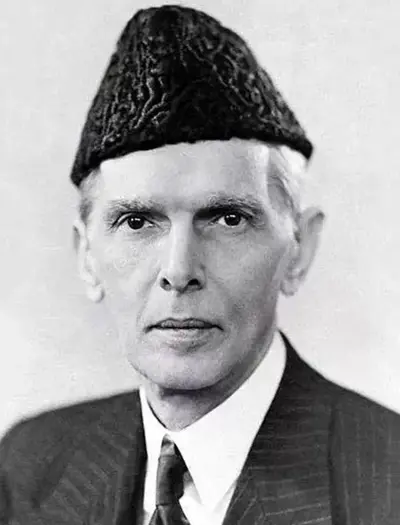
Muhammad Ali Jinnah was a barrister, politician and the founder of Pakistan. Jinnah served as the leader of the All-India Muslim League from 1913 until the inception of Pakistan on 14 August 1947, and then as the Dominion of Pakistan's first Governor-General until his death. He is revered in Pakistan as the Quaid-i-Azam ("Great Leader") and Baba-i-Qaum ("Father of the Nation"). His birthday is observed as a national holiday in Pakistan.
