Muhammad Ali Jinnah Quotes
Differences between Hindus and Muslims are so fundamental that there is nothing that matters in life upon which we agree.
The following year India was partitioned and millions of Hindus were slaughtered by Muslims and vice-a-versa.
Muhammad Ali Jinnah, 1876-1948, Founder of Pakistan and First Governor General, Speech, Kingsway Hall, London, December 13, 1946
Sourced by: Eigen's Political and Historical Quotations


Jinnah himself preached non-violence. At the time there was vicious sectarian violence throughout India but especially in The Frontier Province. However, the Muslims of the day did not heed him or Nehru or Gandhi for that matter and the violence continued. Jinnah however was a particularly shrewd politician who successfully used the threat of Muslim violence to obtain a separate Islamic state with Indian independence. He pointed to the threatening resolution issued earlier {627153}. The man who publicly preached peace, privately threatened violence.


This sura illustrates why peace treaties between Islamic and non Islamic countries are difficult to negotiate and enforce. For some fundamentalist Muslims, even making a peace treaty with Israel would constitute a transgression of the word of God. Nonetheless, the first treaty that the United States ever made was with a Muslim nation—Tripoli.

This quotation illustrates that a narrow orthodox view of Islam is not the only one in Arab nations. Khaled is not an obscure cleric, but a popular television personality. While his views are considered heresy by many orthodox Muslims, the narrow view is by no means universal. Orthodox Islamists believe that God has commanded that all mankind be Muslims and the ones who are not are either ignorant so need to be “educated”, or evil and therefore should be killed. However, Muhammad ordained that an exception should be made for “Children of the Book”—Jews and Christians who revere the Old Testament. This was at a time when Christians would not allow any other form of worship but Christianity. Christianity, Judaism and most other religions have become tolerant of other religions and allow open alternative worship. Islam which early on led the way to tolerance, has in many countries gone back to the intolerance that existed amongst many Christians at the time of Muhammad.
While not in the Koran, this attributed statement is the basis for the ban on non-Muslims going on a Hajj and going to the most holy Muslim places—Mecca, Mina, Muzdalifa, and Arafat as well as the anti-religious hostility to all religions but Islam which is present in some Muslim countries.
Under his leadership most of the Muslims did not accept such a constitution. Partition ensued and with it came the deaths of tens of millions of Indians but Pakistan and Bangladesh were formed. Ironically, there are now about 200 million Muslims in India living under a “Hindu Majority Government” –more than in any country except Indonesia. Few Indian Muslims leave India for Pakistan today.

Toleration is a relative term. The Muslim Moors made Christians (and Jews) pay a special tax. At times they were forced to wear special clothing so that they could be readily identified. And they could not build churches larger or taller than the smallest mosque in the community. At times, their occupations were restricted but at other times Christians and Jews were appointed to the highest positions like Vizier. The Inquisition, in contrast, forced all Muslims (and Jews) to leave the country without any of their property or money or be tortured and killed—usually by burning at the stake unless of course that they converted to Christianity.
“Mussalman” was another name for a Muslim. Jinnah was arguing for a separate Muslim state within India. 7 years later he got is wish and Pakistan was born. However many Muslims chose to remain in India even though it was a majority Hindu state. Jinnah was right for many Muslims and wrong for many others who have integrated into Indian society and there is some intermarriage in India, which has 120 million Muslims, almost as many as Pakistan with 160 million.
The Punjab had been partitioned into a Pakistani part and an Indian part. The latter was a major province of the new state. But in the political process of drawing the boundaries, Jinnah and other Muslim leaders had used fanatic Muslim terrorists to massacre Sikhs and Hindus to ethnically cleanse areas and intimidate the ruling Indian Congress Party and the British government to obtain more area and resources for the Muslim state. However, at this point he had to govern, and there were still many Sikhs and Hindus as well as Christians and Buddhists in the new Muslim state. Jinnah's new state needed all the help it could get from the U. S. and others, and Jinnah started sounding like a passionate democrat. On paper religious freedom was guaranteed in Pakistan. However Pakistan became one of the most dangerous countries in the world for non-Muslims. Most historians agree that the Muslim terrorism in the short run had worked, as it would have been unlikely that India would have been partitioned in the absence of violence. However, it set in motion a cultural pattern of religious hate, bigotry, intolerance, violence and murder which would plague Pakistan thereafter. The politicians throughout the country's history have tried to use the Muslim religious, fundamentalist, extremists for their purposes only to find that the fanatics were out of control and the entire Pakistani population has lived in fear, lest an extremist decide that what they did or say was inimical to Islam and assassinate him or her. They have assassinated even the highest levels of politicians—President, Governors of Provinces, National Legislatures as well as Journalists, writers and academics. But the average Pakistani citizen has always been at risk of brutal murder with hundreds killed every year in an atmosphere of total impunity for the murderers. They have even murdered married women who had been raped on the grounds that they were adulterers and were therefore stoned.

The report was praised by some of the intellectuals of Pakistan and most of the non-Islamic world. However, Pakistan the discussion of each of the cleavages, instigated the public passion of the cleavage and nothing significant was done.


See {586039} for a quotation that goes further and seeks to punish and humiliate the non believers. This sura is often used by those wishing to illustrate the intolerance of Islam—especially of other religions. They fail to put this into the context of the Old Testament which proscribed death for heretics or the history of Christianity regarding the murder of nonbelievers. The difference is however, that a very small proportion of Jews or Christians today believe in following Biblical instructions in this respect while the proportion of Muslims who believe in the literal interpretation of scripture on these points is much larger. However there are Islamic modernists and moderates throughout the world who reject this notion of warring on all other religions and there is a struggle going on within Islam itself.
The place of non-Muslims in an Islamic country, if any, has been a point of great anxiety among Christians, Jews, Bhais, and others. These have been persecuted and expelled from numerous Islamic countries while in others such as modern Turkey there is no problem. This particular cleric is seen as more “modern” and “liberal” than most. Even he has little concept of equality and freedom of religion.

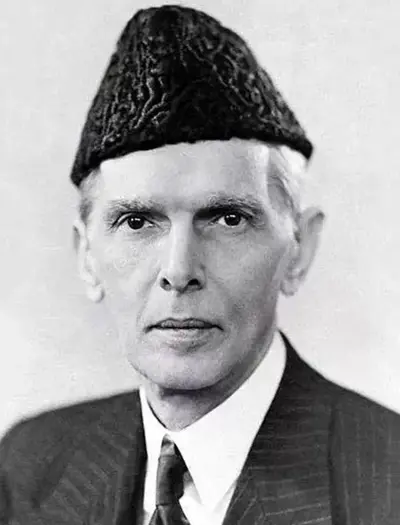
Muhammad Ali Jinnah was a barrister, politician and the founder of Pakistan. Jinnah served as the leader of the All-India Muslim League from 1913 until the inception of Pakistan on 14 August 1947, and then as the Dominion of Pakistan's first Governor-General until his death. He is revered in Pakistan as the Quaid-i-Azam ("Great Leader") and Baba-i-Qaum ("Father of the Nation"). His birthday is observed as a national holiday in Pakistan.
