Amr Khaled Quotes
If God wanted, he could have created all mankind as one religion. He created many different ways so we will cooperate.
This quotation illustrates that a narrow orthodox view of Islam is not the only one in Arab nations. Khaled is not an obscure cleric, but a popular television personality. While his views are considered heresy by many orthodox Muslims, the narrow view is by no means universal. Orthodox Islamists believe that God has commanded that all mankind be Muslims and the ones who are not are either ignorant so need to be “educated”, or evil and therefore should be killed. However, Muhammad ordained that an exception should be made for “Children of the Book”—Jews and Christians who revere the Old Testament. This was at a time when Christians would not allow any other form of worship but Christianity. Christianity, Judaism and most other religions have become tolerant of other religions and allow open alternative worship. Islam which early on led the way to tolerance, has in many countries gone back to the intolerance that existed amongst many Christians at the time of Muhammad.
Amr Khaled, Egyptian Muslim Televangelist, Quoted in New York Times Magazine, April 30, 2006
Sourced by: Eigen's Political and Historical Quotations


While not in the Koran, this attributed statement is the basis for the ban on non-Muslims going on a Hajj and going to the most holy Muslim places—Mecca, Mina, Muzdalifa, and Arafat as well as the anti-religious hostility to all religions but Islam which is present in some Muslim countries.

Watchtower Bible and Tract Society of New York


Head of the Sikh Religion. His teaching was that deeds determined the man, not the professed belief and that the existing religions turned man against man.

New Lanark was a Utopian commune organized by Owen.


Historically, when Christian Europe was torturing and butchering people over differences of religious opinion, Islam was for the time, in most places, a model of tolerance. Suhrawardy died before Islam degenerated into an intolerance that almost rivaled in brutality that of the Christians centuries ago. And while his statement about the invention and initiation of brutal intolerance is correct, he would be shocked at the behavior of 21st century Iran, Pakistan and some other Islamic nations who from a traditional Islamic perspective had degenerated.
In one of the historical ironies of the 12th century, a Christian sect preferred the rule of the Muslims than their Christian brethren—on the grounds of religious tolerance. It illustrates the changes that take place over time. By the 21st century, it was the Christians who were thought of as tolerant and the Muslims as the opposite.

The re-conquest had just taken place where the Christians defeated the Islamic troops and the King found himself ruling extensive Muslim dominated areas like Toledo as well as large Christian areas. While atypical for a Christian Catholic King, Alfonso VI went out of his way to avoid a crisis with either religious group. He told the Muslims that they could follow Islamic practices and let it be known by statements like this that he had two religions in his kingdom.

This was a remarkable public statement for its time. No other political leader of an Islamic country would dare claim that people have a right to be atheists. Very few would even suggest that people should be free to choose their own religion.


His protest was focused on Middle East policies which he believed did not value the lives of Muslims as highly as Christians and Jews. The irony of this protest is that United States policy claims to value all life equally as do virtually all industrialized democracies. Omeish however is unusual among world Islamic leaders and politicians in that he values Christian and Jewish life as much as Muslim. Most, typically value Muslims almost exclusively and many advocate the killing of Christians and Jews.
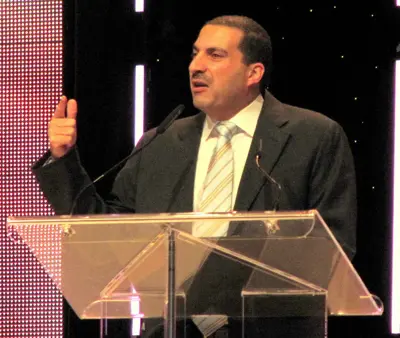
Amr Mohamed Helmi Khaled is an Egyptian Muslim activist and television preacher. The New York Times Magazine, in reference to Khaled's popularity in Arab countries, described him in its April 30, 2006 issue as "the world's most famous and influential Muslim television preacher." Amr Khaled was chosen in 2007 as one of the world's 100 most influential people by Time Magazine.
