Guru Nanak Quotes
There is No Hindu, There is No Muslim.
Head of the Sikh Religion. His teaching was that deeds determined the man, not the professed belief and that the existing religions turned man against man.
Nanak Dev Ji, 1469-1539, Founder of Sikhism and First Sikh Guru Statement attempting to diminish the friction between Hindus and Moslems
Sourced by: Eigen's Political and Historical Quotations


New Lanark was a Utopian commune organized by Owen.

He led an Islamic rebellion against the Quinn Dynasty which ended in his beheading in 1873. Since the Christians were also a minority, he tried to form an alliance with them. Hatred of Christians is not endemic to Islam—politics affect the situation also. His tomb is shown in the graphic.


This quotation illustrates that a narrow orthodox view of Islam is not the only one in Arab nations. Khaled is not an obscure cleric, but a popular television personality. While his views are considered heresy by many orthodox Muslims, the narrow view is by no means universal. Orthodox Islamists believe that God has commanded that all mankind be Muslims and the ones who are not are either ignorant so need to be “educated”, or evil and therefore should be killed. However, Muhammad ordained that an exception should be made for “Children of the Book”—Jews and Christians who revere the Old Testament. This was at a time when Christians would not allow any other form of worship but Christianity. Christianity, Judaism and most other religions have become tolerant of other religions and allow open alternative worship. Islam which early on led the way to tolerance, has in many countries gone back to the intolerance that existed amongst many Christians at the time of Muhammad.

His protest was focused on Middle East policies which he believed did not value the lives of Muslims as highly as Christians and Jews. The irony of this protest is that United States policy claims to value all life equally as do virtually all industrialized democracies. Omeish however is unusual among world Islamic leaders and politicians in that he values Christian and Jewish life as much as Muslim. Most, typically value Muslims almost exclusively and many advocate the killing of Christians and Jews.


The Guru was then horribly tortured, and when he still would not convert, the Emperor had him beheaded. A new Indian Emperor, Aurangzeb, had ascended the throne of India by imprisoning his father and murdering his brothers. All the Emperors in those days were Muslims ever since the Islamic army had left Arabia and conquered most land to the East including most of India. Aurangzeb was worse than most and claimed he had a vision from God telling him that he should make everyone in the kingdom a Muslim. But about half the population was still Hindu. He decided to get the Sikh Guru to convert and then almost all would follow. The Sikhs were considered a Hindu sect at the time, and the Sikh Guru was respected by most Hindus. When the Emperor sent for the Guru, he explained that India should only have one religion, Islam, and offered the Guru much gold to convert, but if he did not do so, it would go badly for him. The Guru asked that a large pile of peppercorns be brought before them, and had it set on fire. When the fire burned out, the Guru went through the ashes and found three peppercorns intact.
She was the first member of European royalty to embrace the Bahai faith. This faith is positive and supportive of all other faiths—an unusual characteristic for a religion. It even speaks well of Islam where literal interpretations of Sharia—Islamic Law—require that all Bahais be put to death. In Iran, they were still murdering Bahais in the 21st century.


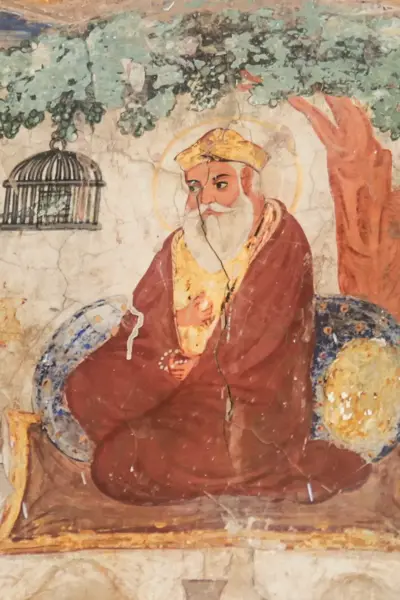
Gurū Nānak, also referred to as Bābā Nānak ('father Nānak'), was the founder of Sikhism and is the first of the ten Sikh Gurus. His birth is celebrated worldwide as Guru Nanak Gurpurab on Katak Pooranmashi ('full-moon of Kattak'), i.e. October–November.
