Muhammad Ali Jinnah Quotes
It is extremely difficult to appreciate why our Hindu friends fail to understand the real nature of Islam and Hinduism. They are not religious in the strict sense of the word, but are, in fact, different and distinct social orders, and it is a dream that the Hindus and Muslims can ever evolve a common nationality, and this misconception of one Indian nation has troubles and will lead India to destruction if we fail to revise our notions in time. The Hindus and Muslims belong to two different religious philosophies, social customs, literatures. They neither intermarry nor interdine together and, indeed, they belong to two different civilizations which are based mainly on conflicting ideas and conceptions. Their aspect on life and of life are different. It is quite clear that Hindus and Mussalmans derive their inspiration from different sources of history. They have different epics, different heroes, and different episodes. Very often the hero of one is a foe of the other and, likewise, their victories and defeats overlap.
“Mussalman” was another name for a Muslim. Jinnah was arguing for a separate Muslim state within India. 7 years later he got is wish and Pakistan was born. However many Muslims chose to remain in India even though it was a majority Hindu state. Jinnah was right for many Muslims and wrong for many others who have integrated into Indian society and there is some intermarriage in India, which has 120 million Muslims, almost as many as Pakistan with 160 million.
Muhammad Ali Jinnah, 1876-1948, Founder of Pakistan and First Governor General, Speech, Lahore, India, March 1940
Sourced by: Eigen's Political and Historical Quotations

The following year India was partitioned and millions of Hindus were slaughtered by Muslims and vice-a-versa.

Arguments against the Partition of India at the time centered around the poor economic viability of a separate Muslim state. However Iqbal and others placed the cultural issues in the forefront. They eventually prevailed.
Jinnah himself preached non-violence. At the time there was vicious sectarian violence throughout India but especially in The Frontier Province. However, the Muslims of the day did not heed him or Nehru or Gandhi for that matter and the violence continued. Jinnah however was a particularly shrewd politician who successfully used the threat of Muslim violence to obtain a separate Islamic state with Indian independence. He pointed to the threatening resolution issued earlier {627153}. The man who publicly preached peace, privately threatened violence.

The Western style of education was extremely effective for the Hindus, but was much less successful for the Muslims. The result was that over time, the Hundus achieved success in the professions, civil service, arts and sciences while the Muslims did not, thus changing the then existing parity of the two groups. For more on the difficulty that the Muslims had with British public education, see {616919} & {616925}.
Under his leadership most of the Muslims did not accept such a constitution. Partition ensued and with it came the deaths of tens of millions of Indians but Pakistan and Bangladesh were formed. Ironically, there are now about 200 million Muslims in India living under a “Hindu Majority Government” –more than in any country except Indonesia. Few Indian Muslims leave India for Pakistan today.

Pandita Indrani Rampersad. She is the first Hindu woman who ever became a pundit—a religious expert who guides Hindus. She is also a professor in the United States.

Fiji is a nation which at the time was beset with ethnic strife and tension. In addition to the religious tension there were Indian immigrants who tended to be economically more successful than the indigenous Fijians. There was an English tradition from the days of being a British Colony and the traditional tribal leaders and chiefs were being disenfranchised by modern democratic structures. The military was not under the control of the civilian government and coups pitted some ethnic groups against others.
A very passionate minority of India’s Muslims demanded a separate Islamic State (that would become Pakistan) but Hindu’s and Muslims were mixed throughout India and many Indians and British were concerned that there would be a bloodbath if the plans for independence went forward. When the decision had been made to partition India, Radcliffe had the unenviable task of deciding where the boundary was to be between Pakistan and India. No one on either side was satisfied with his effort. So, realizing that violence was about to break out, he packed quickly and went back to England. Over two million Indians were killed in the violence that broke out in the next weeks as there was a huge migration and ethnic cleansing to implement Radcliffe’s boundaries. Fifty years later, both India and Pakistan acknowledge that Radcliffe did a very reasonable job.
The problem was that the British had adopted an Indian Civil Service system and instituted an educational system to train Indians. The Hindus attended the schools and did very well on the examinations. The Muslims, however, resisted the secular education, and most of their young men could not pass the examinations. See {616924} & {616925}.


With the partition of India forming an independent Pakistan, ethnic riots broke out and millions of people were killed. This joint statement was issued to try and quell the violence but it had progressed too far. Jinnah as a political ploy to obtain the partition organized Muslims and threatened violence—see {627153} and {627169}. Things got out of hand with ethnic cleansing being an objective in many localities—see {627146} and {627149}.
The Muslim League had whipped up and armed Muslims to fight for a separate Islamic state within India. However, instead of revolt or attacks on the Indian officials, things got out of hand and even after they had won the partition of India, the Muslim mobs went on a frenzy and attacked the Hindus and Sikhs in the areas where the Muslims were in the majority. Part of the reason was to intimidate the Indian and British authorities {627153} and the other part was for ethnic cleansing so when there was a partition—Pakistan—the minority Hindus and Sikhs would have converted, been frightened off, of killed. {627149}. Tragically, Hindus and Sikhs retaliated where they were in the majority and no one really knows how many millions of Indians were butchered in the creation of Pakistan.
At the time almost everyone thought him overly pessimistic. Despite huge efforts to bridge the differences including the partition of India and creating a separate Muslim state, the Muslims have become even more discontented in modern times. The Muslim antagonism however has expanded beyond the Hindus, to include the Christians, Jews, Bhais, Buddhists and any other religion in control of land where there are Muslims or they feel should have Muslims. Today, as in 1925 however, the difficult was caused be a very vocal and often violent extremist minority of the Islamic population.
Many were critical then, and in retrospect, of this speech claiming that it incited Muslim separatism and set the stage for the tragic partition of India a half century later in which 2 million people were killed.

Robertson does not mention the fact that Hindus are the majority of the world’s largest democracy—India. Freedom thrives there and political equality is extensive. However, economic equality is sadly lacking as in the Untied States. However, India is more unequal.


Jinnah who at later years of his life became a rabid leader and facilitator of religious bigotry and violent Jihad, was totally opposed to mixing religion in politics. His view was so strong on this point that he even criticized Gandhi for mixing religion with politics when he was a sing star of the Indian Congress Party. Jinnah's flip flop on this point led to one of the great massacres and tragedies in human history.

There were several difficulties in this definition even for those British and Indian Congress leaders who were willing to accede to an independent Muslim state. Two of the most important where the definition of areas. They could be so defined as to include majority Hindu or Sikh areas surrounded by larger majority Muslim areas—the classic problem of boundary districting and redistricting. This was an insurmountable problem in the Punjab and elsewhere. The 2nd was the undemocratic nature of the demand. The Muslim League, unlike the Congress Party, had never had a very large participation and its leaders were never elected over a series of free and fair elections. Many Muslims were opposed to the Muslim League and there were areas of India, like Kashmir, where a large proportion of the 70% Muslim population were opposed to partition and if there were to be one would prefer to remain with India. With virtually 100% of the Sikhs, Hindus, Buddhists and Christians of Kashmir refusing to be part of a Muslim state, the majority in Kashmir would have then voted to remain a part of India but the Muslim League did not take account of democratic processes at the time. They changed their view later after they had infiltrated tens of thousands of semi nomadic Muslim Tribesmen across the border to gain the majority. Then the Indians would not accede to a plebiscite until the newcomers were removed and India has been in a constant war with Pakistan who has been trying to gain control of Indian Kashmir by war and terrorism.
The Muslim League was demanding that the Punjab become a part of Pakistan when independence was granted later. However, the Hindus, Sikhs, Buddhists, and Christians were all adamant that they would not live in a Muslim nation which would soon become a de facto theocracy if the British could not control them. The Punjab was divided between India and Pakistan, and hundreds of thousands died in Sikh-Muslim attacks and then Hindu-Muslim conflict in the Punjab.
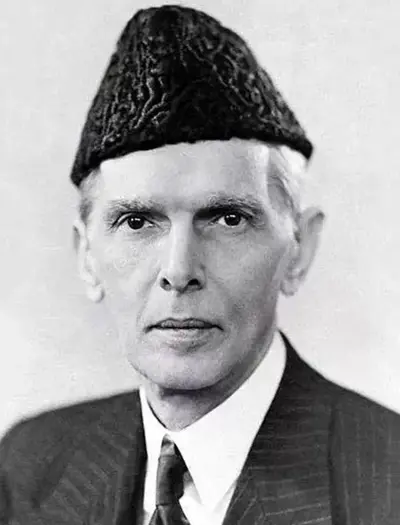
Muhammad Ali Jinnah was a barrister, politician and the founder of Pakistan. Jinnah served as the leader of the All-India Muslim League from 1913 until the inception of Pakistan on 14 August 1947, and then as the Dominion of Pakistan's first Governor-General until his death. He is revered in Pakistan as the Quaid-i-Azam ("Great Leader") and Baba-i-Qaum ("Father of the Nation"). His birthday is observed as a national holiday in Pakistan.
