Muhammad Ali Jinnah Quotes
Muslims of India cannot accept any Constitution which must necessarily result in a Hindu Majority Government.
Under his leadership most of the Muslims did not accept such a constitution. Partition ensued and with it came the deaths of tens of millions of Indians but Pakistan and Bangladesh were formed. Ironically, there are now about 200 million Muslims in India living under a “Hindu Majority Government” –more than in any country except Indonesia. Few Indian Muslims leave India for Pakistan today.
Muhammad Ali Jinnah, 1876-1948, Founder of Pakistan and First Governor General, Title he bestowed upon himself, 1947, Demand for a Separate Homeland for Muslims, March 22, 1940
Sourced by: Eigen's Political and Historical Quotations

Arguments against the Partition of India at the time centered around the poor economic viability of a separate Muslim state. However Iqbal and others placed the cultural issues in the forefront. They eventually prevailed.

an old term for Muslims The Muslims were present in every state if India. Jinnah’s concept of nationhood is very Islamic in that Muslims are united even if they be in different states of nations. He was arguing to reserve some states as Muslim states by designation. 7 years later he would insist on a separate homeland. India was partitioned and Pakistan and Bangladesh resulted but at a fearful cost of tens of millions of lives.
This is one of the early calls for a partition of India which was to be so disastrous after the Second World War. The “free Muslim state of states” turned out to be Pakistan where they have been fighting amongst themselves about how much Sharia would prevail.

He is a Greek Orthodox Christian, and he correctly observes that the Islamic world was considerably more tolerant than the Christian until the 18th century when Islam had become less tolerant in the Middle East while the Christians were modernizing and going through a cultural and intellectual enlightenment and societal modernization while the Muslims, became less tolerant than they were in earlier years leading to the modern situation.

The following year India was partitioned and millions of Hindus were slaughtered by Muslims and vice-a-versa.

Turkey under its great leader, Ataturk, underwent a major cultural revolution. Although Turkey is overwhelmingly Muslim, its constitution provides that it be a secular state with compulsory public non-sectarian education. They adopted a European style law and prohibited Sharia (Islamic law). The nation thrived as no other Muslim country has. Muslims, the world over, are divided on Turkey. For this Sheikh its secular government is an insult to Islam because there is complete separation of mosque and state. For others it is the model which all Muslim countries should emulate.
“Mussalman” was another name for a Muslim. Jinnah was arguing for a separate Muslim state within India. 7 years later he got is wish and Pakistan was born. However many Muslims chose to remain in India even though it was a majority Hindu state. Jinnah was right for many Muslims and wrong for many others who have integrated into Indian society and there is some intermarriage in India, which has 120 million Muslims, almost as many as Pakistan with 160 million.
Jinnah himself preached non-violence. At the time there was vicious sectarian violence throughout India but especially in The Frontier Province. However, the Muslims of the day did not heed him or Nehru or Gandhi for that matter and the violence continued. Jinnah however was a particularly shrewd politician who successfully used the threat of Muslim violence to obtain a separate Islamic state with Indian independence. He pointed to the threatening resolution issued earlier {627153}. The man who publicly preached peace, privately threatened violence.

Despite the fact that the statues were holy symbols to Buddhists, they were offensive to Muslims who say statues as “graven images” prohibited by the Koran. See Wakil Ahmad Muttawakil {608419} and Jamal’s other quotation {604665}.
The Prince had given $20 million to American Universities to establish Islamic Studies programs however. The Muslim religion requires believers to proselytize and spread the faith, while Saudi and Islamic law prohibits any other faith from being public or promoted. It is illegal, for example, to even bring a Christian Bible into the Kingdom. During the Gulf War, American soldiers defending Saudi Arabia were not allowed to bring in their religious texts unless they were Muslims.
The place of non-Muslims in an Islamic country, if any, has been a point of great anxiety among Christians, Jews, Bhais, and others. These have been persecuted and expelled from numerous Islamic countries while in others such as modern Turkey there is no problem. This particular cleric is seen as more “modern” and “liberal” than most. Even he has little concept of equality and freedom of religion.
Pandita Indrani Rampersad. She is the first Hindu woman who ever became a pundit—a religious expert who guides Hindus. She is also a professor in the United States.
The Sikh's had a long history of living under Muslim domination and wanted no part of any more. Patiala was within the Punjab and Jinnah was insisting that the Punjab should be a Province of the new Pakistan because the Punjab was majority Muslim. However, there were many Sikhs, as well as some Hindus, Buddhists, and Christians and none of these wanted to be a part of Pakistan. Further, a significant portion of the Muslim Punjab population also would prefer to join India for many reasons, not the least of which was that they had become used to a democracy where they had complete freedom of religion and civil right as well, and with the exception of Turkey none of the Muslim countries were democratic and based on the Muslim League which did not democratically elect its leaders, Pakistan would not likely be a democracy that guaranteed civil rights (and they were right). So the majority of the people of the Punjab were opposed to becoming a part of Pakistan. The Sikhs were passionate opponents of being a part of Pakistan.


Head of the Sikh Religion. His teaching was that deeds determined the man, not the professed belief and that the existing religions turned man against man.
In one of the historical ironies of the 12th century, a Christian sect preferred the rule of the Muslims than their Christian brethren—on the grounds of religious tolerance. It illustrates the changes that take place over time. By the 21st century, it was the Christians who were thought of as tolerant and the Muslims as the opposite.

Some people read this part of the declaration as saying that if Muslims are in the majority and control the nation, there is no problem with violence. But if the Muslims are in the minority, they will likely be violent. Needless to say, this alarms most Western nations.
The Guru was then horribly tortured, and when he still would not convert, the Emperor had him beheaded. A new Indian Emperor, Aurangzeb, had ascended the throne of India by imprisoning his father and murdering his brothers. All the Emperors in those days were Muslims ever since the Islamic army had left Arabia and conquered most land to the East including most of India. Aurangzeb was worse than most and claimed he had a vision from God telling him that he should make everyone in the kingdom a Muslim. But about half the population was still Hindu. He decided to get the Sikh Guru to convert and then almost all would follow. The Sikhs were considered a Hindu sect at the time, and the Sikh Guru was respected by most Hindus. When the Emperor sent for the Guru, he explained that India should only have one religion, Islam, and offered the Guru much gold to convert, but if he did not do so, it would go badly for him. The Guru asked that a large pile of peppercorns be brought before them, and had it set on fire. When the fire burned out, the Guru went through the ashes and found three peppercorns intact.

The treaty, which was also ratified by the Senate, was actually drafted by Joel Barlow, the U. S. Consul in Tripoli. It was the first official statement of the United States on its religious basis or lack thereof.
Toleration is a relative term. The Muslim Moors made Christians (and Jews) pay a special tax. At times they were forced to wear special clothing so that they could be readily identified. And they could not build churches larger or taller than the smallest mosque in the community. At times, their occupations were restricted but at other times Christians and Jews were appointed to the highest positions like Vizier. The Inquisition, in contrast, forced all Muslims (and Jews) to leave the country without any of their property or money or be tortured and killed—usually by burning at the stake unless of course that they converted to Christianity.
The Jews, Christians and Zoroastrians were allowed to maintain their own religion and live as 2nd class citizens and pay a special tax, but ALL other religions were to be forced to convert.
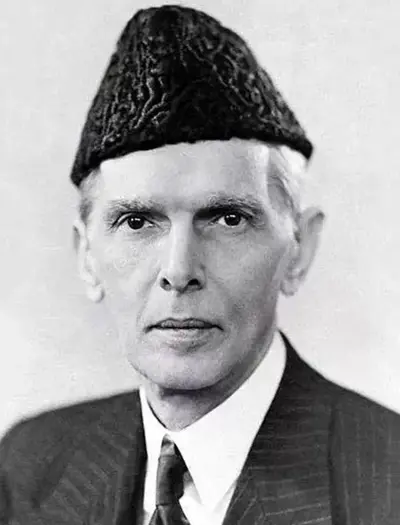
Muhammad Ali Jinnah was a barrister, politician and the founder of Pakistan. Jinnah served as the leader of the All-India Muslim League from 1913 until the inception of Pakistan on 14 August 1947, and then as the Dominion of Pakistan's first Governor-General until his death. He is revered in Pakistan as the Quaid-i-Azam ("Great Leader") and Baba-i-Qaum ("Father of the Nation"). His birthday is observed as a national holiday in Pakistan.
