Muhammad Ali Jinnah Quotes
The Mussulmans are not a Minority. The Mussulmans are a nation by any definition.
an old term for Muslims The Muslims were present in every state if India. Jinnah’s concept of nationhood is very Islamic in that Muslims are united even if they be in different states of nations. He was arguing to reserve some states as Muslim states by designation. 7 years later he would insist on a separate homeland. India was partitioned and Pakistan and Bangladesh resulted but at a fearful cost of tens of millions of lives.
Muhammad Ali Jinnah, 1876-1948, Founder of Pakistan and First Governor General, Title he bestowed upon himself, 1947, Demand for a Separate Homeland for Muslims, March 22, 1940
Sourced by: Eigen's Political and Historical Quotations

He was arguing to reserve some states as Muslim states by designation. 7 years later he would insist on a separate homeland. India was partitioned and Pakistan and Bangladesh resulted but at a fearful cost of tens of millions of lives.


Under his leadership most of the Muslims did not accept such a constitution. Partition ensued and with it came the deaths of tens of millions of Indians but Pakistan and Bangladesh were formed. Ironically, there are now about 200 million Muslims in India living under a “Hindu Majority Government” –more than in any country except Indonesia. Few Indian Muslims leave India for Pakistan today.

Ali was arguing that India should not be a single nation but each major ethnic group should have its own country. Pakistan was later to be separated out. However, the Akhoots, Christians, Dravidians and Sikhs did not have the same desire for separatism as the Muslims and stayed in India, and today India is a pluralistic nation which even includes about the same number of Muslims who have elected to be Indian citizens rather than Pakistani.

For most Muslims, their religious identity supersedes their nationalistic identity. Sukarno’s quotation is famous because many ultraorthodox Muslims castigated him for putting nationalism before Islam. There is an orthodox Islamic concept of the Ulma—the community of all Muslims in the world, and this takes precedence over any nation or set of nations. In that sense, extreme Islamic fundamentalists have always opposed Sukarno claiming he was an enemy of Islam.
The place of non-Muslims in an Islamic country, if any, has been a point of great anxiety among Christians, Jews, Bhais, and others. These have been persecuted and expelled from numerous Islamic countries while in others such as modern Turkey there is no problem. This particular cleric is seen as more “modern” and “liberal” than most. Even he has little concept of equality and freedom of religion.


The writer was born and brought up a Muslim and because he criticizes Islam, he has had a death fatwa issued against him much like Salman Rushdie.

Culturally and historically Muslims have an urgent need to dominate the societies in which they live. By the logic of Islam, how else could they institute Islamic Law—Sharia—which was religiously imperative.

Half the population of Amsterdam was at the time non Western in origin including many Muslims. Cohen was one of the few major Dutch leaders who worked to make multiculturalism work. However, there were so many religious Muslim extremists already active in the Netherlands, that it was very difficult. The Dutch had elected a Muslim as a member of Parliament and whole many Muslims were very proud of this, the religious extremists were furious. She was a woman, and she did not believe or advocate that Holland adopt Sharia (Islamic) law. She was an Islamic reformer who was opposed to Sharia even in Muslim states. The most successful Islamic nation, Turkey, does not allow Sharia law, and Indonesia, the largest of the Muslim nations also does not follow it.
This problem which was so well described over a century ago in Egypt, still vexes most of the Islamic world.


Many, if not most, non-Muslim scholars and thinkers very much disagree with Hamid on this point. The great exceptions of Islam are almost 1,000 years in the past. Current Islam, they argue, is not more exceptional than the beliefs of modern Mongolia which dominated most of the known world centuries ago, but has little that deserves special respect in the 21st country beyond the general respect which is owed to all religions and nationalities. With the exception of Turkey, Islamic nations are for the most part, backward, and virtually no other non-Muslim nations try to emulate them in any way.
Magh Bahul Ekadashi. To this day Golwalker is one of the most revered of the Hindu nationalists. This is the kind of intolerance that Indian Muslims faced amongst the most extreme Hindu’s. The possibility that this would become a reality was one of the great motivators for partition of India on the part of the Muslims. The irony is that the Muslim nation that was created—Pakistan—follows this doctrine exactly, only they substitute Islam for the Hindu culture. With the exception of a few Muslim nations, most of Islam follows the intolerance that the Hindu extremists would have followed. Ironically, “Hindu” India still has many millions of Muslims and they are given full citizenship and more democratic freedom and rights than Muslims have in almost all Islamic countries with the exception of Turkey.


In some countries political candidates run on religious platforms to convert the part of the population that is not of their religion and turn the nation into a theocracy.
Arguments against the Partition of India at the time centered around the poor economic viability of a separate Muslim state. However Iqbal and others placed the cultural issues in the forefront. They eventually prevailed.

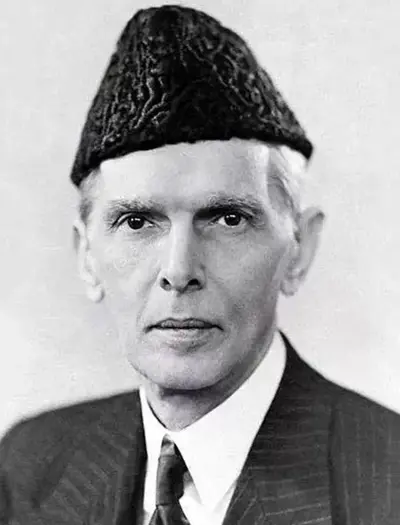
Muhammad Ali Jinnah was a barrister, politician and the founder of Pakistan. Jinnah served as the leader of the All-India Muslim League from 1913 until the inception of Pakistan on 14 August 1947, and then as the Dominion of Pakistan's first Governor-General until his death. He is revered in Pakistan as the Quaid-i-Azam ("Great Leader") and Baba-i-Qaum ("Father of the Nation"). His birthday is observed as a national holiday in Pakistan.
