Muhammad Ali Jinnah Quotes
There should be no resort to violence or force and we must bear up with fortitude and show tolerance despite the gravest provocations. We should not depart from the strictly peaceful path, which we are determined to follow. In no circumstances should the movement be allowed to take communal turn. Our fight is not against the Hindus or Sikhs; we are fighting for a true verdict of people of the province to be obtained by fair and free methods.
Jinnah himself preached non-violence. At the time there was vicious sectarian violence throughout India but especially in The Frontier Province. However, the Muslims of the day did not heed him or Nehru or Gandhi for that matter and the violence continued. Jinnah however was a particularly shrewd politician who successfully used the threat of Muslim violence to obtain a separate Islamic state with Indian independence. He pointed to the threatening resolution issued earlier {627153}. The man who publicly preached peace, privately threatened violence.
Muhammad Ali Jinnah, 1876-1948, Founder of Pakistan and First Governor General, Statement On The Situation In The Frontier Province, New Delhi : May 7, 1947
Sourced by: Eigen's Political and Historical Quotations

With the partition of India forming an independent Pakistan, ethnic riots broke out and millions of people were killed. This joint statement was issued to try and quell the violence but it had progressed too far. Jinnah as a political ploy to obtain the partition organized Muslims and threatened violence—see {627153} and {627169}. Things got out of hand with ethnic cleansing being an objective in many localities—see {627146} and {627149}.

This do called “Direct Action” resolution was a threat of war. The view of these Muslims was that living in a democracy with a majority of Hindus would be “slavery.” Faced with this intimidation and that of Jinnah {627169} the British agreed to partition India.


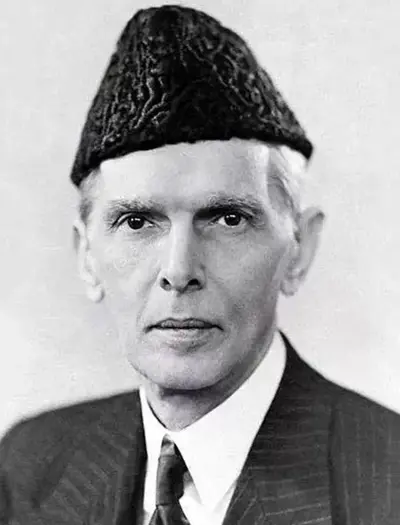
Muhammad Ali Jinnah was a barrister, politician and the founder of Pakistan. Jinnah served as the leader of the All-India Muslim League from 1913 until the inception of Pakistan on 14 August 1947, and then as the Dominion of Pakistan's first Governor-General until his death. He is revered in Pakistan as the Quaid-i-Azam ("Great Leader") and Baba-i-Qaum ("Father of the Nation"). His birthday is observed as a national holiday in Pakistan.
