Muhammad Ali Jinnah Quotes
It is against all canons of morality and civilization and the teachings of Islam that we should harm the weak. On the contrary it is the duty of every Mussalman to protect the minorities in spite of whatever provocation there may be.
The Islamic leadership of that era came from the East and not Arabia. Theirs was a much more modern form of Islam where the basic values were very similar to those of other major religions. Also, toleration of minorities was an assumed requirement for all. When the axis of world Islamic leadership shifted to the Arab nations, the fundamentalist intolerance ascended and minorities were not only persecuted but were expelled from Arab countries in an effective ethnic cleansing. “Mussalman” was a then common word used in India to denote a Muslim.
Muhammad Ali Jinnah, 1876-1948, Founder of Pakistan and First Governor General, Statement On The Situation In The Frontier Province, New Delhi : May 7, 1947
Sourced by: Eigen's Political and Historical Quotations


The “People of the Book” were the Jews and Christians who received special status in Muslim lands and societies. Despite the enmity and Muslim fundamentalist terrorism of modern times, Jews have historically lived in relative harmony in Islamic lands, and with the exception of the Christians in the Crusades, Christians were also given a place in Muslim societies. The “Book” refers to the Bible.

Jinnah himself preached non-violence. At the time there was vicious sectarian violence throughout India but especially in The Frontier Province. However, the Muslims of the day did not heed him or Nehru or Gandhi for that matter and the violence continued. Jinnah however was a particularly shrewd politician who successfully used the threat of Muslim violence to obtain a separate Islamic state with Indian independence. He pointed to the threatening resolution issued earlier {627153}. The man who publicly preached peace, privately threatened violence.


This quotation which appears absurd on the surface given Iran’s terrible record with religious minorities provides insight to Islamic orthodox thought. For the orthodox Muslim, Sharia—Koranic Law—is the basis of the society. God defines the rights of people and their obligations. Whatever rights are provided by Sharia, Khomeini and some others wished to provide them equally to religious minorities also. However, those rights do not include the right to criticize the Islamic law or the leaders who implement it. That would be heresy if done by a Muslim, a Christian, or a Jew. A Christian church may not erect a public cross or ring bells on Sunday. That is prohibited by the Koran and is imposed on all. Bahai religious adherents are tracked down in the Islamic Republic and are often executed. ‘What about their rights?’ they ask. The answer is that the Bahai were Muslims who have become “backsliders” and heretics, and under Sharia, they must be executed for heresy; they are deemed to be heretical Muslims and not members of a minority religion.


One of the strong motivations of Islamic terrorists is the fact that they believe that a Muslim who dies fighting for Islam goes immediately to Paradise. However, terrorists create Hell for innocent civilians and people who have no desire to harm Islam—in many cases babies and young children who do not even know what religion is. While this statement represents the beliefs of most moderate Muslims, it was made after he was out of office. It is doubtful that an Iranian President—a position without much power in the Iranian theocracy where the religious leader rules—in office would dare say something like this when Iran supports Islamic terrorist organizations throughout the world.


Lindbergh, a great aviator, was a Fascist who was a great admirer and supporter of Hitler and Mussolini.


She is a leading American Arab who is a Syrian expatriate.

With the partition of India forming an independent Pakistan, ethnic riots broke out and millions of people were killed. This joint statement was issued to try and quell the violence but it had progressed too far. Jinnah as a political ploy to obtain the partition organized Muslims and threatened violence—see {627153} and {627169}. Things got out of hand with ethnic cleansing being an objective in many localities—see {627146} and {627149}.
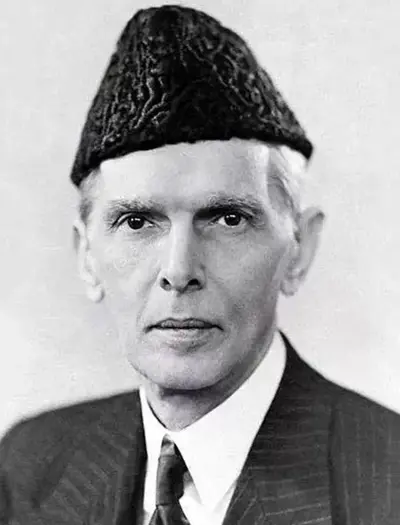
Muhammad Ali Jinnah was a barrister, politician and the founder of Pakistan. Jinnah served as the leader of the All-India Muslim League from 1913 until the inception of Pakistan on 14 August 1947, and then as the Dominion of Pakistan's first Governor-General until his death. He is revered in Pakistan as the Quaid-i-Azam ("Great Leader") and Baba-i-Qaum ("Father of the Nation"). His birthday is observed as a national holiday in Pakistan.
