Ruhollah Khomeini Quotes
In the Islamic Republic, the rights of the religious minorities are respected.
This quotation which appears absurd on the surface given Iran’s terrible record with religious minorities provides insight to Islamic orthodox thought. For the orthodox Muslim, Sharia—Koranic Law—is the basis of the society. God defines the rights of people and their obligations. Whatever rights are provided by Sharia, Khomeini and some others wished to provide them equally to religious minorities also. However, those rights do not include the right to criticize the Islamic law or the leaders who implement it. That would be heresy if done by a Muslim, a Christian, or a Jew. A Christian church may not erect a public cross or ring bells on Sunday. That is prohibited by the Koran and is imposed on all. Bahai religious adherents are tracked down in the Islamic Republic and are often executed. ‘What about their rights?’ they ask. The answer is that the Bahai were Muslims who have become “backsliders” and heretics, and under Sharia, they must be executed for heresy; they are deemed to be heretical Muslims and not members of a minority religion.
Ruhollah Khomeini, 1900-1989, Iranian Cleric [Ayatollah] & Revolutionary Leader, Speech, November 6,1978
Sourced by: Eigen's Political and Historical Quotations

He was referring to whether or not Iraq should be a Muslim state.

Islam was not very strong at this point and the followers of Muhammad were relatively few and the Medina area contained Arab Non-Believers, Jews as well as the new Muslims. Muhammad drew up this document and got the non Muslims to agree to it. Not only were Jews able to practice their religion freely (as were the non-Muslim Arabs) but there was not tax on the non Muslims that was imposed later when the Muslims were much stronger relative to others. Also, which surprises many Jews and Muslims alike, the Community – the Ulma – the People included the Jews and Arab Non Believers. Today it is only the Muslims.

Islam forbids homosexuality and Sharia (Islamic religious law) prescribes death as the penalty for homosexuality. At that time Iran was a Muslim theocracy and if there were overt homosexuality that was officially discovered, the heretics would be killed. The logic of the government was that since they had killed the homosexuals, there were none left. At the same time all the research showed that while Muslim homosexuality was slightly less than Christian, it was still quite significant in all Muslim cultures that had been studied. If the President was to be believed, Iran was the only exception.


Jinnah was a Muslim nationalist who had blocked a united India after independence. However, once the partition began and a total bloodbath ensued, he tried to curtail the slaughter. A Muslim mob had attacked and surrounded a Hindu group in Karachi. Jinnah acted to protect the Hindus. Despite the efforts of many Hindu and Muslim leaders, things had gotten beyond their control and millions were killed.

The place of non-Muslims in an Islamic country, if any, has been a point of great anxiety among Christians, Jews, Bhais, and others. These have been persecuted and expelled from numerous Islamic countries while in others such as modern Turkey there is no problem. This particular cleric is seen as more “modern” and “liberal” than most. Even he has little concept of equality and freedom of religion.

Magh Bahul Ekadashi. To this day Golwalker is one of the most revered of the Hindu nationalists. This is the kind of intolerance that Indian Muslims faced amongst the most extreme Hindu’s. The possibility that this would become a reality was one of the great motivators for partition of India on the part of the Muslims. The irony is that the Muslim nation that was created—Pakistan—follows this doctrine exactly, only they substitute Islam for the Hindu culture. With the exception of a few Muslim nations, most of Islam follows the intolerance that the Hindu extremists would have followed. Ironically, “Hindu” India still has many millions of Muslims and they are given full citizenship and more democratic freedom and rights than Muslims have in almost all Islamic countries with the exception of Turkey.
This was a document prepared by the Caliph and presented to Christians in Syria to sign if they wanted peace and to be free from assault in Islamic lands. For centuries thereafter these, and variations of them, were conditions imposed on Christians and Jews in Islam lands. Some of these can be recognized as variants of conditions that American and other coalition troops were required to adhere to in Saudi Arabia during the Gulf War. By today’s standards this was highly discriminatory and a gross imposition on a minority. However at the time, this was one of the more liberal doctrines. Jews and Christians otherwise could live in Muslim lands, practice their religion, work there, live where they would, acquire property, practice professions, and even achieve high office. Jews and Christians rose to the highest ranks of Islamic government administrators including Prime Ministries. Their persons were safe from assault and derisions all provided they followed the Pact of Umar or its current version. In contrast Jewish and Muslim minorities in Christian nations were treated much more harshly. They could practice only a few occupation, were constantly under physical attack, were forced to live in ghettos, had their property seized, and in many cases were tortured and killed.

See {624641} for Iranian confirmation of its discriminatory policy. The Iranian "justification for murdering Bahais is this: The Behai were originally Muslims and then they created an heretic form of Islam. Under Islamic Law (Sharia), any Muslim who converts away from Islam to ANY other religioun must be out to death. As barbarous as this sounds, the irrational thinking is the same as that of the Catholic Church when Protestant chiurches emerged. All of them were to be put to death. However that was over 600 years ago, and humanity has much imporoved standards today. But the Muslims are 700 years younnger than the Catholic Church and some point out that they are behaving the same way as the Catholics, brutal as it is, when the Church was at the same level of maturity as Islam is today.


He is a Greek Orthodox Christian, and he correctly observes that the Islamic world was considerably more tolerant than the Christian until the 18th century when Islam had become less tolerant in the Middle East while the Christians were modernizing and going through a cultural and intellectual enlightenment and societal modernization while the Muslims, became less tolerant than they were in earlier years leading to the modern situation.


Wesley had been to Island several times and was interested in affairs there. He was a strong advocate of freedom of religion but the violence of the earlier religious conflict made him very wary of the Irish Roman Catholics who seemed to him particularly prone to religious violence.
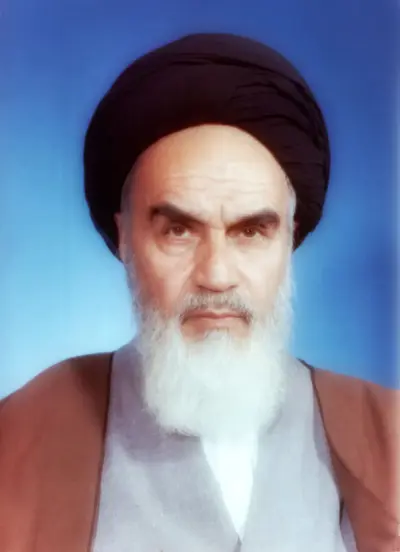
Sayyid Ruhollah Musavi Khomeini, also known in the Western world as Ayatollah Khomeini, was an Iranian political and religious leader. He was the founder of the Islamic Republic of Iran and the leader of the 1979 Iranian Revolution, which saw the overthrow of the last Shah of Iran, Mohammad Reza Pahlavi, and the end of the 2,500-year-old Persian monarchy. Following the revolution, Khomeini became the country's Supreme Leader, a position created in the constitution of the Islamic Republic as the highest-ranking political and religious authority of the nation, which he held until his death. Most of his reign was taken up by the Iran–Iraq War of 1980–1988. He was succeeded by Ali Khamenei on 4 June 1989.
