Mona Eltahawy Quotes
You—the outside world—will be told that it is our “culture” and “religion” to do X, Y, and Z to women. Understand that whoever deemed it as such was never a woman.
Mona Eltahawy, American Egyptian Journalist, “Why Do They Hate Us? The War on Women in the Middle East”, Foreign Policy, May / June 2012
Sourced by: Eigen's Political and Historical Quotations


See {592434} for more on ‘honor killings’ where male relatives kill females who have been accused of sexual activity. This is perceived to dishonor the family by many Muslims. She was responding to an Egyptian judge who was arguing that men who commit honor killings should not be punished to harshly as the men were in great emotional states at the time because they were so upset.

Her husband had been assassinated. It is not uncommon that after a political assassination, the widow of the slain male politician, carries on the political legacy. But otherwise there are few female politicians in the Third World in general and the Middle East in particular. Arab and other cultures so severely restrict a woman’s mobility within the society that death of a husband or father seems to be the only vehicle whereby a woman enters politics.


Despite this pronouncement which kept Caliphs from being female, modern Islamic states (Pakistan, Indonesia) have had female Presidents.
This proverb is a large part of the conceptual basis of the concept of honor killing. It starts with the notion that women are property. However, being animate property women are in the same class as livestock. And if a camel or a donkey get lose and does damage, the owner is responsible. So if a woman does something wrong, it is the father or the husband who is responsible. Since sexual behavior of most kinds is contrary to the Islamic custom and law, any activity in this regard, demonstrates that the father of husband has not been up to his obligations and is therefore dishonored. Therefore, the least he can do, to provide a deterrent to other women is to kill the offending female. Without the concept of property, the entire chain of logic collapses under its own weight.
In Bedouin society women may not own land or cattle.


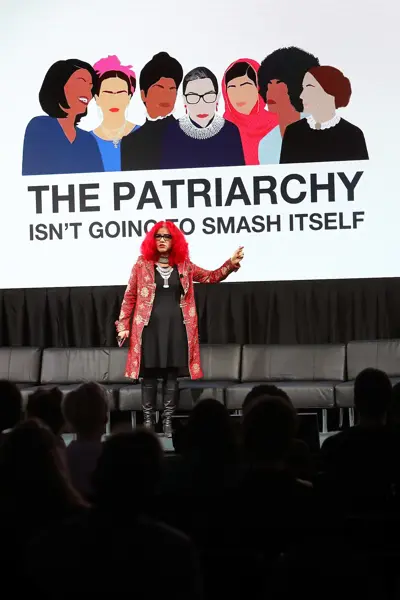
Mona Eltahawy is a freelance Egyptian-American journalist and social commentator based in New York City. She has written essays and op-eds for publications worldwide on Egypt and the Islamic world, including women's issues and Muslim political and social affairs. Her work has appeared in The Washington Post, The New York Times, Christian Science Monitor, and the Miami Herald among others. Headscarves and Hymens, Eltahawy's first book, was published in May 2015. Eltahawy has also been a guest analyst on U.S. radio and television news shows. She is also acknowledged as one of the people who spearheaded the Mosque Me Too movement through the usage of the hashtag #MosqueMeToo.
