Mona Eltahawy Quotes
Not a single Arab country ranks in the top 100 in the World Economic Forum’s Global Gender Gap Report, putting the region as a whole solidly at the planet’s rock bottom. Poor or rich, we [Arabs] all hate our women.
Mona Eltahawy, American Egyptian Journalist, “Why Do They Hate Us? The War on Women in the Middle East”, Foreign Policy, May / June 2012
Sourced by: Eigen's Political and Historical Quotations


Dr. Saadawi was fired from her government post for revealing the status of women in the country. She was also actually arrested and jailed as well for impairing national “values.” See .{586709}.


This proverb is a large part of the conceptual basis of the concept of honor killing. It starts with the notion that women are property. However, being animate property women are in the same class as livestock. And if a camel or a donkey get lose and does damage, the owner is responsible. So if a woman does something wrong, it is the father or the husband who is responsible. Since sexual behavior of most kinds is contrary to the Islamic custom and law, any activity in this regard, demonstrates that the father of husband has not been up to his obligations and is therefore dishonored. Therefore, the least he can do, to provide a deterrent to other women is to kill the offending female. Without the concept of property, the entire chain of logic collapses under its own weight.


This was a very unusual statement for a major party, established, politician to make in a Muslim Arab nation where sexism is not only culturally entrenched, but strongly religiously enforced.]
The Hijra was the spread of Islam after The Prophet organized the first Muslims. Islamic reformers have been trying to improve the legal and cultural position of women in Islamic Societies ever since with little success, even in modern times. The notable exception was the Turkish Revolution led by Ataturk. He was familiar with Aga Kahn arguments for reform and put the force of law behind them. See {444998}.
It would take almost a thousand years for the relationship between women’s role in society, standard of living, poverty and development would be recognized by all but the most fundamentalist religious orders. Yet, at the flowering of Islamic intellectualism, the idea was discussed.

She was chiding the Egyptian military who in the Arab Spring, turned on demonstrators and soldiers in the middle of the central square stripped a female demonstrator half naked and beat her badly;

Despite this pronouncement which kept Caliphs from being female, modern Islamic states (Pakistan, Indonesia) have had female Presidents.


This 12th century observation which appears so obvious has been ignored by the vast majority of Islamic scholars and writers subsequent until modern times, and even then they represent the small reform minority of Islamic thinking.
This type of religious sexism is not unique to Islam. Fundamentalist Christians place women in a secondary role as do fundamentalist orthodox Jews although both allow a man to take only one wife. The Islamic scripture tells us that the Prophet allowed multiple wives only if the man had the resources to care for the wives and all the children. 4 is the maximum.
In much of the Islamic world if a woman commits adultery or becomes pregnant out of wedlock, she will often be killed by her own father or brothers who perceive that this is the only way to maintain the honor of the family. The primitive custom really becomes gross when a woman who is the victim of rape, ends up being killed by her own male family members. In some Muslim countries honor killings are against the law but that prohibition is rarely legally enforced.
This technique she describes is consistent with Sharia—Islamic Law. It however is used by very few women who are sophisticated and courageous enough to do so.
The burqa wearing practice was outlawed by French Law.


Many leaders of nations are in denial about this problem which exists almost everywhere. In Israel, the problem is compounded because the very orthodox Jews and Muslims both come from a tradition where women are allocated a place subservient to men in many ways and to some (like some Christians) there is a perceived duty to discipline wives and daughters. So reform involves religious tradition and theology.

This was a quarter of a century before women in the United States could vote.

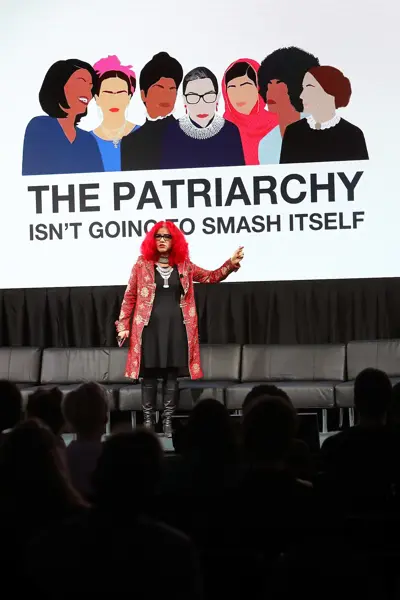
Mona Eltahawy is a freelance Egyptian-American journalist and social commentator based in New York City. She has written essays and op-eds for publications worldwide on Egypt and the Islamic world, including women's issues and Muslim political and social affairs. Her work has appeared in The Washington Post, The New York Times, Christian Science Monitor, and the Miami Herald among others. Headscarves and Hymens, Eltahawy's first book, was published in May 2015. Eltahawy has also been a guest analyst on U.S. radio and television news shows. She is also acknowledged as one of the people who spearheaded the Mosque Me Too movement through the usage of the hashtag #MosqueMeToo.
