Nawal El Saadawi Quotes
Arab women are sacrificed on the alters of God and Money from the moment of birth to the hour of death.
Dr. Saadawi was fired from her government post for revealing the status of women in the country. She was also actually arrested and jailed as well for impairing national “values.” See .{586709}.
Nawal El Saadawi, Egyptian Director of Public Health, The Hidden Face of Eve: Women in the Arab World, 1982
Sourced by: Eigen's Political and Historical Quotations

There is relatively little freedom of speech in Egypt and most Islamic countries where the traditional Sharia laws prohibiting blasphemy and the tradition of not publicly embarrassing the Caliph or the Sultan, combine to protect the modern Islamic state from criticism. Turkey, Tunisia and a few other Islamic states are exceptions. Under this Egyptian law anyone could be jailed for bringing “shame” to national and Islamic values. On September 6, 1981, the Egyptian Director of Public Health, Dr. Nawal El Saadawi was actually arrested and jailed for three months for saying that women were ill treated in Egypt and the rest of the Arab world. See {586710} for the kinds of statements for which Egypt would jail leading citizens.


Formally and informally orthodox Islam is one of the most sexist of the religions. In addition to the fundamentalist Christian and Orthodox discriminatory view of females, Sharia—Islamic Law—makes a woman’s testimony in court with half that of a man, prohibits women from clerical leadership, will not allow females to pray in Mosques in the main section but segregates them, and many others. Islamic customs require women to be covered head to toe in a cloak, forbids them from driving in some countries, does not allow them to be in the presence of men outside the family, mutilates young girls in brutal circumcision rituals, and many others. Not all Muslims are sexist and many call for reforms like Nomani. Turkey, the most modern and successful Islamic nation, outlawed all these discriminatory aspects of Sharia, and gave women the vote BEFORE America did.

This proverb is a large part of the conceptual basis of the concept of honor killing. It starts with the notion that women are property. However, being animate property women are in the same class as livestock. And if a camel or a donkey get lose and does damage, the owner is responsible. So if a woman does something wrong, it is the father or the husband who is responsible. Since sexual behavior of most kinds is contrary to the Islamic custom and law, any activity in this regard, demonstrates that the father of husband has not been up to his obligations and is therefore dishonored. Therefore, the least he can do, to provide a deterrent to other women is to kill the offending female. Without the concept of property, the entire chain of logic collapses under its own weight.

Vladimir Lenin

The burqa wearing practice was outlawed by French Law.
It would take almost a thousand years for the relationship between women’s role in society, standard of living, poverty and development would be recognized by all but the most fundamentalist religious orders. Yet, at the flowering of Islamic intellectualism, the idea was discussed.

He was a major critic of French Quebec Separatism and some elements of French Canadian culture including his perception of sexism. His French Quebec Separatist enemies translated passages of this work into French and (some say deliberately) mistranslated this line to read: Quebec women are sows. The quotation was bandied about Canada in the original version as well as the mistranslation.

In much of the Islamic world if a woman commits adultery or becomes pregnant out of wedlock, she will often be killed by her own father or brothers who perceive that this is the only way to maintain the honor of the family. The primitive custom really becomes gross when a woman who is the victim of rape, ends up being killed by her own male family members. In some Muslim countries honor killings are against the law but that prohibition is rarely legally enforced.

Some modern versions of the Koran annotate the “beating” injunction and argue that this should only be used as a last resort. This is an example of socially unacceptable anachronisms that are found in the scripture of most older religions. All but the radical fundamentalists do not take these passages literally.


Actually, shortly thereafter some women in Egypt were allowed to be judges, but were not allowed to handle serious criminal cases on the grounds that women could not be hard enough to impose heavy punishment like the death penalty.

Islam and Sharia do NOT require women to wear burkas or headscarves. The religious requirement is for women to dress modestly. The scarves and burkas are cultural customs which differ from place to place. However, in many places, the customs are so ingrained along with islam that many Muslims believe these forms of dress are required by their religion.

The Hijra was the spread of Islam after The Prophet organized the first Muslims. Islamic reformers have been trying to improve the legal and cultural position of women in Islamic Societies ever since with little success, even in modern times. The notable exception was the Turkish Revolution led by Ataturk. He was familiar with Aga Kahn arguments for reform and put the force of law behind them. See {444998}.
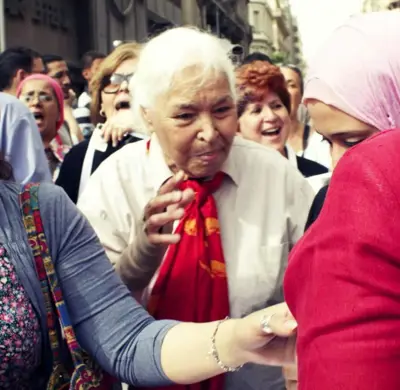
- Born: October 27, 1931
- Died: March 21, 2021
- Nationality: Egyptian
- Profession: Physician, Psychiatrist, Author
Nawal El Saadawi was an Egyptian feminist writer, activist, physician, and psychiatrist. Described as "the Simone de Beauvoir of the Arab World", and "Egypt's most radical woman", she was the author of several books on the oppression of women in Islam, including the practice of female genital mutilation; She wrote and spoke to ban it. She also wrote and spoke to ban male circumcision.
