Djemal Ahmed Quotes
Thus will the Sharif Husain ... be made to suffer the humiliation which he has brought upon himself by having bartered the dignity conferred upon him by the Caliph of Islam [the Ottoman Sultan] for a state of enslavement to the British.
Sharif Husain was the leader of the Hashemite Tribes who had agreed with the British to lead a Hashemite Arab revolt against the Ottoman Turks in exchange for the Hashimites to have their own independent state—Jordan. This also explains the close relationship between Jordan and Britain. The notion of enslavement to the British illustrates a blind spot that the Ottoman Empire had in its waning years. The Ottoman Sultan had the power of life and death over everyone in the empire, and Istanbul appointed all public officials for all jurisdictions, and made laws that applied to all. The Hashemites would instead have their own nation, make their own laws and would by subject to British foreign policy to the extent that the British guaranteed their independence from the Sultan and the Ottomans. They regarded it as freedom and not slavery.
Ahmed Djemal, 1872—1922, Ottoman Turkish Administrator & Military Leader, Speech, Beirut, Lebanon, December 4, 1917
Sourced by: Eigen's Political and Historical Quotations


This quotation illustrated the extreme polarization between the current fundamentalist Muslims, and the Muslim modernists and the West. Kamal Ataturk, the great leader and stateman who is the father of modern Turkey, is castigated by the author for leading the new Turkish parliament to depose the Caliph – the civil and religious autocrat, one of whom reigned from after the death of Muhammad till his abolishment in 1924. Most of the rest of the world credits Ataturk with being one of the great leaders of all time—one who led a democratic revolution which transformed Turkey into the only Muslim secular democracy, requiring pubic secular European type education for all children, giving women the right to vote (before the U. S. even), adopting a European alphabet and dress, and outlook on life—creating most remarkably a total cultural revolution with virtually no loss of life. No revolutionary leader, before or since has led so extensive a political and cultural revolution, and it was a bloodless revolution. Turkey, into the 21st century, was by far the most powerful, industrialized, scientific and modern nation of Muslims in the world and others were far behind. Yet many Islamic theologian still castigate Atatork for his great achievements as being against the will of God.


The British suspected that the Turks of Anatolia were complicit with Bolshevism

The Turkish revolution was by historical standards relatively bloodless as compared especially with other republican revolutions like the United State and France. However, the revolution that brought Ataturk to power was a relatively mild one in terms of the immediate changes that unlike many revolutions which produced instant radical change. In Turkey, the radical change took place in the years after the revolution when Ataturk with hardly any bloodshed produced compulsory public secular education, scientific elevation in society, separation of mosque and state, gender equality including universal voting, change to western dress, elimination of the caliphate, speech and press freedom, and many others including changing the entire language to use the Latin alphabet instead of Arabic. No nation in history has gone thought more social and cultural change and modernized so fast as Turkey after its revolution. The result is the most modern and successful Islamic country in the world.
The caliphate was abolished by the Turkish republic in 1924

The Germans allied themselves with the Islamic insurgency of the day as a strategic maneuver. The Grand Mufti of Jerusalem broadcast propaganda from Nazi radio in Berlin and was dispatched to organize Muslim fighters in Iraq. Fascism was introduced into the Middle East and the Arabs and Persians saw it as a natural extension of their authoritarian and highly prescriptive forms of religious and civil government. 60 years later, there would be Islamic Fascists throughout the Middle East in control or vying for control of many of the countries.

He was sent into exile.


At the time, Palestine was technically Turkish territory. Turkey was one of the defeated axis powers in World War I. England, as part of the World War I peace treaties, had control over Palestine as well as most of the rest of the Middle East.

This is an amazing quotation in the sense that it shows the absolute manner in which the Ottoman Turkish Empire ruled the Islamic World in the Middle East and North Africa. The Sultan and Caliph had absolute rule over both the civil and religious areas of the Islamic world. In this decree, the Caliph actually gave an entire nation to his loyal servant, Muhammad Ali, who had acted as Governor of Egypt for the Sultan. Muhammad Ali was neither a Turk or an Egyptian. He was an Albanian, racially and ethnically totally different from the nation that became his. From then on, Muhammad Ali’s children would inherit the Egyptian throne. And they did and his dynasty lasted until the revolution in 1923. The Ottoman Empire was far more controlling and arbitrary than the British Empire and lasted much longer as the Ottoman Caliph controlled the Islamic religion as well as the civil nations.

The historical relationship between Greece and Turkey is as complicated as any. Ypsilantis was born in the Greek section of Istanbul, then the Turkish capital and became the military commander of the cultural Greeks in the Istanbul Turkish area in the battles between the two nations and cultures for control and dominance of the culturally Greek areas of the Ottoman Empire. So geographically he was a Turk, but always identified with Greece.
“Lebensraum” was a German expansionist concept of the time which has no good English translation. Literally, it means “living room”. The Germans had this notion that the German race and nation had to have more land to accommodate the growth of the German people. And because the Germans were a superior race, they were entitled to the land surrounding Germany in which to have Germans grow and thrive. The “inferior” peoples who lived on the land could be exterminated so that Germany would have this expansion room. The “Death’s Head units” were special German elite troops who used the Death’s Head as a symbol on their uniforms. Some of the Generals were concerned that the rest of the world would condemn Germany and possibly interfere if they exterminated the Poles. Hitler pointed to the example of the Turks who had killed most of the Armenians in the Armenian Genocide in the early 20th century. They got away with it with no outside interference, and there were no international consequences for Turkey. Hitler, convinced that the Armenian genocide was the precedent, thought Germany could easily get away with murdering the Gypsies, seriously handicapped, homosexuals, Russians, Poles and Jews. For other quotations on the Armenian Genocide, see {51838}, {638251}, {620602}, {620603}, {620604}, {620605}, {620600}, and {620606}

Bulgaria was under the control of the Ottoman Turkish Empire. Levski always made it clear that Muslims were welcome in the Bulgaria that would be created after the Revolution. Most Muslims did not believe him, and many could not understand the concept of a nation without the Sultan who was the political AND religious head of Islam the world over. Essentially for many Muslims there can be no such thing as separation of church and state. To two cannot be distinct.

The Ottoman Turks, at war with Russia, exterminated a large proportion of the Armenian population of the then Turkish Empire. Some of the ethnic Armenians were working with Armenians in greater Russia and thus were a risk to the Turks. However, they starved, shot, beat, hung, and bayoneted hundreds of thousands of ethnic Armenians, wiping out entire villages and towns. Despite the fact that women and little children were all killed, Modern Turkey even into the 21st century refused to admit that this was a genocide even though there was ample documentation to prove it was not spontaneous but government ordered by the “Young Turks” then controlling Turkey. See {620603} and {612638} for examples. The modern Turks maintain the view expressed during the genocide that Armenians were a threat to Turkish Independence.
The Turkish Ottoman Empire controlled most of the Middle East and at times Arab areas and tribes would revolt. Egypt was considered the prize of the Middle East. The Ottomans not only controlled the Middle East militarily and civilly, but also religiously. The Turkish Sultan was the spiritual leader of almost all of the Middle Eastern Muslims.

Part of the problem lies in a part of the Muslim religion which values stability over all else except Islam itself. Traditionally Muslims have been told to tolerate a bad, corrupt leader, unless he is blasphemous. So dictators who can create an alliance between themselves and the religious influentials by giving them money and allowing them to control civil society as in Saudi Arabia, have been insulated from rebellion and revolutionary forces.
The Ottoman Turks had just conquered the city of Constantinople including the Eastern Roman Empire in their domain. They would be the dominant power in the area until the First World War when they made the mistake of siding with the Germans and the Ottoman Empire was broken up in the Treaty of Versailles.

The Byzantine emissary had pointed out that Mehmed’s predecessors had signed a treaty agreeing to “consult” with Constantinople before building any fortified structure in the area surrounding Constantinople. Mehmed was only 19 years old at this time. His intention f building a fort was to have a platform from which to attack and capture Constantinople itself which he did 2 years later. Earlier, the Eastern Roman Empire was much stronger and the Ottoman sultans were more cautious in dealing with them. However, the various Christian factions were all feuding with each other, and Mehmed II, despite his youth, was much better organized and was a better leader than his predecessors.

Yazid ibn al-Walid ibn 'Abd al-Malik. This is an Islamic doctrine that operates to this day together with the stricture that a bad ruler must be endured and not revolted against UNLESS he does not follow his Islamic religious obligations. This is why many Islamic rulers curry favor with the clerics. As long as they do not claim he is violating the word of God, his rule is safe from revolution. However, if the clerics turn on him, he is in deep trouble. Thus Saudi Arabia endures a monarchy and the ruling family pays the Wahhabi enormous sums to avoid their religious condemnation.

Greece had always coveted Anatolia which was a part of the Ottoman Empire but had been in antiquity a Greek dominated area. Further, people of Greek ethnicity and culture, who hundreds of years ago use to be the vast majority were after the hundreds of years of Ottoman rule and migration were then the largest minority in Anatolia. After the Turks lost the First World War as a consequence of their allying with Germany, and had been stripped of its Arab territories and was determined to keep the territories that they still had. Also, Turkey had just undergone a revolution and the old order was displaced. Venizelos and the Greeks saw this as an opportunity to get back Anatolia and sent a military invasion force to land at Smyrna (Ismir to the Turks), the largest city of Anatolia where despite the Greek minority in all of Anatolia, Greeks were a small majority in Smyrna and many of the ethnic Greeks not only aided the Greeks once they had landed but participated in atrocities against the minority of Turkish Muslims of Smyrna. The Ambassador was then trying to rationalize the heavy hand with which the Turks dealt with the indigenous Greeks many of whom were guilty and many of whom were not.
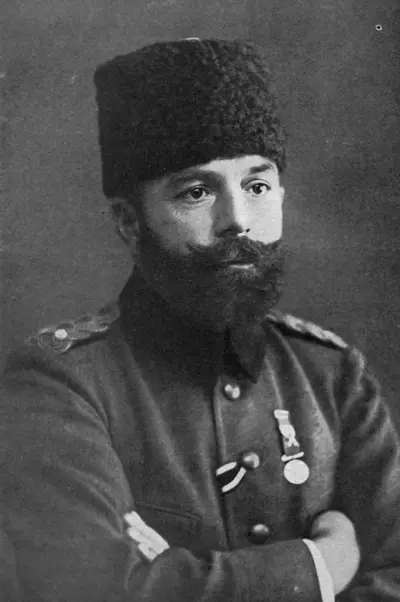
Ahmed Djemal Pasha, also known as Jamal Basha as-Saffah ("the Bloodthirsty") in the Arab world, was an Ottoman military leader and one of the Three Pashas that ruled the Ottoman Empire during World War I and carried out the Armenian Genocide.
