Mustafa Kemal Ataturk Quotes
Bloody revolutions are solid; bloodless ones are not permanent. But we have shed sufficient blood to come to this revolution. It has been shed not only on battlefields, but within the country…There have been many risings, all of which have been suppressed. Let us hope that there will be no more bloodshed. The first duty of our educated people is to enlighten and guide the opponents of our happy revolution.
The Turkish revolution was by historical standards relatively bloodless as compared especially with other republican revolutions like the United State and France. However, the revolution that brought Ataturk to power was a relatively mild one in terms of the immediate changes that unlike many revolutions which produced instant radical change. In Turkey, the radical change took place in the years after the revolution when Ataturk with hardly any bloodshed produced compulsory public secular education, scientific elevation in society, separation of mosque and state, gender equality including universal voting, change to western dress, elimination of the caliphate, speech and press freedom, and many others including changing the entire language to use the Latin alphabet instead of Arabic. No nation in history has gone thought more social and cultural change and modernized so fast as Turkey after its revolution. The result is the most modern and successful Islamic country in the world.
Kemal Ataturk, 1881-1938, 1st President and founder of the Turkish Republic, Speech, Orient Cinema, Bursa, 1923, Quoted in Andrew Mango, Ataturk
Sourced by: Eigen's Political and Historical Quotations


Germany, after its defeat in WWI was going through massive demonstrations and strikes. The government kept issuing bulletins that “Order Prevails” and the like. Luxemburg’s rhetoric and writing was so damaging to the government that they had her assassinated shortly after this statement.


Thai society had been polarized and very large peaceful demonstrations (by the Yellow Shirts) were calling for the resignation of the government which although very corrupt and controlled by a single very rich family which had extensive support of the rural and poor (the Red Shirts). This quotation illustrates how a peaceful protest could lead to violence and terrorism. This Red Shirt leader, rather than lose, would lead violence in the streets like the Brown Shirts of the pre WWII Germany. If the violence fails, he was willing to go underground and become a terrorist movement.


This was the exact political logical scenario that German socialist Bebel had predicted a few years earlier--{642075}. “Hectacomb” was an ancient Greek term referring to the public sacrifice of the blood of 100 oxen. It developed a more generalized meaning referring to making a very large human sacrifice of life for a national purpose.


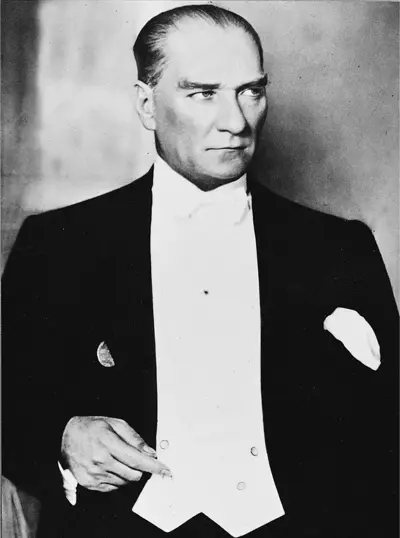
Kemal Atatürk was a Turkish field marshal, revolutionary statesman, author, and the founding father of the Republic of Turkey, serving as its first president from 1923 until his death in 1938. He undertook sweeping progressive reforms, which modernized Turkey into a secular, industrial nation. Ideologically a secularist and nationalist, his policies and theories became known as Kemalism. Due to his military and political accomplishments, Atatürk is regarded as one of the most important political leaders of the 20th century.
