Elliott Abrams Quotes
History may someday record that the Arab awakening that began with the Arab revolt of 1916 against the Ottomans ended about a century later with a whimper.
Abrams, Elliott. Realism and Democracy: American Foreign Policy after the Arab Spring. Cambridge University Press, 2017.


The professor was lecturing to British university students about 75 years after the American Revolution. The “American War” is the term the British use for the American Revolution.

After the first Arab Spring revolution ousting Mubaric, a military dictator, the Egyptians elected a leader, Morsi, of the Muslim Brotherhood. Morsi then abused his powers and tried to turn Egypt into a theocracy. Huge popular protests against the Muslim Brotherhood led to el-Sisi leading a military coup where the army took over the government. Then they held elections, el-Sisi resigned from the military, and ran for President and won by a large percentage even though a small proportion of the population voted.

This was a classic criticism of Barack Obama—namely that he was an intellectual who could only communicate in a rational, academic, unemotional style and was reluctant to express outrage and publicly chastise other parties or counties.


The Shiites are a faction of Islam that has contested with the majority faction, the Sunnis, for theological and cultural dominance of Islam and the Middle East. The Shiites were the majority in Iraq but under Saddam were dominated by the Sunni. Iran is a Shiite country but the Arab states other than Iraq have Sunni majorities and dominance.
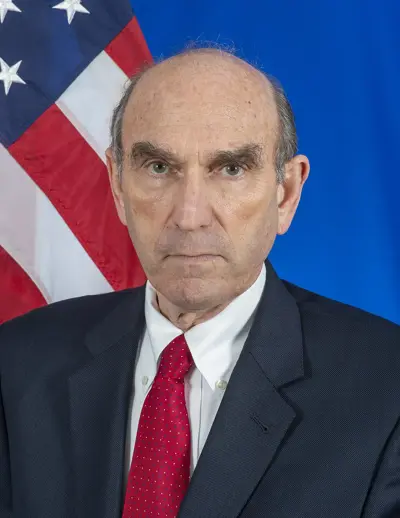
Elliott Abrams is an American politician and lawyer, who has served in foreign policy positions for Presidents Ronald Reagan, George W. Bush, and Donald Trump. Abrams is considered to be a neoconservative. He is currently a senior fellow for Middle Eastern studies at the Council on Foreign Relations. On January 25, 2019, he was appointed as Special Representative for Venezuela. On September 1, 2020, he was further appointed to concurrently serve as the U.S. Special Representative for Iran.
