MOHAMMED II
(Mehmed II)
This statement was made after he had led the Muslim Ottoman Turkish Army to success in capturing Constantinople—Byzantium, Istanbul—bringing the Byzantine Empire (Eastern Roman Empire) to an end. He had his sights set on the Western Roman Empire next which was the remainder of what they knew of as the world then.
The Byzantine emissary had pointed out that Mehmed’s predecessors had signed a treaty agreeing to “consult” with Constantinople before building any fortified structure in the area surrounding Constantinople. Mehmed was only 19 years old at this time. His intention f building a fort was to have a platform from which to attack and capture Constantinople itself which he did 2 years later. Earlier, the Eastern Roman Empire was much stronger and the Ottoman sultans were more cautious in dealing with them. However, the various Christian factions were all feuding with each other, and Mehmed II, despite his youth, was much better organized and was a better leader than his predecessors.
Gennadios II, 1400-1473, had been taken as a prisoner when the Ottomans captured Constantinople 3 days earlier. Despite the fact that there was doctrine that said that Islam should be the only religion, Mehmed—only 21 at the time—realized that he had to rule the city including the many Greek Orthodox and had Gennadios freed and personally invested him as the Petrarch of the Eastern Christian Church. Mehmed was particularly shrewd in his choice. Gennadios had been a strong opponent of the Union movement of Eastern and Western Christian Churches would end their schism and reunite. See {635099} for another notable who was vehemently opposed to Union. There were some Unionists among the defeated Christians who were still alive. The last thing strategically that the Ottoman’s wanted was for Union to have traction and the Eastern Christians of Constantinople looking to the Western Christians led by the Pope, the Holy Roman Emperor and the Christian European Kings for an alliance to eject the Ottomans from and retake Constantinople. The graphic depicts Mehmed investing Gennadios—a practice that was followed with each new Patriarch and the Sultan then in office. See {635084} for another quotation describing Ottoman pragmatic religious tolerance. One of Mehmed’s historical heroes was Alexander the Great who was able to rule most of the known world in large part because of his education by Aristotle advising him to be very tolerant of conquered people’s cultures, religious and otherwise. Mehmed, after his death, came under criticism from ultra orthodox Muslims including his own son and successor, for his religious tolerance and emulating a non-believer—Alexander the Great.
Mehmet’s father Murat had just died. There was a custom in Islam that the new Sultan have all his brothers executed so that there would be absolute certainty who was the legitimate Sultan and that dissenting forces should not rally around another son of the old Sultan to have a regime change and/or a civil war. Stability and certainty in the line of succession was critical to the Muslims in that the Sultan was not only the civil ruler, but the highest religious authority as well. He had the power of the Christian Pope and the Holy Roman Emperor together. The struggle between the Sunnis and the Shiites which has overwhelmed Islamic unity was originally all about who the successor to Muhammad would be.
The Muslims were poised to make the final assault on Constantinople. Religious leaders were whipping up the troops by calling for Jihad and telling them those who fell in battle would enjoy immediate access to Paradise and the virgins that went with Islamic martyrdom. However, the Sultan did not trust religious fervor alone. He said this to the leaders of his soldiers who then spread the word. The City fell the next day. The troops had 3 days of looting, rape and pillage which the Sultan had promised, but there was almost no further damage to the infrastructure other than that caused by the seige cannons.
The Emperor had sent a challenging message to the young Ottoman Sultan {634798}. Constantine would not negotiate terms of surrender despite the overwhelming strength of the Turkish forces. The Sultan attacked and took the city in a battle where not only was Constantine killed but a large part of his people as well. The Muslims have held Byzantium (Constantinople, now Istanbul) since.
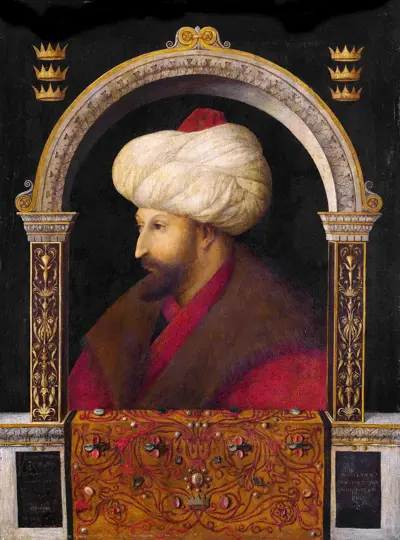
Mehmed II, commonly known as Mehmed the Conqueror, was an Ottoman sultan who ruled from August 1444 to September 1446, and then later from February 1451 to May 1481. In Mehmed II's first reign, he defeated the crusade led by John Hunyadi after the Hungarian incursions into his country broke the conditions of the truce Peace of Szeged. When Mehmed II ascended the throne again in 1451 he strengthened the Ottoman navy and made preparations to attack Constantinople. At the age of 21, he conquered Constantinople (modern-day Istanbul) and brought an end to the Byzantine Empire.
