Mohammed II Quotes
Either surrender the city or stand ready to do battle.
The Emperor had sent a challenging message to the young Ottoman Sultan {634798}. Constantine would not negotiate terms of surrender despite the overwhelming strength of the Turkish forces. The Sultan attacked and took the city in a battle where not only was Constantine killed but a large part of his people as well. The Muslims have held Byzantium (Constantinople, now Istanbul) since.
Mehmed II, 1432-1481, Ottoman Turkish Sultan, Response to the message sent by Byzantine Emperor Constantine XI, 1453
Sourced by: Eigen's Political and Historical Quotations

This is a good example of how religious zeal has sometimes caused rulers to really do stupid things. Rather than try and negotiate a deal with the Sultan and pay an annual tribute or other such diplomatic solution as was common at the time, he was convinced that God would make sure that the capital of the Eastern Roman Empire—a holy city would not fall to the infidel and allow all the holy relics to fall into the hands of the heathen. In reality he would not fight for the inhabitants; he would force the inhabitants to fight for him and his view of the will of God. The message was taken by the young Sultan to be a personal challenge to him and to his God. See {634805} for his response to Constantine.
The Ottoman Turks had already conquered the Eastern Roman empire outside of Byzantium. They had overwhelming superiority and it was just a matter of time when they would take the city. Surrender would have been the sensible course, but religious passion against surrendering the holy city capital of Christendom to the Muslims was dominant in the Emperor and some of the leadership. But the morale of most was very low—and for good reason. The Ottomans soon captured the city.

General Grant had the fort surrounded and the confederate general hoped to surrender the fort and allow him and his men to leave to fight again some other day. This was often agreed to so the military objective would be gained without the casualties of a battle. However, Grant and Lincoln did not simply want to gain forts and territory. They wanted to end the war. Those Confederates who survived the battle were taken prisoner and were out of the fight.

The so called War on Terror had many lessons. President Obama and many of the military leaders in the Pentagon realized that just as we evolved the concept of a Cold War, a new concept was needed to deal on the long run with the Al Qaeda terrorists. Typically in war, the nation is fully mobilized with the surrender of the enemy the major objective. When peace is negotiated, there is some demobilization and other things begin to take precedence. However, given the non state highly decentralized nature of Al Qaeda, there is no way to ever negotiate peace because no Al Qaeda official can speak for any more than his immediate cell and cadre. They will likely never stop attacking in any foreseeable future since their motivation is ideological and religious. It doesn’t take full military mobilization to protect against individual acts of terrorism, and indeed arguably the large mobilization only gives the terrorists more nearby targets. So American leaders were evolving a state of high protection, surgical strikes and attacks on Al Qaeda leadership and cells, and at the same time a demobilization of many of the overseas ground troops. It is not a state of war yet there will be attacks from time to time against us and attacks by us on Al Qaeda, yet there cannot be an all out war which is de factor non winnable in toto, but is very controllable. For Stein and other hawks, this new state is unfathomable. If there is any attack on Americans or American interests to them we are either at war with full mobilization or have surrendered. The total number of American civillians killed in the 10 year war on terror has been less than 2 months of normal automobile crash deaths or 3 months worth of gun accidents, or one tenth of the deaths caused by flu in a single year.

The Turks could not take the city then, but they did 56 years later in 1453.


Alluding to Ecclesiastes 3:1 ff, "For everything there is a season, and a time for every matter under heaven: a time to be born, and a time to die;.." The exact wording of his sermon has been lost, but the sentiment was reported by many.

The meaning is that to be victorious in war one should not be inhibited from doing cruel and brutal things that war sometimes necessitates.

Aeneas Sylvius Piccolomini. 6 years earlier, the Ottoman Turks, had captured Byzantium (Constantinople, later Istanbul), the capital of the Eastern Roman Empire. One o the reasons the city fell was the squabbling of the different Christian national armies about support for the city and the internal bickering of those armies and navies that were there. The Emperor, Constantine XI, the successor to Constantine the Great—the roman Emperor who Christianized the Empire, was killed. Emperor Justinian had built the Hagia Sophia—the largest church at the time and for 1000 years thereafter under a single dome, and this great house of Christianity was turned into a Mosque by the Islamic conquerors.

The Byzantine emissary had pointed out that Mehmed’s predecessors had signed a treaty agreeing to “consult” with Constantinople before building any fortified structure in the area surrounding Constantinople. Mehmed was only 19 years old at this time. His intention f building a fort was to have a platform from which to attack and capture Constantinople itself which he did 2 years later. Earlier, the Eastern Roman Empire was much stronger and the Ottoman sultans were more cautious in dealing with them. However, the various Christian factions were all feuding with each other, and Mehmed II, despite his youth, was much better organized and was a better leader than his predecessors.

Washington was describing the British strategy at the start of the war. The expectation was not only that of the British high command in America but was the prevailing expectation in the Court, Parliament, and the media in London. British critics of the military strategy point to this as a key reason the British lost the war in the end. Instead of waiting for the American troops to fall apart during the hard winter and gain a cheap and easy victory, the critics argue that the British should have initiated full scale attacks on the weakened and ill provisioned American soldiers.


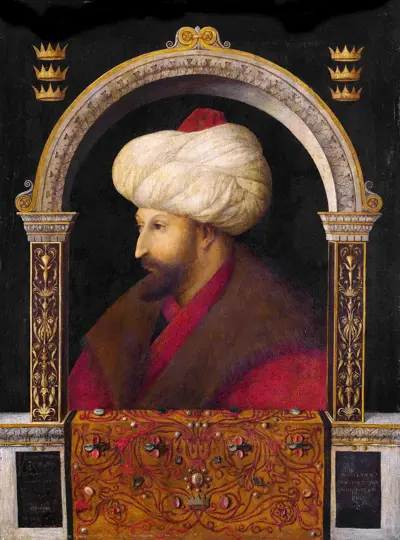
- Born: March 30, 1432
- Died: May 3, 1481
- Nationality: Ottoman
- Profession: Sultan
Mehmed II, commonly known as Mehmed the Conqueror, was an Ottoman sultan who ruled from August 1444 to September 1446, and then later from February 1451 to May 1481. In Mehmed II's first reign, he defeated the crusade led by John Hunyadi after the Hungarian incursions into his country broke the conditions of the truce Peace of Szeged. When Mehmed II ascended the throne again in 1451 he strengthened the Ottoman navy and made preparations to attack Constantinople. At the age of 21, he conquered Constantinople (modern-day Istanbul) and brought an end to the Byzantine Empire.
