Eleanor Roosevelt Quotes
Being a pacifist means that you do not seek a fight, that you use every means in your power to prevent a fight …. but if war comes into your own country, then even a pacifist it seems to me, must stand up and fight for their beliefs.
Eleanor Roosevelt, 1884-1962, First Lady (Franklin Delano Roosevelt), U. S. Delegate to the United Nations, Column, My Day, July 22, 1937
Sourced by: Eigen's Political and Historical Quotations


Magh Bahul Ekadashi


Note that Mormon doctrine requires that peace be offered 3 times before even a righteous war is begun. Under this doctrine, preemptive war would not be permissible, but diplomacy must be tried first and that by offering genuine peace. It is hard to apply this doctrine to the War on Terror, where there is no “other side” to negotiate with and the dispute is existential for democracy and freedom. The parenthetical references are to Mormon Scripture.

This appears to be the first American utterance of a longstanding doctrine of foreign policy.

Theodore Roosevelt was the Presidential nominee. Johnson was a leader of some members of Congress some of whom were extreme isolationists and some of whom were Nazi sympathizers and Hitler admirers. When the Japanese attacked Pearl Harbor later that year, Germany, fulfilling its treaty with Japan, declared war on America, Johnson’s group no longer mattered. Before WWII most Republicans were opposed to Defense Spending and accused the Democrats of being war hawks. After WWII, they flip flopped and became more hawkish than the Democrats who they accused of being soft on defense for years thereafter. See {631380} for President Roosevelt’s different view.

This was Ford in the middle of his career. As he got older, he changed radically. He was later one of the biggest supporters and admirers of Adolf Hitler and his aggressive militarism.


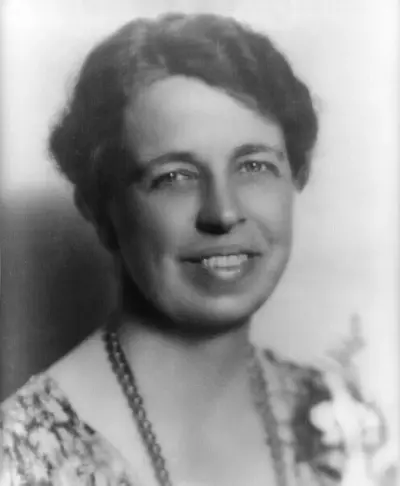
Anna Eleanor Roosevelt was an American political figure, diplomat and activist. She served as the First Lady of the United States from March 4, 1933, to April 12, 1945, during her husband President Franklin D. Roosevelt's four terms in office, making her the longest-serving First Lady of the United States. Roosevelt served as United States Delegate to the United Nations General Assembly from 1945 to 1952. President Harry S. Truman later called her the "First Lady of the World" in tribute to her human rights achievements.
