Manuel II Palaiologos Quotes
Lord Jesus Christ, let it not come to pass that the great multitude of Christian people should hear it said that it was in the days of the Emperor Manuel that the City, with all its sacred and venerable monuments of the Faith, was delivered to the infidel.
The Turks could not take the city then, but they did 56 years later in 1453.
Manuel II Palaiologos, 1350–1425, Byzantine Emperor, Prayer when the Ottoman Turks were attacking Constantinople, 1397
Sourced by: Eigen's Political and Historical Quotations

The Ottoman Turks had already conquered the Eastern Roman empire outside of Byzantium. They had overwhelming superiority and it was just a matter of time when they would take the city. Surrender would have been the sensible course, but religious passion against surrendering the holy city capital of Christendom to the Muslims was dominant in the Emperor and some of the leadership. But the morale of most was very low—and for good reason. The Ottomans soon captured the city.

In 1453 the Ottoman Turks shocked Christendom by capturing Constantinople, the capital of the Byzantine Eastern Christian Empire. It was always perceived as a religious conflict between Christians and Muslims but that is an over simplification of a very complex sociological, religious, and political historical period. As this quotation shows us there were many Christians aiding the Muslim side. There were also many Muslims fighting on the Christian side.

For many extremists Muslims, this sura calls for the torture or killing of the enemies of Islam. For the more moderate Muslims, the penalty of opposing Islam should be expulsion or banishment. The further modern complication of this sura is the definition of “making war with Allah.” To some extremists, it is writing or publishing anything contrary to their view of Islam; it is occupying any Islamic nation or warring with that nation even though the basis of the war might have nothing to do with religion; it is bringing a Bible into an Islamic nations; it is allowing alcohol to be sold and served; it is opposing their discriminatory customs and laws; it is pressuring them not to stone adulteresses.

Different Christian European powers moved in and out of alliances with each other and with the Islamic Ottoman Empire. So Christians were not unified and whenever a Christian country was at war with the Muslims some Christians perceived it as an assault on Christianity—except that there were Christian allies of the Muslims. Later many Muslims would see any conflict with a Christian country as an attack in Islam even when Muslim nations were allied with the Christians as was Turkey at the end of the 20th century. Turkey was a member of NATO and was therefore seen as traitors to Islam by some Muslims. There has always been this tendency to see conflict in terms of religious or ethnic hostility where convenient.

In modern times there has been much criticism of the Muslim fundamentalists and the claim of the religious leadership that those who die in Holy War (Jihad) will immediately go to heaven. The concern is that this encourages terrorism and aggressive war. Yet, here we have virtually the same kind of “reward” for violence as issued by the Christians. See {611697} for another such example.


This sura is interpreted in two ways. For many modern Muslims it means that in discussions and debates on religion with non-Muslims, do not back off, and if you do it is a religious transgression. Defend the faith. For the fundamentalists and extremists, they interpret the same sura in physical warlike terms. So if there is a fight or battle with disbelievers, retreating from the battlefield is not only cowardice and perhaps a crime under military regulations as it is in the West, but it is in Christian terms a mortal sin for which there one will go to hell. So the most religious of Muslims will fight to the death using this sura as their guidance. On the other hand, Muhammad himself as the military and civil leader of Islam made strategic retreats. In the history of almost all warfare between the West and Muslims—especially the Arabs—courage on the battlefield has been lacking and the Israelis, British, French, Americans, and Hindus of India all observe this military weakness and accounting for this is built into their military doctrine.
See {586041} for a Koranic quotation that urges world domination by Islam. In this quotation, The Prophet was talking to his followers at a time when Islam was not even a dominant religion in Arabia. And war was the way in which tribes, groups, and religions and sects, established themselves and grew. Although there are other Koranic passages which tell the faithful that people can only legitimately come to Islam through individual commitment and willingly, this passage not only seems to contradict that but also reflects a desire to punish and disgrace “non-believing” groups. This vengeance motif is also contradictory to much else of the Koran which generally preaches love, forgiveness, and understanding. However, there are contradictions and intellectual inconsistencies within the Koran just as there are within the Old and New Testaments.
When the Turks defeated the Christians, the only explanation many Christians could conceive of was that God was on the side of the Turks.


Odo of Chatillon-Sur-Marne. Westerners who look with horror at the religious promises of Islamic clerics that suicide bombers and other Muslims who die “defending Islam” will immediately pass to Paradise without the usual requirements and judgments which might deny admission because of previous sins. However, this is exactly what the Christians did in the Crusades as this well documented quotation demonstrates. To see the Islamic version, go to {617166}

Most modern Islamic clerics were and are shocked at this interpretation of Islam,

One Islamic belief that has stood since the inception of the religion is that if a true believer who is defending the faith in a jihad is killed, he will immediate be transported to Paradise where he will receive the best of the other world. If a Muslim dies under normal circumstances, he is judged and may or may not attain Paradise depending on his past life. However, if he dies in jihad, all past sins are immediately erased and he is guaranteed Paradise. This quotation is exactly what is told to Muslim fighters and suicide bombers today (see {635766}, {588728} and {590762}) and it is just as effective as ever in persuading men to fight and sacrifice themselves. The Roman Catholic Pope issued a similar edict in the Crusades and fights of both religions were willing and almost anxious to die in battle. In modern times Christian leaders do not make such appeals and if they did, few would believe them.
In the early stages of Islam, Muhammad had hoped to convert the Jews and others on the Arabian Peninsula. When they refused to be converted, he warred against them usually killing the men, and taking the women and children as slaves. The result was that non-believing tribes were “cleansed” from the Arabian Peninsula. The Muslims at the time preferred children as slaves. For then they could convert the children against their will. Adults in Islam must accept Islam in order to convert. Children are regarded as having no such maturity of decision making and therefore opposition to conversion may be ignored and they may be forced. Critics of Islam and those who argue that Islam is at odds with all other religions point to this quotation. They claim that it is the only religion whose founder and fundamental scriptures demand war against others for no other reason than that they believe in a different religion. The Catholic Church during the Crusades and the Inquisition had a similar philosophy as did Christian missionaries colonizing Africa later. One difference is that most Christians today repudiate the doctrine as against the true spirit and teachings of Christ and view it as historical error, while very few modern Muslims repudiate this quotation of the Prophet.
This is a good example of how religious zeal has sometimes caused rulers to really do stupid things. Rather than try and negotiate a deal with the Sultan and pay an annual tribute or other such diplomatic solution as was common at the time, he was convinced that God would make sure that the capital of the Eastern Roman Empire—a holy city would not fall to the infidel and allow all the holy relics to fall into the hands of the heathen. In reality he would not fight for the inhabitants; he would force the inhabitants to fight for him and his view of the will of God. The message was taken by the young Sultan to be a personal challenge to him and to his God. See {634805} for his response to Constantine.

The Emperor had sent a challenging message to the young Ottoman Sultan {634798}. Constantine would not negotiate terms of surrender despite the overwhelming strength of the Turkish forces. The Sultan attacked and took the city in a battle where not only was Constantine killed but a large part of his people as well. The Muslims have held Byzantium (Constantinople, now Istanbul) since.
Shahin’s empire which he conquered for Khosrow II comprised all of the Middle East into parts of India. The Byzantine Roman Empire controlled everything from Constantinople to the West. They were the two “superpowers” of the day. Shahin was attacking various Byzantine holdings outside of the city of Constantinople. Even before Islam, religion was a major conflict between East and West.

Greece had always coveted Anatolia which was a part of the Ottoman Empire but had been in antiquity a Greek dominated area. Further, people of Greek ethnicity and culture, who hundreds of years ago use to be the vast majority were after the hundreds of years of Ottoman rule and migration were then the largest minority in Anatolia. After the Turks lost the First World War as a consequence of their allying with Germany, and had been stripped of its Arab territories. Also, Turkey had just undergone a revolution and the old order was displaced. Venizelos saw this as an opportunity to get back Anatolia and sent a military invasion force to land at Smyrna (Ismir to the Turks), the largest city of Anatolia where despite the Greek minority in all of Anatolia, Greeks were a small majority in Smyrna. Greece was accused of making war on the Muslim Ottoman Turks. This was his answer to the British press. The invasion was initially successful but was then repulsed by the Turk revolutionists lead by their great patriot Ataturk who defeated the Greek forces handily despite the fact that they were hastily organized, untrained together, and much more poorly equipped than the Greeks. Turkey was very corrupt until the Ataturk reforms, but Greece was arguably even moreso.


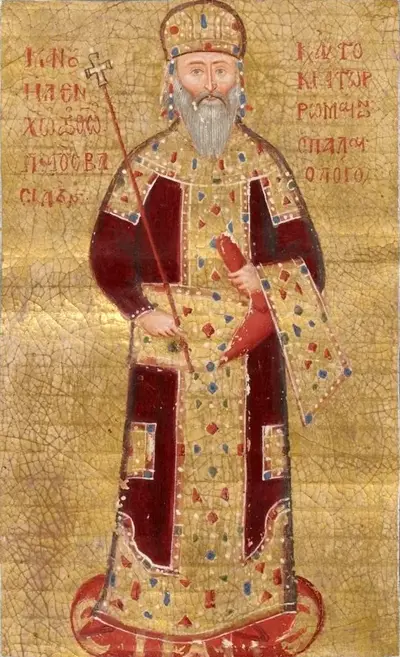
Manuel II Palaiologos or Palaeologus was Byzantine Emperor from 1391 to 1425. Shortly before his death he was tonsured a monk and received the name Matthew. His wife Helena Dragaš saw to it that their sons, John VIII Palaiologos and Constantine XI Palaiologos, become emperors.
