Eoin O'Duffy Quotes
Let us pray that the destruction of civilization may be averted, that Christ may live and reign, and that Communism and the power of Satan on Earth be brought to naught.
Eoin O’Duffy, 1892-1944, Irish General and Volunteer on the Fascist/Nationalist side in the Spanish Civil War, Crusade in Spain, 1938
Sourced by: Eigen's Political and Historical Quotations

The Turks could not take the city then, but they did 56 years later in 1453.

It was this perverted logic that led the Nationalists to adopt a policy of killing lower class and poor workers. Though there were communists in Spain at the time, most of the peasants and the abject poor had little or no political philosophy or education. More sophisticated Nationalist apologists observed that the ultra poor were easily enlisted into left-wing causes like communism, so their elimination before the fact was a preventive technique.


In a massive terror campaign captured Republican males were shot and the Republican women were raped as a matter of the General’s policy. He would commonly broadcast—see {592113}—what had and would happen to Republicans who remained loyal to the government and continued to fight. It was the actions of men like this that led to the modifications of the Geneva Conventions.

Speaking of the Italian support of the nationalists and their bombing of Barcelona during the Spanish Civil War.

Shelly was a reformer and admired Jesus Christ and his preaching. However, he was an opponent of organized religion and was an atheist himself.
They became Company C of the 125th Regiment of the Pennsylvania Volunteers, and were known as the Huntington Bible Company. See {618057}.

A force of 4,000 Spaniards, aided by Irish Catholics attempted to thwart the English Protestant Reformation forces in Ireland. They were defeated in their war by Lord Mountjoy. This is one of the many wars in history that was described as “holy” by one or both of its participants.
Aymeric (Albert) was a Frenchman who as a result of the Crusades Some historians credit him with founding of the Carmelite Order. The Patriarch was trying to raise more money for the Crusades. The Second Crusade had been a failure. The initial enthusiasm for the Crusades had diminished but the expenses increased. This is one of the more dramatic fundraising requests in history.

This quotation illustrates not only the virulent racism of some people of the era, but General Walker had been the commander of the Federal Troops that President Eisenhower had to depend upon in the Little Rock desegregation law enforcement. Radical segregationists held key positions at the time in the military and FBI. When it came to segregation, many of the Federal officials sworn to uphold the law, thought desegregation wrong and positively evil as Walker did, and opposed or undermined the law.

Many Americans and Europeans fought on the side of the Republicans against the Fascists.

Like many in the 1920s, Dewar saw the Communist Soviet Union as the biggest potential risk to peace. However, although the Russian leaders constantly castigated the West, they did not have a large military, and were for the most part highly anti-war as they saw war as the product of Capitalistic competition and the tool of the aristocracy. They had little military equipment and almost no training or officer corps with which to build any Army. Germany in contrast had the skill, experience, officers, a history of aggression, and huge resentment over what they considered their humiliating WWI defeat and peace terms. They would start WWII, not Russia.


The Nationalist/Fascist views in the Spanish Civil War were so gross that they actually hurt the Nationalist cause in International opinion. See {592113} for another example. Despite the facts, most of the Western world was not then knowledgeable about the evils of Fascism and distrusted democracy, socialism, and communism more.
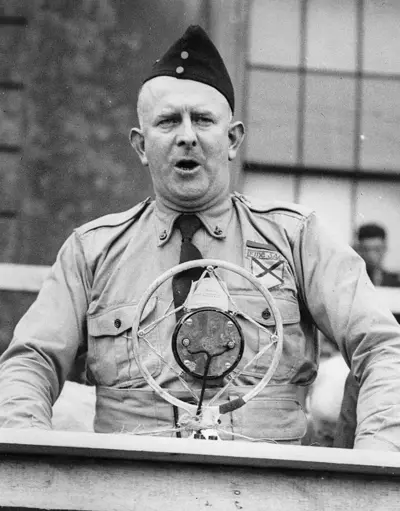
Eoin O'Duffy was a fascist Irish nationalist politician, military commander and police commissioner. He was the leader of the Monaghan Brigade of the Irish Republican Army (IRA) and a prominent figure in the Ulster IRA during the Irish War of Independence. In this capacity he became Chief of Staff of the IRA in 1922. He accepted the Anglo-Irish Treaty and served as a general in the National Army in the Irish Civil War, on the pro-Treaty side.
