Edwin A. Walker Quotes
Integration is a plot of the Anti-Christ.
This quotation illustrates not only the virulent racism of some people of the era, but General Walker had been the commander of the Federal Troops that President Eisenhower had to depend upon in the Little Rock desegregation law enforcement. Radical segregationists held key positions at the time in the military and FBI. When it came to segregation, many of the Federal officials sworn to uphold the law, thought desegregation wrong and positively evil as Walker did, and opposed or undermined the law.
Edwin A. Walker, 1909-1993, U. S. Army General, Member, The John Birch Society, Republican Candidate for Governor of Texas, Statement to racist, segregationist mob, Oxford, Mississippi, 1962
Sourced by: Eigen's Political and Historical Quotations

Following the lead of Arkansas, many southern schools were closed by order of the Governor when they received a court order to desegregate. Southern education was the poorest in the nation and the Southern students not able to go to school made the situation worse. Governor Almond changing his position realized that the cost of defying the Constitution and the courts was the ignorance of the students of the state, and became a major force persuading the state to integrate their schools. He is remembered for his leadership of desegregation and most people have forgotten that at the beginning of his term as governor he was as bad as most of the other Southern segregationist politicians.


There are few people today who could believe that a United States senator would castigate the head of a Federal Agency for spreading “racial equality propaganda.” But at the time—1943—the actions of Education Commissioner John W. Studebaker and his Assistant took remarkable courage.


This quotation was used by the Lyndon B. Johnson 1964 Campaign as: “We represent the majority of the people in Alabama who hate niggerism, Catholicism, Judaism, and all the isms of the whole world.” So said Robert Creel of the Alabama Ku Klux Klan. He also said, “I like Barry Goldwater. He needs our help.” The second statement was made at a different time.


This report was submitted to President Franklin D. Roosevelt, who accepted the recommendation and signed Executive Order 9066. The Japanese on the West Coast were then rounded up and interned by DeWitt in what was one of the lowest and disgraceful points in American history. A national apology was made 34 years later. See {635792}.
The teaching of hatred towards other people—especially people of a different religion has a long and tragic history. The Palestinians and other Muslims did not invent or even perfect the technique which was ongoing before Islam began and reached a low point in WWII Nazi Germany. But in the modern world, most other religions and people have put a stop to the overt teaching of hatred. The Muslims alone invest large resources towards teaching hate of Americans, The West, Jews, Israel

The statement was made even more dramatic as the outgoing Governor, Lester Mattox, standing behind Carter at the ceremony, was an arch segregationist.


Defending his action of using national guard troops to prevent school integration:


Armstrong rarely commented on politics (see {615854}), but the Governor defying the Supreme Court and not letting his people even go to school with other students was too much for him. He not only made the statement, but he approved it for publication. This shocked many who knew him as an apolitical person. He was particularly distressed with President Eisenhower who although he had warned Faubus that he would enforce the court order and then used federal troops to do so, Eisenhower was a man of action and not rhetoric and his lack of firm public statements overlooked an opportunity to use the Presidential “bully pulpit” and exercise his moral leadership and authority. Many then, and even 50 years later, were not sure where he stood on the issue of school desegregation. See {615852}.

Sumner would later become a Senator. However over a century before Brown v. Board of Education finally outlawed segregated schools, Sumner made one of the basic legal arguments that was involved in the case.

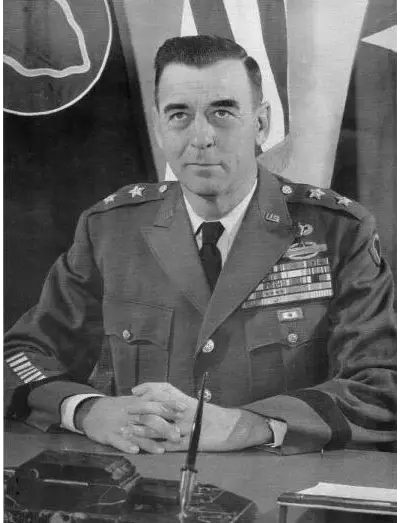
Edwin Anderson Walker — known as Ted Walker — was a United States Army officer who served in World War II and the Korean War. He became known for his staunch conservative political opinions and was criticized by U.S. President Dwight D. Eisenhower for promoting a personal political opinion while in uniform. Walker resigned his commission in 1959, but Eisenhower refused to accept his resignation and gave Walker a new command of the 24th Infantry Division in Augsburg, Germany. Walker again resigned his commission in 1961 after being publicly and formally admonished by the Joint Chiefs of Staff for allegedly referring to Eleanor Roosevelt and Harry S. Truman as "pink" in print and for violating the Hatch Act of 1939 by attempting to influence the votes of his troops. President John F. Kennedy accepted his resignation, making Walker the only US general to resign in the 20th century.
