Ruhollah Khomeini Quotes
Those who know nothing of Islam pretend that Islam counsels against war. Those who say this are witless. Islam says: Kill all the unbelievers just as they would kill you all! Does this mean that Muslims should sit back until they are devoured by the unbelievers? Islam says: Kill them, put them to the sword and scatter their armies. Does this mean sitting back until [non-Muslims] overcome us? Islam says: Kill in the service of Allah those who may want to kill you! Does this mean that we should surrender [to the enemy]? Islam says: Whatever good there is exists thanks to the sword and in the shadow of the sword! People cannot be made obedient except with the sword! The sword is the key to paradise, which can be opened only for holy warriors! There are hundreds of other Koranic psalms and hadiths urging Muslims to value war and to fight. Does all that mean that Islam is a religion that prevents men from waging war? I spit upon those foolish souls who make such a claim
Most modern Islamic clerics were and are shocked at this interpretation of Islam,
Ruhollah Khomeini, 1900-1989, Iranian Cleric (Ayatollah) & Revolutionary Leader, "Islam Is Not a Religion of Pacifists" (1942), "Speech at Feyziyeh Theological School" August 24, 1979
Sourced by: Eigen's Political and Historical Quotations

This particular quotation is very important. Khomeini was probably the most influential Muslim in the 20th Century. The fact that he wrote this in 1942—before there was an Israel as an enemy—shows how deep seated the requirement for world conquest is. To the Nazi’s world conquest was a justifiable goal. To Khomeini and his many followers, it is a religious obligation and duty and thus is every more dangerous. Extreme anti Muslims justify the attempted expulsion of Muslim immigrants on the grounds that they are a fifth column whose loyalty is and will be to the religion which will attempt to conquer their country. It gives Islamaphobia a veneer of respectability.


For many extremists Muslims, this sura calls for the torture or killing of the enemies of Islam. For the more moderate Muslims, the penalty of opposing Islam should be expulsion or banishment. The further modern complication of this sura is the definition of “making war with Allah.” To some extremists, it is writing or publishing anything contrary to their view of Islam; it is occupying any Islamic nation or warring with that nation even though the basis of the war might have nothing to do with religion; it is bringing a Bible into an Islamic nations; it is allowing alcohol to be sold and served; it is opposing their discriminatory customs and laws; it is pressuring them not to stone adulteresses.
In the early stages of Islam, Muhammad had hoped to convert the Jews and others on the Arabian Peninsula. When they refused to be converted, he warred against them usually killing the men, and taking the women and children as slaves. The result was that non-believing tribes were “cleansed” from the Arabian Peninsula. The Muslims at the time preferred children as slaves. For then they could convert the children against their will. Adults in Islam must accept Islam in order to convert. Children are regarded as having no such maturity of decision making and therefore opposition to conversion may be ignored and they may be forced. Critics of Islam and those who argue that Islam is at odds with all other religions point to this quotation. They claim that it is the only religion whose founder and fundamental scriptures demand war against others for no other reason than that they believe in a different religion. The Catholic Church during the Crusades and the Inquisition had a similar philosophy as did Christian missionaries colonizing Africa later. One difference is that most Christians today repudiate the doctrine as against the true spirit and teachings of Christ and view it as historical error, while very few modern Muslims repudiate this quotation of the Prophet.
This sura is one of the quotations that causes major anxiety on the part of the Israelis. If the Arabs ever win a major battle and invade Israel, they are instructed to kill the Israelis who in the view of the Arabs “turned them out” of Palestine. Not doing so would produce “tumult and oppression” which, in contrast to most religions, are considered to be worse calamities than slaughter of human beings. A little later in the sura, the Prophet tells the faithful that the infidels need not be killed if they cease to oppose Islam.

She is a leading American Arab who is a Syrian expatriate.


If some Islamic cleric declares a war or dispute to be an attack on Islam, the penalty is indeed severe for those Muslims who do not join the fight. In some Islamic lands, unbelievers are put to death. Note that the children become the Islamic society’s hostages for the behavior of the father.


“Amir” was the Arabic term for the commanding general or admiral. This is an important quotation as it shows that the ethics of war for the Muslims allowed guerilla warfare and formal pitched battles. Most Christians looked down upon guerilla warfare at the time.
After years of minority Sunni Muslim rule of Iraq, the U. S. invasion gave the majority Shiite Muslims political control. The Sunnis and Shiites have been at each others throats for centuries despite the fact that they are both Muslims. Saudi Arabia is the center of Sunni Islam and many of its religious extremists issue edicts advocating the suicide bombing of Shiite mosques and other facilities and assuring martyrdom for the suicide bombers.

“Martyrdom” is the euphemism that fundamentalist Muslims use to denote being killed while “fighting for Islam” or on a suicide mission for same. Many believe that such people ascend directly to Paradise where they are given a bevy of virgins and other “perks.” Ironically, this was the last interview that he gave before he himself was “martyred”—he was killed by coalition troops. This mental perspective is one of the reasons that fighting fundamentalist Islamic terrorists is so difficult. They perceive victory whichever way the battle or even the war comes out.


of the Central Intelligence Agency fomented Iranian Revolution. At the request of the British MI6 intelligence service, the CIA implemented a “spontaneous” coup d’etat to overthrow the popularly elected Iranian President Mohammad Mosaddegh. One of the reasons this is a very important quotation is that it shows an interesting aspect if jihad—Islamic Holy War. One of the many tactics the CIA used was to bribe key Islamic Imams and other religious officials to declare a jihad against Mosaddegh—to tell the people that it was their Islamic duty to get rid of Mosaddegh who was a threat to Islam and the word of God. The quote illustrates that most of the Western powers who wanted to achieve a political objective would play this jihad religious card—one that was much easier to start than to control. When Eisenhower urged using the jihad tactic, he did not imagine that jihad would be used against the United States for the 9-11 attack and the Iraq and Iran wars. See {637008} and {637007}.

The Turks could not take the city then, but they did 56 years later in 1453.


Historically, this quotation shows that the negative relationship between the West and Islam and negative views of Islam was not a new phenomenon at the beginning of the 21st century. It existed long before, and as with the 21st century concerns, violence and war were the major concerns.
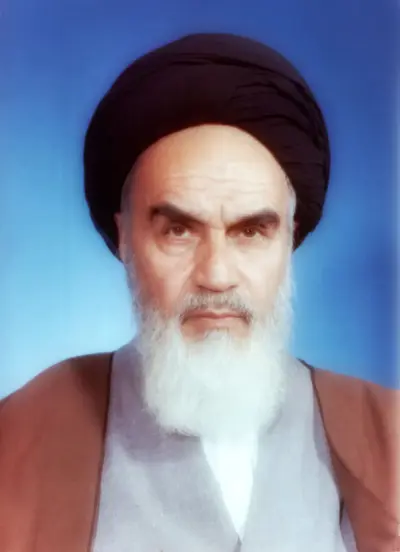
Sayyid Ruhollah Musavi Khomeini, also known in the Western world as Ayatollah Khomeini, was an Iranian political and religious leader. He was the founder of the Islamic Republic of Iran and the leader of the 1979 Iranian Revolution, which saw the overthrow of the last Shah of Iran, Mohammad Reza Pahlavi, and the end of the 2,500-year-old Persian monarchy. Following the revolution, Khomeini became the country's Supreme Leader, a position created in the constitution of the Islamic Republic as the highest-ranking political and religious authority of the nation, which he held until his death. Most of his reign was taken up by the Iran–Iraq War of 1980–1988. He was succeeded by Ali Khamenei on 4 June 1989.
