Ruhollah Khomeini Quotes
Islam says: Whatever good there is exists thanks to the sword and in the shadow of the sword! People cannot be made obedient except with the sword! The sword is the key to Paradise, which can be opened only for the Holy Warriors! There are hundreds of other [Qur'anic] psalms and Hadiths [sayings of the Prophet] urging Muslims to value war and to fight. Does all this mean that Islam is a religion that prevents men from waging war? I spit upon those foolish souls who make such a claim.
Khomeini, Ruhollah. Speech in Qom, 12 Dec. 1984. Quoted in Taheri, Amir. Holy Terror: Inside the World of Islamic Terrorism. Adler & Adler, 1987, p. 226.

Most modern Islamic clerics were and are shocked at this interpretation of Islam,


She is a leading American Arab who is a Syrian expatriate.


Professor Tibi and others have also pointed out that with this definition within Islam, there is no possible justification for a non-Muslim state to war against a Muslim state even of the non-Muslim state was attacked first. However, note that most educated Muslims, like Dr, Tibi, do not hold this preposterous position. It does however illustrate why some Muslims can be outraged when Israel fights back against the thousands of rockets fired from Gaza. To them the 7000 rocket firing was a just war to make Israel a Muslim territory, but no retaliation by non-Muslims can be just.

“Martyrdom” is the euphemism that fundamentalist Muslims use to denote being killed while “fighting for Islam” or on a suicide mission for same. Many believe that such people ascend directly to Paradise where they are given a bevy of virgins and other “perks.” Ironically, this was the last interview that he gave before he himself was “martyred”—he was killed by coalition troops. This mental perspective is one of the reasons that fighting fundamentalist Islamic terrorists is so difficult. They perceive victory whichever way the battle or even the war comes out.


If some Islamic cleric declares a war or dispute to be an attack on Islam, the penalty is indeed severe for those Muslims who do not join the fight. In some Islamic lands, unbelievers are put to death. Note that the children become the Islamic society’s hostages for the behavior of the father.
See {586041} for a Koranic quotation that urges world domination by Islam. In this quotation, The Prophet was talking to his followers at a time when Islam was not even a dominant religion in Arabia. And war was the way in which tribes, groups, and religions and sects, established themselves and grew. Although there are other Koranic passages which tell the faithful that people can only legitimately come to Islam through individual commitment and willingly, this passage not only seems to contradict that but also reflects a desire to punish and disgrace “non-believing” groups. This vengeance motif is also contradictory to much else of the Koran which generally preaches love, forgiveness, and understanding. However, there are contradictions and intellectual inconsistencies within the Koran just as there are within the Old and New Testaments.

This threat of massacre by the Arabs backfired in that the Israelis had no other alternative but to fight and win or else die. It also gained them a great deal of world sympathy and revulsion at the Arab call for massacre. See related quotes for another of the many examples.
This verse is one of those most often cited by Muslim militants justifying terrorism and war against non-Muslims. However, other more modern Muslim theologians cite the unique historical circumstances when the Muslims in Arabia were opposed by all else there. They also cite the end of the verse which tends to be ignored by the militants: “But know that God is with those who restrain themselves.”


A force of 4,000 Spaniards, aided by Irish Catholics attempted to thwart the English Protestant Reformation forces in Ireland. They were defeated in their war by Lord Mountjoy. This is one of the many wars in history that was described as “holy” by one or both of its participants.
This particular quotation is very important. Khomeini was probably the most influential Muslim in the 20th Century. The fact that he wrote this in 1942—before there was an Israel as an enemy—shows how deep seated the requirement for world conquest is. To the Nazi’s world conquest was a justifiable goal. To Khomeini and his many followers, it is a religious obligation and duty and thus is every more dangerous. Extreme anti Muslims justify the attempted expulsion of Muslim immigrants on the grounds that they are a fifth column whose loyalty is and will be to the religion which will attempt to conquer their country. It gives Islamaphobia a veneer of respectability.

“Amir” was the Arabic term for the commanding general or admiral. This is an important quotation as it shows that the ethics of war for the Muslims allowed guerilla warfare and formal pitched battles. Most Christians looked down upon guerilla warfare at the time.
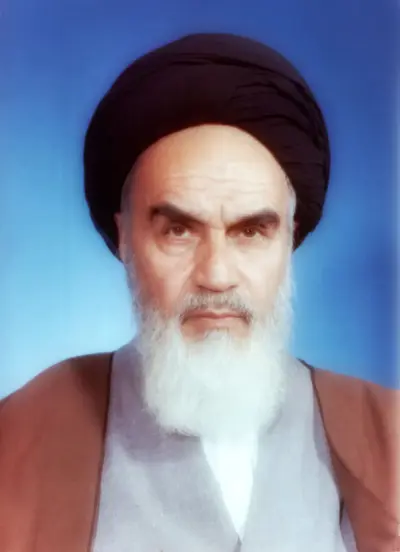
Sayyid Ruhollah Musavi Khomeini, also known in the Western world as Ayatollah Khomeini, was an Iranian political and religious leader. He was the founder of the Islamic Republic of Iran and the leader of the 1979 Iranian Revolution, which saw the overthrow of the last Shah of Iran, Mohammad Reza Pahlavi, and the end of the 2,500-year-old Persian monarchy. Following the revolution, Khomeini became the country's Supreme Leader, a position created in the constitution of the Islamic Republic as the highest-ranking political and religious authority of the nation, which he held until his death. Most of his reign was taken up by the Iran–Iraq War of 1980–1988. He was succeeded by Ali Khamenei on 4 June 1989.
