Constantine XI Palaiologos Quotes
Now that you have broken the treaties to which I am bound by oath, let these be dissolved. Henceforth, I will keep the city gate closed. I will fight for the inhabitants with all my strength. You may continue in your power until the Righteous Judge passes sentence on each of us.
This is a good example of how religious zeal has sometimes caused rulers to really do stupid things. Rather than try and negotiate a deal with the Sultan and pay an annual tribute or other such diplomatic solution as was common at the time, he was convinced that God would make sure that the capital of the Eastern Roman Empire—a holy city would not fall to the infidel and allow all the holy relics to fall into the hands of the heathen. In reality he would not fight for the inhabitants; he would force the inhabitants to fight for him and his view of the will of God. The message was taken by the young Sultan to be a personal challenge to him and to his God. See {634805} for his response to Constantine.
Constantine XI Palaiologos, 1404–1453, Byzantine Emperor, Message he sent to the young Ottoman Turkish Sultan whose armies controlled most of the area around Byzantium, 1453
Sourced by: Eigen's Political and Historical Quotations

The Emperor had sent a challenging message to the young Ottoman Sultan {634798}. Constantine would not negotiate terms of surrender despite the overwhelming strength of the Turkish forces. The Sultan attacked and took the city in a battle where not only was Constantine killed but a large part of his people as well. The Muslims have held Byzantium (Constantinople, now Istanbul) since.

The Ottoman Turks had already conquered the Eastern Roman empire outside of Byzantium. They had overwhelming superiority and it was just a matter of time when they would take the city. Surrender would have been the sensible course, but religious passion against surrendering the holy city capital of Christendom to the Muslims was dominant in the Emperor and some of the leadership. But the morale of most was very low—and for good reason. The Ottomans soon captured the city.

This quotation shows The Prophet relaying a message from Allah. This quotation is often used to explain the reason that Islamic nations often support each other regardless of interests, legality, or morality of the position. If the other Muslim nation is a friend of Allah’s, and one opposes the other Islamic nation, then one is not only standing against Allah’s “friend” but Allah himself might make war on you for standing against his friend. So for Islamic nations like Turkey and Pakistan to even be supportive of anti-terrorist activities against Islamic terrorists is a politically, culturally and religiously very difficult thing to do because fundamentalists will cite this quotation and warn that the policy may well be “standing in enmity” against one of Allah’s friends. For most Islamic nations, their religious culture produces a basic instinct to support other Islamic nations against heretics (the Judeo-Christian West or the Hindu-Buddhist East) lest Allah declare war on them.

The Turks could not take the city then, but they did 56 years later in 1453.

This treaty was an attempt to end the 100 Years War.

Young Mehmed II, had just replaced his dead father as Ottoman Turkish Sultan. Constantine XI had threatened to finance a cousin of Mehmed’s, Orhan and back his challenge to Mehmed for the Sultanate in order to put pressure on the young Sultan to renegotiate a treaty that had been signed with Mehmed’s father. It was a very ham-handed diplomatic effort, The Grand Vizier was the main force in the Ottoman Government counseling the new Sultan against war and an attack on Byzantium. He was furious as the Emperor’s action had weakened his influence with the young Sultan, who after he captured Byzntium later in the year, had his Grand Vizier executed.

In 1453 the Ottoman Turks shocked Christendom by capturing Constantinople, the capital of the Byzantine Eastern Christian Empire. It was always perceived as a religious conflict between Christians and Muslims but that is an over simplification of a very complex sociological, religious, and political historical period. As this quotation shows us there were many Christians aiding the Muslim side. There were also many Muslims fighting on the Christian side.


See related quote to consider other’s view of the Greeks at the time. The Crusades were going badly for the Christians at this point. The Greek Emperor had, after promising to be a part of the Christian alliance, made a separate treaty with Saladin and the Muslims, making him an outcast and sewing the seeds of the schism between the Eastern and Western Christian Churches.

They had seen many other abolitionists attacked and butchered by the pro-slavery forces. The civil war of Kansas was over whether Kansas would enter the Union as a slave state of a free state. If a free state, the free states would be able to block further slavery. If Kansas were to become a slave state, the slave states would have a sufficient majority to make all future expansion hospitable to slavery. The slavery forces started sending man and families into Kansas so that they could vote; the abolitionists did the same. Both sides armed and a war began with each faction trying to kill or drive the other faction out of Kansas before the vote. See {617388} and {612516}.


The President had earlier threatened to execute Confederate prisoners, if the South implemented its threat to execute any Union Negro soldiers they captured. The threat seems to have worked. See Lincoln.


This is a very controversial Franklin quotation. In fact, Franklin never sent this letter to Strahan, but it is one of the most famous of the Franklin quotations. It was even famous in 1775. Franklin saw to it that copies of his “letter” reached most American newspaper editors, many of who reprinted it. It was not the first time that an American politician had made quotations for domestic consumption only, and it certainly was not the last. So Franklin never said this to his friend Strahan, but he did claim that he did to all who Americans who would listen. The result is that Franklin developed a reputation for really ‘telling off those Englishmen.’ This was important for him because since he had many friends and admirers in England, he was suspect to many anti-British Americans.


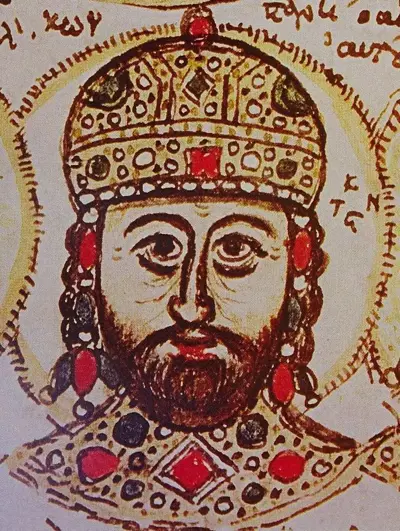
- Born: February 8, 1405
- Died: May 29, 1453
- Nationality: Byzantine
- Profession: Emperor
Constantine XI Dragases Palaiologos or Dragaš Palaeologus was the last Byzantine emperor, reigning from 1449 until his death in battle at the Fall of Constantinople in 1453. Constantine's death marked the end of the Byzantine Empire, which traced its origin to Constantine the Great's foundation of Constantinople as the Roman Empire's new capital in 330. Given that the Byzantine Empire was the Roman Empire's medieval continuation, with its citizens continually referring to themselves as Romans, Constantine XI's death and Constantinople's fall also marked the definitive end of the Roman Empire, founded by Augustus almost 1,500 years earlier.
