Frederick Barbarossa Quotes
Because the burnt child dreads the fire, we can in the future have no confidence in the words and oaths of the Greeks.
See related quote to consider other’s view of the Greeks at the time. The Crusades were going badly for the Christians at this point. The Greek Emperor had, after promising to be a part of the Christian alliance, made a separate treaty with Saladin and the Muslims, making him an outcast and sewing the seeds of the schism between the Eastern and Western Christian Churches.
Frederick I, 1123-1190, [Barbarossa], German King & Holy Roman Emperor, Letter to Leopold of Austria, 1189
Sourced by: Eigen's Political and Historical Quotations

At the time of the writing she was an ex-queen. See {618099} for Frederick’s own view of the Greeks. The Crusades were going badly for the Christians at this point. The Greek Emperor had, after promising to be a part of the Christian alliance, made a separate treaty with Saladin and the Muslims, making him an outcast and sewing the seeds of the schism between the Eastern and Western Christian Churches. In a year, the Western Christians would sack Constantinople, and murder and plunder their fellow Eastern Christians. The two previous Greek Emperors were suspect from the Western point of view, but the treaty with Saladin “proved” what had been suspected about the Greeks who were now allied with the hated Muslims.


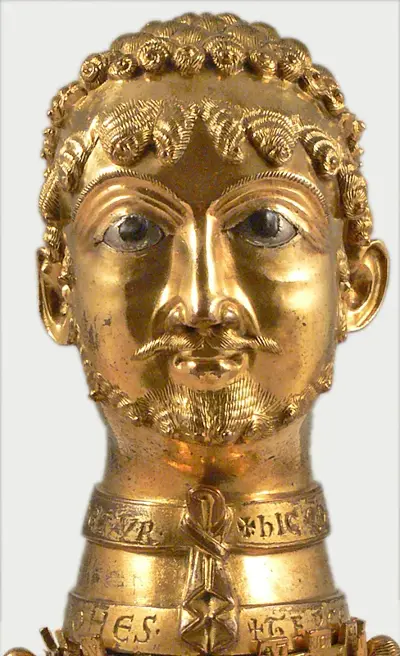
Frederick Barbarossa, also known as Frederick I, was the Holy Roman Emperor from 1155 until his death 35 years later. He was elected King of Germany at Frankfurt on 4 March 1152 and crowned in Aachen on 9 March 1152. He was crowned King of Italy on 24 April 1155 in Pavia and emperor by Pope Adrian IV on 18 June 1155 in Rome. Two years later, the term sacrum ("holy") first appeared in a document in connection with his empire. He was later formally crowned King of Burgundy, at Arles on 30 June 1178. He was named Barbarossa by the northern Italian cities which he attempted to rule: Barbarossa means "red beard" in Italian; in German, he was known as Kaiser Rotbart, which has the same meaning. The prevalence of the Italian nickname, even in later German usage, reflects the centrality of the Italian campaigns to his career.
