Muhammad Quotes
In the jihad against Constantinople, one third of Muslims will allow themselves to be defeated, which Allah cannot forgive. One third will be killed in battle making them wondrous martyrs. And one third will be victorious.
Muhammad, 571-632, Prophet and Founder of Islam, Hadith
Sourced by: Eigen's Political and Historical Quotations


Ottoman Turkish Sultan Mehmed II Aeneas Sylvius Piccolomini. 6 years earlier, the Ottoman Turks, had captured Byzantium (Constantinople, later Istanbul), the capital of the Eastern Roman Empire. The Pope had called together the rulers and leaders of Christendom to organize a common defense in this war of civilizations. This was the period where Christian Islamophobia began. The Muslims had a religious duty to convert the rest of the world to Islam and adopt Islamic law (Sharia). However, so did the Christians. Sultan Mehmed II, when he conquered Byzantium, did not require the conversion of the Christians in the great city. He took the greatest churches, but by and large left the Christians to worship in their own Churches. The Muslims at the time were far more tolerant of Christians (and Jews) than the Christians were of Muslims (and Jews). Like in the 21st century, there was much Islamic doctrine and reality to be worried about, but not all the Muslims were as rabid and extreme as Eastern paranoia suggested in the 15th century or the 21st.

This sura is interpreted in two ways. For many modern Muslims it means that in discussions and debates on religion with non-Muslims, do not back off, and if you do it is a religious transgression. Defend the faith. For the fundamentalists and extremists, they interpret the same sura in physical warlike terms. So if there is a fight or battle with disbelievers, retreating from the battlefield is not only cowardice and perhaps a crime under military regulations as it is in the West, but it is in Christian terms a mortal sin for which there one will go to hell. So the most religious of Muslims will fight to the death using this sura as their guidance. On the other hand, Muhammad himself as the military and civil leader of Islam made strategic retreats. In the history of almost all warfare between the West and Muslims—especially the Arabs—courage on the battlefield has been lacking and the Israelis, British, French, Americans, and Hindus of India all observe this military weakness and accounting for this is built into their military doctrine.
See {586041} for a Koranic quotation that urges world domination by Islam. In this quotation, The Prophet was talking to his followers at a time when Islam was not even a dominant religion in Arabia. And war was the way in which tribes, groups, and religions and sects, established themselves and grew. Although there are other Koranic passages which tell the faithful that people can only legitimately come to Islam through individual commitment and willingly, this passage not only seems to contradict that but also reflects a desire to punish and disgrace “non-believing” groups. This vengeance motif is also contradictory to much else of the Koran which generally preaches love, forgiveness, and understanding. However, there are contradictions and intellectual inconsistencies within the Koran just as there are within the Old and New Testaments.
The Sunna and Hadith are Islamic Reverential Texts. The “final battle” is prophesised just as in the Christian Book of Revelations such a final battle between good and evil is predicted (Armageddon), and is believed to be in the future by some fundamentalist Christians. One difference however is that a small population of Christians believe this literally, while most Muslims believe in the great battle to come. However in this case, the battle is between the Muslims and the evil heretics—all others.
This is the basis of the immediate access to paradise that Mullahs promise would be suicide bombers or other fighters in jihad. Lest we think of Islam as more reprehensible than other religions, note that this same type of promise of immediate entry to Heaven was given to Christians who fought for Christianity. See {617185} .

Most sophisticated Muslim theologians would not agree at all with the “permission” he quotes from the Koran. However, there is no hierarchy of belief in Islam and there are tens of thousands of Muslim imams and millions of individual Muslims who believe and teach just what this particular terrorist stated.
If some Islamic cleric declares a war or dispute to be an attack on Islam, the penalty is indeed severe for those Muslims who do not join the fight. In some Islamic lands, unbelievers are put to death. Note that the children become the Islamic society’s hostages for the behavior of the father.
For many extremists Muslims, this sura calls for the torture or killing of the enemies of Islam. For the more moderate Muslims, the penalty of opposing Islam should be expulsion or banishment. The further modern complication of this sura is the definition of “making war with Allah.” To some extremists, it is writing or publishing anything contrary to their view of Islam; it is occupying any Islamic nation or warring with that nation even though the basis of the war might have nothing to do with religion; it is bringing a Bible into an Islamic nations; it is allowing alcohol to be sold and served; it is opposing their discriminatory customs and laws; it is pressuring them not to stone adulteresses.

This is the justification that some Muslims use for the murder of prisoners of war if the war is perceived to be an attack on Allah. This for most includes Westerners.
It was a custom for suicide bombers in the Middle East to write or video record last words to loved ones.
This is the type of person who suicide bomber recruiters seek out.
This quotation was reported to Congress by Thomas Jefferson. Essentially, this religious justification is no different from that made by contemporary Islamic extremists. Particularly interesting is the last sentence. The Koran states that all Muslims who die defending Islam will go immediately to heaven regardless of their previous sins and transgressions. Under that justification, even criminal extortion and terrorism is justified by some Muslims whenever the victims are non-believers.

One Islamic belief that has stood since the inception of the religion is that if a true believer who is defending the faith in a jihad is killed, he will immediate be transported to Paradise where he will receive the best of the other world. If a Muslim dies under normal circumstances, he is judged and may or may not attain Paradise depending on his past life. However, if he dies in jihad, all past sins are immediately erased and he is guaranteed Paradise. This quotation is exactly what is told to Muslim fighters and suicide bombers today (see {635766}, {588728} and {590762}) and it is just as effective as ever in persuading men to fight and sacrifice themselves. The Roman Catholic Pope issued a similar edict in the Crusades and fights of both religions were willing and almost anxious to die in battle. In modern times Christian leaders do not make such appeals and if they did, few would believe them.

His views are a mix of modernism and fundamentalism. He favors democracy and elections but also favored the Taliban destroying the great ancient Buddha statues when he was called an idol worshipper for urging the preservation of art.
Aeneas Sylvius Piccolomini. 6 years earlier, the Ottoman Turks, had captured Byzantium (Constantinople, later Istanbul), the capital of the Eastern Roman Empire. One o the reasons the city fell was the squabbling of the different Christian national armies about support for the city and the internal bickering of those armies and navies that were there. The Emperor, Constantine XI, the successor to Constantine the Great—the roman Emperor who Christianized the Empire, was killed. Emperor Justinian had built the Hagia Sophia—the largest church at the time and for 1000 years thereafter under a single dome, and this great house of Christianity was turned into a Mosque by the Islamic conquerors.
The Sultan, led 17 different military expeditions to India to spread the Muslim faith He is one of the few major conquerors of the world who was never defeated in Battle. He conquered the Lahore area and others of India that became Muslim and eventually became Pakistan. He was the first Islamic leader to bear the Title of Sultan demonstrating the separation of the civil power from the Caliph.
This is the pitch that has brought volunteers to the Al-Qaeda terrorist banner throughout the Muslim world. “Polytheists” refer to Christians who because of the concept of the Trinity are believed by Muslims to be breaking the Commandment to worship only one God. “Crusaders” refers to Christians. Christians and Jews are not the only religions who many Muslims regard as the enemy of Islam. In the final pitch the listener is given the choice between victory or martyrdom. The latter does not have quite the same meaning for the Muslim as for most of the rest of the world. A Muslim who dies fighting for Islam, the religion teaches, goes directly to Heaven bypassing all judgment. He gets the best treatment in heaven including the services of 72 virgins. The notion seems ludicrous to most of us today, but in the Crusader era, several Popes essentially claimed the same thing for Christians who died fighting for the faith in the Crusades—the virgins were only a modern Muslim thing.
Palestinian Authority Television Station Broadcast.

In modern times there has been much criticism of the Muslim fundamentalists and the claim of the religious leadership that those who die in Holy War (Jihad) will immediately go to heaven. The concern is that this encourages terrorism and aggressive war. Yet, here we have virtually the same kind of “reward” for violence as issued by the Christians. See {611697} for another such example.
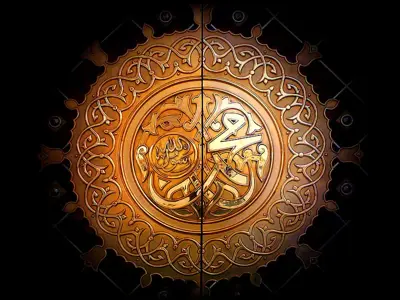
Muhammad was an Arab religious, social, and political leader and the founder of Islam. According to Islamic doctrine, he was a prophet, sent to preach and confirm the monotheistic teachings of Adam, Abraham, Moses, Jesus, and other prophets. He is believed to be the final prophet of God in all the main branches of Islam, though some modern denominations diverge from this belief. Muhammad united Arabia into a single Muslim polity, with the Quran as well as his teachings and practices forming the basis of Islamic religious belief.
