Mohammed II Quotes
Whichever of my sons inherits the Sultan’s throne, it behooves him to kill his brothers in the interest of world order. Most of the jurists have approved this procedure. Let action be taken accordingly.
Mehmet’s father Murat had just died. There was a custom in Islam that the new Sultan have all his brothers executed so that there would be absolute certainty who was the legitimate Sultan and that dissenting forces should not rally around another son of the old Sultan to have a regime change and/or a civil war. Stability and certainty in the line of succession was critical to the Muslims in that the Sultan was not only the civil ruler, but the highest religious authority as well. He had the power of the Christian Pope and the Holy Roman Emperor together. The struggle between the Sunnis and the Shiites which has overwhelmed Islamic unity was originally all about who the successor to Muhammad would be.
Mehmed II, 1432-1481, Ottoman Turkish Sultan, Order to kill his half brother, Ahmet, February 1451
Sourced by: Eigen's Political and Historical Quotations

The Byzantine emissary had pointed out that Mehmed’s predecessors had signed a treaty agreeing to “consult” with Constantinople before building any fortified structure in the area surrounding Constantinople. Mehmed was only 19 years old at this time. His intention f building a fort was to have a platform from which to attack and capture Constantinople itself which he did 2 years later. Earlier, the Eastern Roman Empire was much stronger and the Ottoman sultans were more cautious in dealing with them. However, the various Christian factions were all feuding with each other, and Mehmed II, despite his youth, was much better organized and was a better leader than his predecessors.

This statement was made after he had led the Muslim Ottoman Turkish Army to success in capturing Constantinople—Byzantium, Istanbul—bringing the Byzantine Empire (Eastern Roman Empire) to an end. He had his sights set on the Western Roman Empire next which was the remainder of what they knew of as the world then.

This quotation tells us important facts about the Caliphate in Moorish Spain. First, the Caliphate was not always hereditary. In this case the Caliph was picking his own successor who was not of his own family. In addition, there was some meritocracy expected by the Muslim population. Hisham had to extol the virtue of his selection. Last, nobility and high birth was not an absolute requirement. Hisham tells the people that he has searched both the aristocracy and the commoners looking for the right candidate. Actually, the successor had none of the virtues attributed to him. He was a dishonest scoundrel of the worst sort. The Caliph was very weak, and Abd Al-Rahman al Sanchol not only persuaded the Caliph to name him successor, but many historians believe that al Sanchol actually wrote the proclamation that Hisham II read.

Pasha Muhammed Ali was the Ottoman Overlord of Egypt and Syria. He is an unusual example of a leader who was a realist relative to the skills and abilities of his family for succession. His family indeed could not hold Egypt.
He had tripled the size of Rus, pulling together the disparate areas which had been under the thrall of the Golden Horde. The custom was when the Grand Prince died he left parts of his dominion to each of his sons and grandsons. However. Ivan changed that pattern and wanted one son to be the ruler over all of what was becoming a large unified state. After that his pattern was followed by all the Czars until the Russian Communist Revolution in 1917." Ivan the Great

The import of this quotation is to see how matter of fact, atrocities by our standards, were committed in the earlier times. “Beys” was an Ottoman term for a class of nobles.


Bulgaria was under the control of the Ottoman Turkish Empire. Levski always made it clear that Muslims were welcome in the Bulgaria that would be created after the Revolution. Most Muslims did not believe him, and many could not understand the concept of a nation without the Sultan who was the political AND religious head of Islam the world over. Essentially for many Muslims there can be no such thing as separation of church and state. To two cannot be distinct.

Khomeini was a politician as well as a cleric. He was not always consistent depending on his audience. This book was the publication of 17 different speeches with different audiences. Here he opposes all monarchy, but there is little doubt that his main target was the monarchy of Saudi Arabia. In {620335} he suggests that monarchy would be acceptable if the monarch followed Islamic law. Here he leaves no room for monarchies of which there were and are a number in the Muslim world. And at the height of Islam there was a Caliph who not only had absolute rule of ALL Muslim countries, but he was the absolute ruler of the religion. The Caliph and later the Islamic Sultan held more absolute power than any king or Pope ever had. Most of the Islamic fundamentalists claim that they want a return to having a Caliph with absolute power. And even in Iraq today, the “Supreme Leader” exercises more autonomous power, than any monarch or dictator does in his own country.


This is an amazing quotation in the sense that it shows the absolute manner in which the Ottoman Turkish Empire ruled the Islamic World in the Middle East and North Africa. The Sultan and Caliph had absolute rule over both the civil and religious areas of the Islamic world. In this decree, the Caliph actually gave an entire nation to his loyal servant, Muhammad Ali, who had acted as Governor of Egypt for the Sultan. Muhammad Ali was neither a Turk or an Egyptian. He was an Albanian, racially and ethnically totally different from the nation that became his. From then on, Muhammad Ali’s children would inherit the Egyptian throne. And they did and his dynasty lasted until the revolution in 1923. The Ottoman Empire was far more controlling and arbitrary than the British Empire and lasted much longer as the Ottoman Caliph controlled the Islamic religion as well as the civil nations.

Describing the Muslim concept of a just ruler.


The Nigerian Government was very slow in making a policy to protect communities against the Boko Haram, fundamentalist Islamic terrorists. The Nigerian army was totally corrupt with no interest in risking their lives, so they would rarely go after the terrorists or interpose themselves between the terrorists and their targets even when they had advance knowledge.

This is an amazing speech which illustrated the best of the development and growth of Islam. Note that: The ruler who has just been given ALL secular AND religious power admits candidly that he may not be the best qualified. This would not happen for over another 1000 years and even today is very rare in any society. In addition, he invites the citizens to correct him when he is wrong. Later, Calihs would, like the Christian kings and popes claim infallibiity and kill any who suggested otherwise. And daring to correct the ruler was capital offence for most of history and is even dangerous in some Muslim countries today. Last and perhaps most amazing, the new Caliph called for an affirmative leveling of the inequality of rights and power and announces it asa one of his major responsiblities. It is this kind of vision so unheard of at the time which shows us why so many flocked to Islam at the time. From a fairness, human rights, and accoutabiity of the ruler point of view Islam was the most modern of the religions then. Tragically, other forces shaped Islam for the next 1500 years and most Muslim countries become the least modern and its rulers are least accountable to the citizenry with none of the other rights and concept of fairness that Abu Bakr and other early Islamic leaders brought.


This treaty was an attempt to end the 100 Years War.
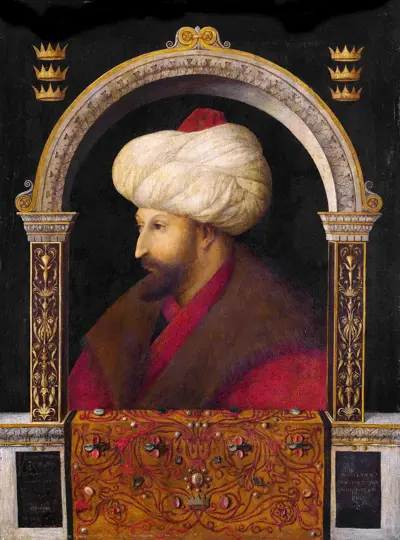
Mehmed II, commonly known as Mehmed the Conqueror, was an Ottoman sultan who ruled from August 1444 to September 1446, and then later from February 1451 to May 1481. In Mehmed II's first reign, he defeated the crusade led by John Hunyadi after the Hungarian incursions into his country broke the conditions of the truce Peace of Szeged. When Mehmed II ascended the throne again in 1451 he strengthened the Ottoman navy and made preparations to attack Constantinople. At the age of 21, he conquered Constantinople (modern-day Istanbul) and brought an end to the Byzantine Empire.
