Ruhollah Khomeini Quotes
Islam proclaims monarchy and hereditary succession wrong and invalid. When Islam first appeared in Iran, the Byzantine Empire, Egypt, and the Yemen, the entire institution of monarchy was abolished.
Khomeini was a politician as well as a cleric. He was not always consistent depending on his audience. This book was the publication of 17 different speeches with different audiences. Here he opposes all monarchy, but there is little doubt that his main target was the monarchy of Saudi Arabia. In {620335} he suggests that monarchy would be acceptable if the monarch followed Islamic law. Here he leaves no room for monarchies of which there were and are a number in the Muslim world. And at the height of Islam there was a Caliph who not only had absolute rule of ALL Muslim countries, but he was the absolute ruler of the religion. The Caliph and later the Islamic Sultan held more absolute power than any king or Pope ever had. Most of the Islamic fundamentalists claim that they want a return to having a Caliph with absolute power. And even in Iraq today, the “Supreme Leader” exercises more autonomous power, than any monarch or dictator does in his own country.
Ruhollah Khomeini, 1900-1989, Iranian High Cleric (Ayatollah) & Revolutionary Leader, Islam and Revolution
Sourced by: Eigen's Political and Historical Quotations

Here Khomeini takes the classic Islamic view of the Koran that leaders should be obeyed unless they do not follow Islam. To the leaders of Islamic nations, this means that even if the state is not a theocracy, the Muslim clergy has the final say as to whether a ruler may justly remain in power since they are the ones who determine if a ruler is properly following Islam.

The last Caliph of the Muslims was removed in 1924 as part of the Turkish Reform. The position has had attraction for many Muslim leaders who saw themselves in the role, but since 1924, nationalism and modernism and the lack of an effective international Muslim leader has precluded it. This anti-revolutionary sentiment of the Islamic political state that is so traditional, may in part account for the Islamic tolerance of autocratic regimes. Note that the distinction between religious responsibilities and civil are important. Tyranny must be tolerated but not blasphemy or heresy. Traditional Muslims provide more tolerance and forbearance for a leader’s civil failings than religious. But Muslims were not the only people to do this. A British prime minister had a view with the same conservative logic. See {639130}. The ancient Jewish Macabean revolt against the Jewish king was all based on failure to perform required religious duties of sacrifice as opposed to tyranny and poor government which also existed. Popes excommunicated Kings for religious reasons, not because of their civil failures at governing. Holding rulers accountable for civil performance is a relatively new concept yet is indispensible in a modern democracy.
The last Caliph of the Muslims was removed in 1924 as part of the Turkish Reform. The position has had attraction for many Muslim leaders who saw themselves in the role, but since 1924, nationalism and modernism and the lack of an effective international Muslim leader has precluded it.

This is a very important quotation as it focused on one critical difference between historical Islam and all the other major religions and fundamentally on the separation between church and state. In Islam there was a Caliph who was both the political ruler and the religious ruler. In comparison at the time, the Christians had a Holy Roman Emperor who was theoretically the overlord of all the Christian Kings but in reality he really could not exercise total or even much authority over all the other kings. At the same time, there was the Pope who was the religious leader of all the Christians. Since the distinction between Church and state was constantly in flux, the Christian Pope and Holy Roman Emperor were often at odds. The third Abrahamic religion, Judaism, had neither a secular leader or a religious one and no hierarchy other than local. Khaldun observed the theoretical advantage of Theocracy as a model, however he did not analyze the disadvantages among which were the assassination of many Caliphs and the laces. Even the Muslim Arabic states abandoned the idea of a Caliph in modern times until Iran adopted a Theocracy with a single Leader all powerful. However, all the other Arab nations wanted no part of a singular leader for all Muslim nations or even a single civil and religious leader within any other country. Al Qaeda however claimed to be fighting for a return to a Caliphate not only for the current Islamic Nations but for all nations which must be subservient to Islam.


This is an amazing quotation in the sense that it shows the absolute manner in which the Ottoman Turkish Empire ruled the Islamic World in the Middle East and North Africa. The Sultan and Caliph had absolute rule over both the civil and religious areas of the Islamic world. In this decree, the Caliph actually gave an entire nation to his loyal servant, Muhammad Ali, who had acted as Governor of Egypt for the Sultan. Muhammad Ali was neither a Turk or an Egyptian. He was an Albanian, racially and ethnically totally different from the nation that became his. From then on, Muhammad Ali’s children would inherit the Egyptian throne. And they did and his dynasty lasted until the revolution in 1923. The Ottoman Empire was far more controlling and arbitrary than the British Empire and lasted much longer as the Ottoman Caliph controlled the Islamic religion as well as the civil nations.

The Caliph in the past was the religious and secular leader of all Muslims. Many of the fundamentalist terrorists have as their objective, the reestablishment of the Caliphate which will unite all Islamic countries under one leader who is both the secular and religious supreme authority—a religious and a civil dictatorship. Most Muslims, like most people of all religions, are not terrorists and believe that much of terrorist activity violates many basic tenets of Islam. However, in order to function, the terrorist must have the tacit support of sufficient numbers of people so that they can function without being exposed. That is an important objective for Al-Qaeda: to enlist sufficient numbers of ordinary people who although they will not commit the terrorist acts, will support the objectives of the terrorists and provide money, shelter, and other services.


The caliphate was abolished by the Turkish republic in 1924
This principle explains why so many Islamic governments are monarchies and dictatorships. Islamic legitimacy requires the ruler to be sure that the society functions according to Sharia (Islamic Law). It is better if the ruler is selected by the senior and responsible members of society but that is not required. He could be a king or a dictator. And it is irrelevant how he comes to power under this interpretation so long as he rules following Islamic law. Saudi Arabia is an excellent example of a dictatorial monarchy which is considered legitimate since it follows Islamic law. Some modern Muslims do not support this traditional view and believe that a legitimate ruler must be selected by the will of the people.

His immediate frustration was the title form of address first selected by Congress for the President. See {586767}

The last Calif of the Muslims was removed in 1924 as part of the Turkish Reform. The position has had attraction for many Muslim leaders who saw themselves in the role, but since 1924, nationalism and modernism and the lack of an effective international Muslim leader has precluded it.
The statement so offended the Lords—the highest court of England—that he was imprisoned by the Lords and not released until he had recanted the position. The argument goes on today in many countries incuding the United States.
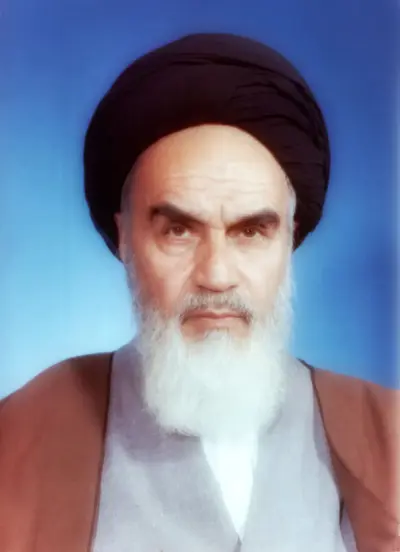
- Born: May 17, 1900
- Died: June 3, 1989
- Nationality: Islam
- Profession: Statesman
Sayyid Ruhollah Musavi Khomeini, also known in the Western world as Ayatollah Khomeini, was an Iranian political and religious leader. He was the founder of the Islamic Republic of Iran and the leader of the 1979 Iranian Revolution, which saw the overthrow of the last Shah of Iran, Mohammad Reza Pahlavi, and the end of the 2,500-year-old Persian monarchy. Following the revolution, Khomeini became the country's Supreme Leader, a position created in the constitution of the Islamic Republic as the highest-ranking political and religious authority of the nation, which he held until his death. Most of his reign was taken up by the Iran–Iraq War of 1980–1988. He was succeeded by Ali Khamenei on 4 June 1989.
