Hisham II Quotes
After searching … high ranks as well as low, the Caliph Hisham has found none more deserving to be his successor or to become the heir to his Caliphate after his death than the trustworthy, honest, and beloved son of Ibn Abi Amir
This quotation tells us important facts about the Caliphate in Moorish Spain. First, the Caliphate was not always hereditary. In this case the Caliph was picking his own successor who was not of his own family. In addition, there was some meritocracy expected by the Muslim population. Hisham had to extol the virtue of his selection. Last, nobility and high birth was not an absolute requirement. Hisham tells the people that he has searched both the aristocracy and the commoners looking for the right candidate. Actually, the successor had none of the virtues attributed to him. He was a dishonest scoundrel of the worst sort. The Caliph was very weak, and Abd Al-Rahman al Sanchol not only persuaded the Caliph to name him successor, but many historians believe that al Sanchol actually wrote the proclamation that Hisham II read.
Hisham II, 966-1002, Andalusian Caliph of Cordoba, Proclamation of Succession to His Caliphate
Sourced by: Eigen's Political and Historical Quotations


The last Caliph of the Muslims was removed in 1924 as part of the Turkish Reform. The position has had attraction for many Muslim leaders who saw themselves in the role, but since 1924, nationalism and modernism and the lack of an effective international Muslim leader has precluded it. This anti-revolutionary sentiment of the Islamic political state that is so traditional, may in part account for the Islamic tolerance of autocratic regimes. Note that the distinction between religious responsibilities and civil are important. Tyranny must be tolerated but not blasphemy or heresy. Traditional Muslims provide more tolerance and forbearance for a leader’s civil failings than religious. But Muslims were not the only people to do this. A British prime minister had a view with the same conservative logic. See {639130}. The ancient Jewish Macabean revolt against the Jewish king was all based on failure to perform required religious duties of sacrifice as opposed to tyranny and poor government which also existed. Popes excommunicated Kings for religious reasons, not because of their civil failures at governing. Holding rulers accountable for civil performance is a relatively new concept yet is indispensible in a modern democracy.
The last Calif of the Muslims was removed in 1924 as part of the Turkish Reform. The position has had attraction for many Muslim leaders who saw themselves in the role, but since 1924, nationalism and modernism and the lack of an effective international Muslim leader has precluded it.
He was referring to Joseph ibn Naghrela, the son of Samuel ibn Naghrela ({623786} & {623774}) The father had been the vizier the King and the son was appointed Secretary to the Muslim King. He was one of the Muslims who were jealous that Jews should have influential positions in a Muslim society.
The caliphate was abolished by the Turkish republic in 1924
The last Caliph of the Muslims was removed in 1924 as part of the Turkish Reform. The position has had attraction for many Muslim leaders who saw themselves in the role, but since 1924, nationalism and modernism and the lack of an effective international Muslim leader has precluded it.
The Caliph was both the religious authority and the civil authority. Islam traditionally sees no desirable separation between church and state.
Many Muslims did not want science and technology to fall into the hands of the heathens. Even today America limits the information and technological products that can be exported to the Islamic nations. At the time it was the case that some Christian and Jewish Scholars translated Islamic scientific treatises and promoted them under their own name, but most of the translations were published and labeled as such .The reason was that at that time Europe was emerging from the Dark Ages and was scientifically relatively ignorant whereas the Muslims had the best scientists and mathematicians in the world. It was more prestigious and credible to attribute science material to Muslims. At the same time, a good bit of the Islamic science texts were translations of the great Greek scientists and some Muslims offered it as their own. Most however translated the Greek works and labeled it as such. Ibn Abdun quotations are very important because he wrote many of the Islamic legal opinions that governed Muslim Spain and influenced the Arabs of North Africa.
His quotations are very important because he wrote many of the Islamic legal opinions that governed Muslim Spain and influenced the Arabs of North Africa. This is yet another example of the classic antipathy that many Muslims have for People of the Book—Christians and Jews.
From a religious point of view a Christian or Jew was cursed, but ibn Naghrela had the respect of most (See {623787} ) and was the most influential citizen of a Golden Era of Muslim Spain. In 1056 he was assassinated by jealous Muslims.
See {623774} for a poem he wrote in Arabic about the battle itself. He had written books in Arabic about Hebrew grammar and language and was the first person to use the Arabic poetic style with its meter and rhyming and used it for writing Hebrew poetry. This poem was so written.
At the time, most Muslims and Jews of Andalusia lived together very amicably. Ibn Hazm was a brilliant scholar of philosophy, law, theology, and science and the leading Islamic intellectual of Andalusia. However, he had one major rival, a Jew named Samuel ibn Naghrela who was just as brilliant a scholar, but also one of the best military leaders, and physicians of the kingdom. (See {623786} & {623774}) Ibn Hazm was very jealous and tried to turn the Muslim Berber King Habbus al-Muzaffar against ibn Naghrela and other Jews. The king however made Samuel ibn Naghrela his hajib (prime minister / vizier) of Grenada in 1037. He was also made military commander and excelled at both areas while continuing his scholarly activity. Samuel ibn Naghrela held his political and military positions for 17 years and both these intellectuals wrote brilliant books in several field which added to the reputation of this era as the Golden Age of Islamic Spain.


Mehmet’s father Murat had just died. There was a custom in Islam that the new Sultan have all his brothers executed so that there would be absolute certainty who was the legitimate Sultan and that dissenting forces should not rally around another son of the old Sultan to have a regime change and/or a civil war. Stability and certainty in the line of succession was critical to the Muslims in that the Sultan was not only the civil ruler, but the highest religious authority as well. He had the power of the Christian Pope and the Holy Roman Emperor together. The struggle between the Sunnis and the Shiites which has overwhelmed Islamic unity was originally all about who the successor to Muhammad would be.

Abu Ja'far Abdallah ibn Muhammad al-Mansur. And al-Rahman had assembled a very powerful army of blond, blue-eyed Slavic slaves supplemented with black African warriors. The Caliph, was always concerned when one of his subjects had an effective fighting force as he might be a rival. But if the troops were Muslims the danger was not so great as there was a built in loyalty to the Caliph. However, in this case, the fierce fighters were not Muslims. Hence the sea was a desirable barrier.

Abd al-Rahman ibn Mu'awiya ibn Hisham ibn Abd al-Malik ibn Marwan. Born near Damascus in Syria, grandson of Hisham ibn Abd al-Malik,Abd al Rahman was the son of the Umayyad prince Mu'awiya ibn Hisham and a Berber mother. He was twenty when his family, the ruling Umayyads, were overthrown by a popular revolt known as the Abbasid Revolution, occurring in the year 750. Abd al-Rahman and a small selection of his family fled Damascus with assassins chasing him. He ended up running to Spain, and there built his incredibly successful dynasty.


Toleration is a relative term. The Muslim Moors made Christians (and Jews) pay a special tax. At times they were forced to wear special clothing so that they could be readily identified. And they could not build churches larger or taller than the smallest mosque in the community. At times, their occupations were restricted but at other times Christians and Jews were appointed to the highest positions like Vizier. The Inquisition, in contrast, forced all Muslims (and Jews) to leave the country without any of their property or money or be tortured and killed—usually by burning at the stake unless of course that they converted to Christianity.

One Islamic belief that has stood since the inception of the religion is that if a true believer who is defending the faith in a jihad is killed, he will immediate be transported to Paradise where he will receive the best of the other world. If a Muslim dies under normal circumstances, he is judged and may or may not attain Paradise depending on his past life. However, if he dies in jihad, all past sins are immediately erased and he is guaranteed Paradise. This quotation is exactly what is told to Muslim fighters and suicide bombers today (see {635766}, {588728} and {590762}) and it is just as effective as ever in persuading men to fight and sacrifice themselves. The Roman Catholic Pope issued a similar edict in the Crusades and fights of both religions were willing and almost anxious to die in battle. In modern times Christian leaders do not make such appeals and if they did, few would believe them.
At the time, the Muslim culture was far more advanced than the Christian. Also, the Roman Catholic Church was very sexually prudish compared with the more modern Arabs, To the distress of the Christian leaders, the Christians of Spain were attracted to the more modern Islamic society. This was just the opposite of today. Since the 9th century, the Muslims have become much more restrictive and prudish in their religion while the Christians and the West have eclipsed them and greatly modernized. So today, it is the Islamic leaders who worry that the Muslims are attracted to Western culture.
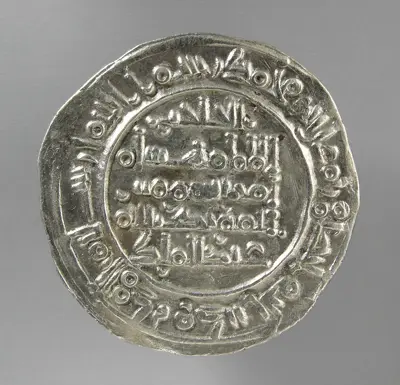
Abu'l-Walid Hisham II al-Mu'ayyad bi-llah (ابو الولید ھشام المؤيد بالله, Abū'l-Walīd Hishām al-Muʾayyad bi-ʾllāh) (son of Al-Hakam II and Subh of Cordoba) was the third Umayyad Caliph of Spain, in Al-Andalus from 976–1009, and 1010–13.
