Robert Toombs Quotes
They all agree, they are all unanimous in Congress, in the States, on the rostrum, in the sanctuary - everywhere they declare that slavery shall not go into the Territories.
Toombs, Robert. Speech of Hon. Robert Toombs, Delivered in Milledgeville, on Tuesday Evening, November 13, 1860, Before the Legislature of Georgia. Boughton, Nisbet & Barnes, State Printers, 1860.


In June of 1850, a bipartisan group of Southern politicians met in Nashville, TN for the purpose of organizing strategy and tactics to ward off and defeat the growing aggressiveness of Northern politicians and other leaders in trying to abolish slavery. They issued an address to the people. This is one of the clearest statements of the position of most of the Southern Politicians on the increased efforts to abolish or curtail slavery. They felt that a deal had been made by the founding fathers and the first Congress not to deal with the slavery issue, and that deal must be honored in perpetuity. Most Northerners agreed that a deal had been made, but it was not binding forever—that a Congress could not limit the scope of a future Congress except via a Constitutional Amendment. The deal on Slavery was a deal not to address it for a while. It was not a deal to accept the Southern point of view. And none of it was written into the Constitution because opinion was even then split and a majority could not be mustered for a compromise that would write legal slavery into the Constitution. But many Southerners believed that its absence implied that it could not be addressed by the government. They demanded the right of their states to choose slavery if they so wished. Time was not on the side of the South and the Southerners who insisted on State’s Rights regarding slavery opposed States Rights for Northern States who wished to disallow fugitive slaves to be returned to owners. The more fugitive slaves there were, the more hypocritical the Southern position became as they needed Federal preemption on the issue of Fugitive Slaves, else slavery would end by escape and non-return of slaves.


Southerners from the slave states wanted California to be admitted to the Union as a slave state. But a large majority of Californians saw that as a terrible alternative. It was argued that the Southern states would never vote to admit California if it were a free state (see {613404}) and in order to make it clear to the South that admission as a slave state was out of the question, this clause was passed at the Constitutional Convention.

as opposed to bringing slaves into the territory of California. There was a recognition that the institution of slavery corrupted the whole society. It therefore was preferable to use Chinese contract labor to diminish agricultural labor costs. If the price of admission to the union was to allow slavery, this paper and its readership would think it too high and would rather be independent.

See {613644} for the earlier decree which this modified.

By not dealing with the issue of slavery early in America’s history when it was a very small economic factor in American society, our ancestors delayed action to the point where the economic factor was the overwhelming practical impediment to abolition.

One of the many complaints that many people made at the time about Smith and his Mormons was that they opposed slavery. In fact, Smith not only opposed it be had a plan for compensating the slave owner and a method for paying for it. Smith was not advocating the kinds of personal lifestyle issues of his church the way modern religious leaders do, but was concerned with the much larger issues of expansionism, corruption of the courts and judiciary, and land distribution. He was a classic reform candidate in that sense. Smith had written to most of the then likely Presidential candidates of both major parties asking for their position on the Mormons who were facing persecution wherever they went. None of the politicians would make any satisfactory commitments. Smith took Direct Action and became the only major religious official to have run for the Presidency of the United States until Pat Robertson tried and failed in 2000. Smith’s assassination shortly thereafter cut his run for the Presidency short before it made much headway and politically he had no chance to affect the race.

Missouri was to be admitted to the Union. But the anti-slavery forces of Congress insisted that slavery be outlawed in the new state. Most Southerners argued that Congress had no right to regulate the slavery issue claiming among other arguments that the fact that slavery had not been regulated in the Constitution or the Bill of Rights was evidence of the agreement of the founding fathers that slavery was never to be interfered with. However the specific agreement on the subject called for no legislation on slavery to be debated in Congress in its early years, but the time of that agreement was up. The “Missouri Compromise” ended the debate for a short time. Niles knew his fellow Southerners and felt that Civil War was coming and strived to hold the Union together by compromise even though he was a personal opponent of slavery.

This quotation illustrates the strong abolitionist tendency in the Ohio Territory. Under this clause, escaped slaves from Southern states would not be returned by the state authorities. Even more insulting to the slave enthusiasts of the South, if a Southerner brought any slaves into Ohio with them as was common for Southerners traveling with their personal slaves or horse team drivers, those slaves would be free. An interesting aspect of this clause of the Ohio Constitution was that the beginning was, word for word, copied from the Northwest Ordinance of 1787. See {618100}.

See {633926} for a quotation from the text that transmitted the resolution.


As a key member of Lincoln’s cabinet, William H. Seward was most concerned with preserving The Union. However, since the Constitution was written in 1787, there had been compromises made with the pro slavery forces of the South to give them proportionally more political power and to avoid interfering with the institution of slavery. The Dred Scott Supreme Court decision forced the Northern States to actively cooperate in enforcing and maintaining slavery. Large numbers of abolitionists had reached their limit and wanted no more compromises regarding slavery. Mrs. Seward was one of those. This quotation also illustrates the influence that some women had in politics even though women could not vote. Frances Seward was very much a political partner with her husband who was favored to beat Lincoln for the Republican Presidential nomination.

The National Enquirer was originally a serious abolitionist newspaper, not the sensationalist tabloid it became in modern times.

In February of 1861, in a last ditch effort to hold the Union together the Senator offered this proposed Constitutional amendment which would not only guarantee the existence of slavery in the South, but would assure that there could be no later Constitutional amendment to do so—the so-called "unamendable amendment." Surprising to us today is the fact that this amendment was not only supported by incoming President Abraham Lincoln, but was passed by the required two-thirds of both houses of Congress. However, before it could be ratified by the States, events overtook the amendment, the South seceded, and the Civil War began.
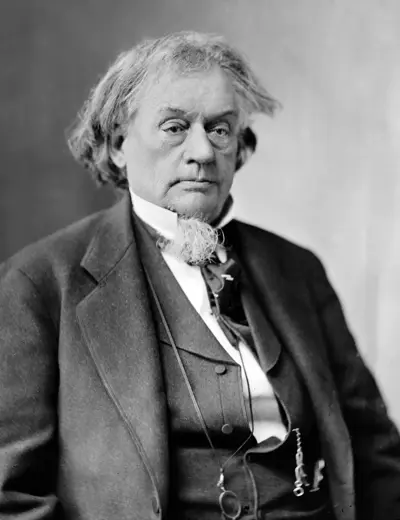
Robert Augustus Toombs was an American lawyer, planter, and national politician from Georgia who became one of the organizers of the Confederacy and served as its first Secretary of State under President Jefferson Davis. He also served in the Confederate States Army, but later became one of Davis' critics. After the Confederate defeat, Toombs fled the United States. He did not return until 1867, after his daughter's death. He regained political power in Georgia as Congressional Reconstruction ended in 1877.
