California Quotes
Neither slavery nor involuntary servitude unless for the punishment of crime shall ever be tolerated in this state
Southerners from the slave states wanted California to be admitted to the Union as a slave state. But a large majority of Californians saw that as a terrible alternative. It was argued that the Southern states would never vote to admit California if it were a free state (see {613404}) and in order to make it clear to the South that admission as a slave state was out of the question, this clause was passed at the Constitutional Convention.
California, Constitutional Convention while California was still a territory
Sourced by: Eigen's Political and Historical Quotations

See {613416} for the clause that the Southerners found so offensive.


What was particularly interesting about this quotation is that Pinkney was a political leader of Maryland, a slave state. He saw the injustice and immorality of slavery but like many others of our founding fathers assumed that ending slavery would infringe on the property rights of the slave holders. Others argued that there can be no right to deny others their basic rights—property and wealth are subordinate to natural rights. See {632258} and {632259} for more on this point.


Southern secession and the Civil War This is one of the major quotations with which historians rebut the revisionist view that the Civil War was about States’ Rights or other economic factors.


Baron Brougham and Vaux

as opposed to bringing slaves into the territory of California. There was a recognition that the institution of slavery corrupted the whole society. It therefore was preferable to use Chinese contract labor to diminish agricultural labor costs. If the price of admission to the union was to allow slavery, this paper and its readership would think it too high and would rather be independent.


Negotiations regarding the exchange of prisoners and property. This was his view of his supposed obligation to return Negro slaves who had escaped and gone to the British during the war. The treaty of peace specified that all “property” including slaves, taken by, the British be returned to the Americans. But he and other officers did not always do so as they thought they had higher moral obligations. See {621936} for example.


In the first article of its first Constitution Vermont banned slavery and indentured servitude. Delaware had previously done it. See {621427}

Brown was the richest man in Rhode Island and made much of his money in the slave trade. This quotation shows that slavery was not completely a North verses South split. Northerners like Brown for whose family Brown University was named, was as virulent supporter of slavery as the most ardent Southerner.

As an entertainer she had toured much of the world and seen American slavery and that of some other nations. She became a staunch abolitionist and like entertainers in the 20th and 21st centuries she used her celebrity to give anti-slavery lectures and perform for audiences where she donated the proceeds of the event to the abolition cause. She is a particularly interesting political figure in that she seems to be one of the first entertainers to perform for a social cause and become an activist.

This law required the treatment of Blacks as whites were then treated with respect to indentured servitude—a limit of 10 years after which the person would be free. However, this law was poorly enforced. The “General Court” was the name for the legislature of the Rhode Island colony.

In April, 1784, the Continental Congress passed a series of laws that Jefferson had drafted for the NorthWest territory—Ohio then being the west and the states that would develop there. However, the quotation is the clause that the Southern States blocked and hence did not become law, as the Soothers states cared little about the status of the area regarding slavery, but feared that the new states wold become a sanctuary for runaway slaves. It was another case where Jefferson attempted to end slavery. It also was yet another example of the unwieldiness of the Continental Congress to manage the new nation which led up to the Constitutional Convention of 1787. Ironically, as a price for union, the Southern States demanded and obtained a disproportionate representation in the New House of Representatives by having 60 percent of their slaves counted inzallocating congressional seats. The senate also worked in their favor as there were enough Southern states to block any attack on slavery in the Senate. There was no democratic way to eliminate slavery and the Civil War resulted. However, Jefferson’s proposed law was passed by the last Continental Congress in June, 1787. The difference was that there was also added a proviso that required the return of all runaway slaves from the new territory and states which was lacking in the earlier attempt.


- Born:
- Nationality:
- Profession:
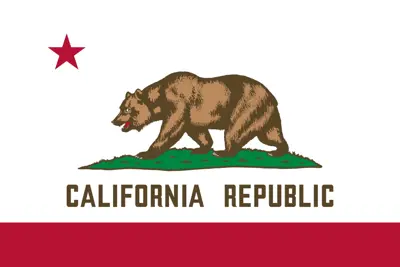
California is a state in the Western United States. With over 39.3 million residents across a total area of approximately 163,696 square miles (423,970 km2), it is the most populous and the third-largest U.S. state by area. It is also the most populated subnational entity in North America and the 34th most populous in the world. The Greater Los Angeles area and the San Francisco Bay Area are the nation's second and fifth most populous urban regions respectively, with the former having more than 18.7 million residents and the latter having over 9.6 million. Sacramento is the state's capital, while Los Angeles is the most populous city in the state and the second most populous city in the country (after New York City). Los Angeles County is the country's most populous, while San Bernardino County is the largest county by area in the country. San Francisco, which is both a city and county, is the second most densely populated major city in the country (after New York City) and the fifth most densely populated county in the country, behind four of New York City's five boroughs.
