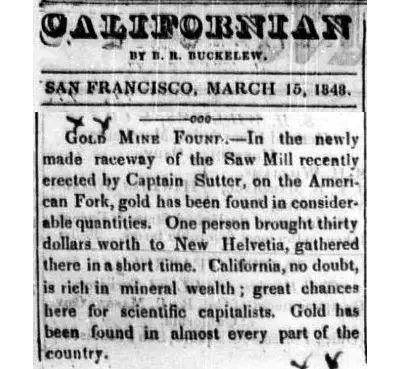
The Californian Quotes
If white labor is too high for agriculture, laborers on contract may be brought from China …. 97-100 of the present population are opposed to it [slavery] …. We left the slave states because we did not like to bring up a family in a miserable, can’t-help-one’s-self condition, … as dearly we love the union, we would prefer California independent to seeing her a slave State.
as opposed to bringing slaves into the territory of California. There was a recognition that the institution of slavery corrupted the whole society. It therefore was preferable to use Chinese contract labor to diminish agricultural labor costs. If the price of admission to the union was to allow slavery, this paper and its readership would think it too high and would rather be independent.
The Californian [Newspaper], May, 1848
Sourced by: Eigen's Political and Historical Quotations

Southerners from the slave states wanted California to be admitted to the Union as a slave state. But a large majority of Californians saw that as a terrible alternative. It was argued that the Southern states would never vote to admit California if it were a free state (see {613404}) and in order to make it clear to the South that admission as a slave state was out of the question, this clause was passed at the Constitutional Convention.

Ruffin is more widely known as the man who fired the first shot of the Civil War.


As a key member of Lincoln’s cabinet, William H. Seward was most concerned with preserving The Union. However, since the Constitution was written in 1787, there had been compromises made with the pro slavery forces of the South to give them proportionally more political power and to avoid interfering with the institution of slavery. The Dred Scott Supreme Court decision forced the Northern States to actively cooperate in enforcing and maintaining slavery. Large numbers of abolitionists had reached their limit and wanted no more compromises regarding slavery. Mrs. Seward was one of those. This quotation also illustrates the influence that some women had in politics even though women could not vote. Frances Seward was very much a political partner with her husband who was favored to beat Lincoln for the Republican Presidential nomination.


One of the many complaints that many people made at the time about Smith and his Mormons was that they opposed slavery. In fact, Smith not only opposed it be had a plan for compensating the slave owner and a method for paying for it. Smith was not advocating the kinds of personal lifestyle issues of his church the way modern religious leaders do, but was concerned with the much larger issues of expansionism, corruption of the courts and judiciary, and land distribution. He was a classic reform candidate in that sense. Smith had written to most of the then likely Presidential candidates of both major parties asking for their position on the Mormons who were facing persecution wherever they went. None of the politicians would make any satisfactory commitments. Smith took Direct Action and became the only major religious official to have run for the Presidency of the United States until Pat Robertson tried and failed in 2000. Smith’s assassination shortly thereafter cut his run for the Presidency short before it made much headway and politically he had no chance to affect the race.

Missouri was to be admitted to the Union. But the anti-slavery forces of Congress insisted that slavery be outlawed in the new state. Most Southerners argued that Congress had no right to regulate the slavery issue claiming among other arguments that the fact that slavery had not been regulated in the Constitution or the Bill of Rights was evidence of the agreement of the founding fathers that slavery was never to be interfered with. However the specific agreement on the subject called for no legislation on slavery to be debated in Congress in its early years, but the time of that agreement was up. The “Missouri Compromise” ended the debate for a short time. Niles knew his fellow Southerners and felt that Civil War was coming and strived to hold the Union together by compromise even though he was a personal opponent of slavery.


As late as 2005 Saudi Arabia was officially listed by the State Department as trafficking in women for sexual exploitation and domestic servitude.

Gusley had been captured by the Confederates and was in a prison camp. Richardson published Gusley’s diary and Southerners were surprised to find that this Yankee who had been bombarding them from a ship was very similar to them in many ways including slavery but saw the situation regarding succession as worth fighting for preservation of the Union.

Baldwin was a young lawyer at the time. He represented a shipload of ex-slaves who had taken over their Spanish slave ship and landed in America. The Spanish claimed, the ship owners and some of the crew all claimed the “property.”


The issue of slavery which had been suppressed in Congress for the first decades of the nation broke out when Missouri was considered for statehood. By previous agreement, slavery was not even discussed in Congress but the time period elapsed. Tallmadge not only proposed that no more slaves could come into Missouri but most shocking to the Southerners was that every person born in the new state would be free at the age of 25. In a generation, there would be no more slavery in Missouri and there would be no economic compensation for slave owners at all. The House of Representatives accepted the amendment, but it failed in the Senate. At that time, Senators were not elected by voters but were appointed by the state legislators and the Southern slave states had a disproportionate share of the senate from a population point of view. But what this quotation shows clearly that a majority of the country in 1819 were opposed to slavery and were willing to end it without compensation.

See {613416} for the clause that the Southerners found so offensive.

Baron Brougham and Vaux

Fitzhugh was a Southern iconoclast whose view of Northern labor was much like that of Karl Marx but who was an enthusiastic supporter of slavery. Fitzhugh was of the opinion that slavery would be reinstated in the North and his treatise agues for that. More and more intellectual opinion was coming to the conclusion that slavery must be abolished or made universal before Lincoln’s famous statement in his debate against Douglas. Although Northerners and Southerners had come to agree on this point, they disagreed about which alternative would and should prevail.