William Rawle Quotes
The effect of a treaty on state constitutions and state laws cannot be questioned. Without considering whether it operates directly as a repeal of them, we are warranted in saying that an act done under a state law, in opposition to a treaty, cannot be set up as a legal bar to a proceeding founded on a treaty.
This constitutional interpretation is what has caused many conservative Americans to generally oppose treaties and trade pacts. They claim that U. S. sovereignty is whittled away whenever a treaty is signed. And a treaty can possibly not only nullify state law in some instances, but prevent a state from legislating in a given area. The number of treaties and international agreements that American Presidents have signed but Congress would not ratify is quite large.
William Rawle, 1759–1836, Attorney & Constitutional Scholar, A View of the Constitution of the United States, 1825
Sourced by: Eigen's Political and Historical Quotations


Commonly referred to as the Kentucky Resolution. This concept of Nullification was one of the factors that aggravated the tensions leading to the Civil War. Were the individual States to be the arbiters of whether or not a Federal act was Constitutional or was it to be the Supreme Court.

On June 12, 1789 a Senate committee proposed a federal court system for the nation. Maclay described it as:


Soon after Jackson's reelection, delegates from South Carolina, led by John C. Calhoun, moved quickly to declare "null, void, and no law" the Tariff Act of 1832. The president's reaction to the Ordinance of Nullification was swift.
Jackson was reacting to the claimed right of South Carolina to nullify Federal tariffs and other Federal laws.


The Constitution was not drafted until 1787 and was ratified later. In the interim the young United States functioned under the Articles of Confederation, in a sense, our first Constitution. This clause established that the Federal Government should have the exclusive power and authority to conduct foreign affairs.


Bolton had an idealistic view of the sanctity of treaties. For a more sophisticated “realpolitic” view, see {138034} .


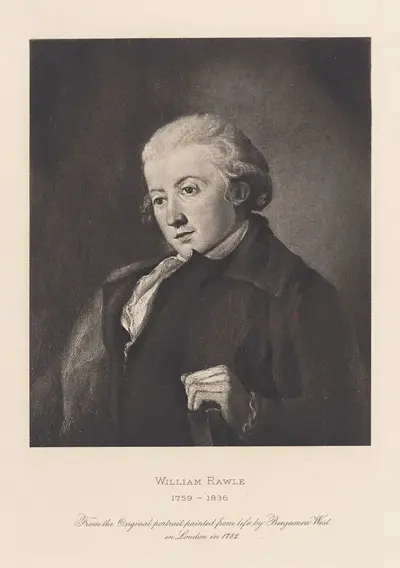
William Rawle was an American lawyer in Philadelphia, who in 1791 was appointed as United States district attorney in Pennsylvania. He was a founder and first president of the Historical Society of Pennsylvania, president of the Pennsylvania Abolition Society, and for 40 years a trustee of the University of Pennsylvania.
