John Bolton Quotes
How do you deal with these countries which have happily signed all these treaties and are just as happily violating them…. They have signed solemn treaties agreeing not to do what they are doing.
Bolton had an idealistic view of the sanctity of treaties. For a more sophisticated “realpolitic” view, see {138034} .
John Bolton, United States Representative to the United Nations (Republican), Under Secretary of State for Arms Control and International Security, Speech, December 2, 2003
Sourced by: Eigen's Political and Historical Quotations

See linked quotes for a North Korean example.

Advocating a multinational treaty on drug enforcement:


The United States Senate must ratify all treaties before they can become effective. The Senate has been very reluctant to ratify treaties where the U. S. government or any of its citizens could come under the jurisdiction of any legal entity which did not abide by all the rights citizens are guaranteed by the U. S. Constitution. As a result, we do not recognize the World Court and the Treaty of Rome for example. The latter is the one that gives the World Court jurisdiction over a high level official who commits war crimes even in his own country. The result is that many dictators who do not want to be constrained by international law, do not sign the treaty fending off any pressure to do so by pointing to the United States. But Rothkopf and others who agree with him have not yet been able to come up with a mechanism that will assure American Constitutional rights to Americans who might be involved with the World Court and allow the court to punish the dictators who abuse their own population. The French would like their laws and constitution to control. The Russians, theirs. The Chinese, theirs. Every American public official takes an oath to defend The Constitution. That is their primary duty. Foreign policy and punishing international war criminals must take a lower priority.


The minister had refused to be pressured by the George W. Bush Administration to sign an agreement with the US agreeing never to turn over an American or a foreign national working for America to the International Criminal Court (ICC). Even if a Peruvian or other non-American were working for an American Agency as an informant, agent, or other role, the country could not respect the treaty obligations that they had already made with regard to the ICC. Peru was “punished” losing $4 million aid. Nations were so “punished” while the State Department was spending huge sums to remedy negative opinion that so many nations had developed for the US during the George W. Bush administration. See {585493},65901 & {585496}, for more quotations on this. The US did not join the ICC Treaty as in some countries political considerations and different ethical values have labeled some American legitimate behavior as criminal and have attempted to hold individuals responsible for carrying out lawful orders. So many foreigners could understand the United States not wanting to deny Americans and others in the United States the protection of the United States Constitution, there was ire at the US pressuring others to boycott the ICC and break their existing treaties.


The Constitution was not drafted until 1787 and was ratified later. In the interim the young United States functioned under the Articles of Confederation, in a sense, our first Constitution. This clause established that the Federal Government should have the exclusive power and authority to conduct foreign affairs.


See {585493},65902, and {585496}, for more quotations on this.

Dulles lied to Congress. The CIA at the time was supplying planes and American pilots in support of an anti-Sukarno Government faction that was in armed revolt. It is not clear whether or not Dulles knew the truth when he had so testified.


The basic treaty sold some of Ethiopia’s colonial territory (Eritrea and Tigray) to Italy in exchange for arms. Italy had tried to conquer the area but lost 500 men in the Battle of Dogali. However, after this peace treaty, Italy maintained that Article 17 of the treaty gave them the right to declare Ethiopia an Italian Protectorate which they did. However, there were two different versions of the treaty that the Italians had drawn up—one in Italian, the other in Aramaic. Britain, Belgium and Germany supported Italy; France, Turkey and Russia supported Ethiopia. Menelik then, to make matters clear, repudiated the treaty in 1893. Italy send an invasion force that was soundly thrashed by the Ethiopians setting the stage for the Italian attack on Ethiopia in World War II years later. Parties to International treaties thereafter have paid close attention to the different language versions.
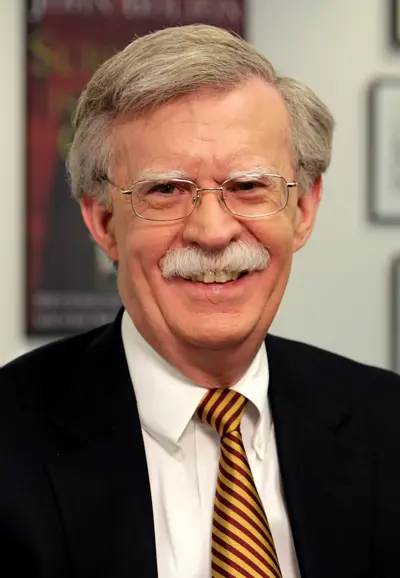
- Born: November 20, 1948
- Nationality: American
- Profession: Statesman
John Robert Bolton is an American attorney, diplomat, Republican consultant and political commentator who served as the 25th United States Ambassador to the United Nations from 2005 to 2006 and as the 27th United States National Security Advisor from 2018 to 2019.
