Dwight D. Eisenhower Quotes
No treaty or international agreement can contravene the Constitution.
Eisenhower, Dwight D. "The President's News Conference." Public Papers of the Presidents of the United States: Dwight D. Eisenhower. Office of the Federal Register.

This constitutional interpretation is what has caused many conservative Americans to generally oppose treaties and trade pacts. They claim that U. S. sovereignty is whittled away whenever a treaty is signed. And a treaty can possibly not only nullify state law in some instances, but prevent a state from legislating in a given area. The number of treaties and international agreements that American Presidents have signed but Congress would not ratify is quite large.


The Presidential election of 1800 produced a crisis even greater than that of 2000. There was an Electoral College tie between Thomas Jefferson and Aaron Burr—both of the same party, Democratic Republicans. The Federalist Party led by President John Adams had been totally rejected by the voters and Adams was in third place. However, the Federalists saw an opportunity of maintaining the Presidency anyway. The Constitution threw the election into the House of Representatives with each State delegation having a single vote. In the House, the Federalists had parity with Jefferson’s party which resulted in 35 tie votes. Finally, Congressman Bayard, the sole Congressman from Delaware, withheld his vote on the 36th ballot, thereby electing Thomas Jefferson of the opposition party. His reason was:


See {632309} for an similar French Political expression made at approximately the same time over an important principle. However, commerce in its many forms such as business and job creation has been the major reason for compromising important moral and political principles during much of recorded history.


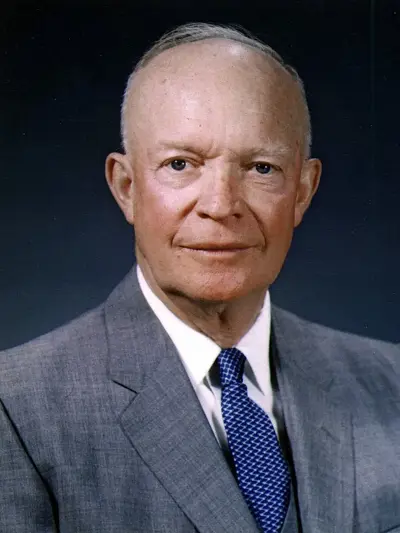
Dwight David "Ike" Eisenhower GCB OM GCS CCLH KC NPk was an American military officer and statesman who served as the 34th president of the United States from 1953 to 1961. During World War II, he became a five-star general in the Army and served as Supreme Commander of the Allied Expeditionary Force in Europe. He was responsible for planning and supervising the invasion of North Africa in Operation Torch in 1942–43 and the successful invasion of Normandy in 1944–45 from the Western Front.
