William H. P. Blandy Quotes
The bomb will not start a chain-reaction in the water converting it all to gas and letting the ships on all the oceans drop down to the bottom. It will not blow out the bottom of the sea and let all the water run down the hole. It will not destroy gravity.
What makes this quote important historically is to realize the assurances that he had to give the press and the public. This shows the level of anxiety about nuclear science that existed at the time and some of the absurd claims that critics and skeptics made. While it was true that there were same dangers in the nuclear testing, some of which the authorities were ignorant of, they were not of the expansive catastrophic magnitude that the critics claimed. Almost all new science and technology develops a Luddite community of opponents who want the technology stopped or at least slowed much. These opponents almost always exaggerate dangers in order to alarm public opinion via fear. At the same time, almost all the new scientific arenas eventually display and disclose problems and potential dangers of which the scientists and policy makers originally unaware. But they are almost always different from those the original critics claim. For example instead of environmental concern for radiation caused mutations in the animal life or the problem of what to do with radioactive byproducts of making atomic weapons, the warnings were that the water would flow out of the oceans and that gravity would be nullified.
William H. P. Blandy, 1890-1954, Navy Amiral, Commander Joint Task Force One in Operation Crossroads, Statement before the atomic bomb tests at Bikini Island in the Pacific Ocean
Sourced by: Eigen's Political and Historical Quotations

The Scientific Project that developed the Atomic Bomb. In the development of the atomic bomb there was a hypothetical possibility that the Earth as we know it might be destroyed. Robert Oppenheimer the scientist who directed the bomb development and his staff framed the question which Oppenheimer presented to Arthur Compton. The decision was that Oppenheimer’s team would calculate every possibility and make sure that such a catastrophe was not within the realm of possibility. They did all the calculations, concluded that there was no possibility, the bomb was exploded, and the question was then finally answered in the negative.


This was the first Russian atomic explosion.


Within a few months 11,021 scientists, of forty-nine countries also signed the appeal.

This is one of the earliest uses of the phrase “weapons of mass destruction.” Panneloek quoted it in 1948, so it was used by Urey before then.


Leaders of the nuclear powers were uttering nonsense like this to keep public fear of nuclear war to a minimum. See {618658} and {618657}.

This declaration, drafted by Russell and Einstein two days before Einstein’s death was signed by a number of other prominent scientists.

The Scientific Project that developed the Atomic Bomb. After the development of the atomic bomb there were great pressures on the involved scientists to downplay the dangers of nuclear weapons development. The weapons developer arm of the government was anxious not to frighten the public which might call for more oversight or even limitation of development and testing. Equally important was the scientists themselves who understood the forces that they had unleashed and were worried that if the public realized the worst of the possibilities, science and scientific research itself might be in jeopardy from a new Luddite reaction. Oppenheimer urged candor with the public. Most scientists took his advice but the Atomic Energy Commission had become politicized and when Oppenheimer went public with his and others scientific concerns they punished him by calling him a security risk and withdrawing his clearance thus cutting him off from new developments and discrediting him and his views at the same time.
The Scientific Project that developed the Atomic Bomb

Morrison was then a graduate student of Oppenheimer. The quotation is important, not because it shows how quickly the “father of the atomic bomb” realized that a nuclear bomb could be made and how, but how relatively easy and rapid it was for a competent theoretical physicist could conceptually design a nuclear weapon if they first had knowledge of the Hahn / Strassmann Experiment and the Meitner / Frisch explanation of what had happened ({640924}). Note Leo Szilard’s letter at about the same time--{640925}.

Quoting the Baghavad-Gita at the first atomic bomb test, Alamogordo, NM, July 16, 1945


The article showed how a nuclear bomb worked. The Government attempted to suppress the publication by getting a Federal court injunction. Day and others claimed the article was based on public sources. It was. The U. S. Court of Appeals lifted the injunction and the article was published.


The Iranian religious theocrat of Iran sees the issue as one where the United States is trying to keep nuclear technology from Iran and other Islamic countries. He seems to discount his own often uttered calls for “death to America” and the statements of intended war with the United States by the leading military officer of Iran. See {624408}.
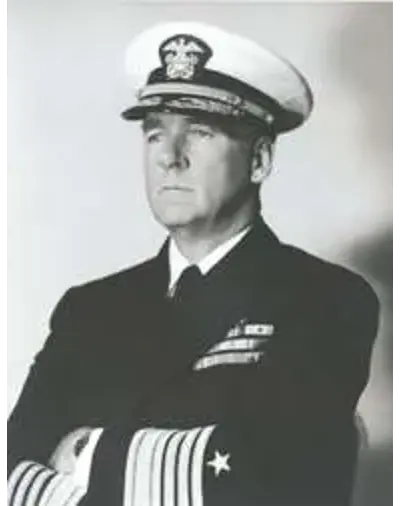
William Henry Purnell Blandy, known to friends as "Spike", was an admiral in the United States Navy during World War II.
