J. Robert Oppenheimer Quotes
It will not help to rub the edges off this new terror that we have helped bring to this world.
The Scientific Project that developed the Atomic Bomb. After the development of the atomic bomb there were great pressures on the involved scientists to downplay the dangers of nuclear weapons development. The weapons developer arm of the government was anxious not to frighten the public which might call for more oversight or even limitation of development and testing. Equally important was the scientists themselves who understood the forces that they had unleashed and were worried that if the public realized the worst of the possibilities, science and scientific research itself might be in jeopardy from a new Luddite reaction. Oppenheimer urged candor with the public. Most scientists took his advice but the Atomic Energy Commission had become politicized and when Oppenheimer went public with his and others scientific concerns they punished him by calling him a security risk and withdrawing his clearance thus cutting him off from new developments and discrediting him and his views at the same time.
J. Robert Oppenheimer, 1904-1967, Physicist and Scientific Director of the Manhattan Project Speech to fellow scientists after he had let the development of the atomic bomb, Played at The National Book Festival, September 30, 2006
Sourced by: Eigen's Political and Historical Quotations


What makes this quote important historically is to realize the assurances that he had to give the press and the public. This shows the level of anxiety about nuclear science that existed at the time and some of the absurd claims that critics and skeptics made. While it was true that there were same dangers in the nuclear testing, some of which the authorities were ignorant of, they were not of the expansive catastrophic magnitude that the critics claimed. Almost all new science and technology develops a Luddite community of opponents who want the technology stopped or at least slowed much. These opponents almost always exaggerate dangers in order to alarm public opinion via fear. At the same time, almost all the new scientific arenas eventually display and disclose problems and potential dangers of which the scientists and policy makers originally unaware. But they are almost always different from those the original critics claim. For example instead of environmental concern for radiation caused mutations in the animal life or the problem of what to do with radioactive byproducts of making atomic weapons, the warnings were that the water would flow out of the oceans and that gravity would be nullified.


He had been invited to a White House arts function but refused.


Einstein saw the war as madness but what distressed him most was that his friend and colleague, Fritz Haber, to help the war effort developed poison chlorine gas as a weapon which killed and maimed hundreds of thousands. He was a devoted pacifist thereafter. It took an even greater madman like Adolf Hitler and his Nazis to reach the mental point where he recommended to President Roosevelt that scientists develop an atomic bomb.

Kissinger and Nixon were talking about the Russian discrimination and persecution of Jews throughout the Soviet Union. Kissinger had drawn an extreme hypothetical analogy of Russians sending Jews to gas chambers. See related quote. This quotation was uncovered in 2010 when more of the Nixon White House tapes were released. Nixon tended to have the worst stereotyped view of all minority groups.

The atomic bomb had just been used the year before. However, in the next decades, nuclear weapons were not used again as those nations with nuclear capability also had potential enemies with nuclear weapons. The fear of Mutually Assured Destruction prevented nuclear weapons from being used for a long time.

Newspapers and politicians of the time would sometimes whip up public opinion to a point of violence and then complain that people are violent.


The employees, almost all scientists, are evaluated based on their answers which the employees keep a daily record of.
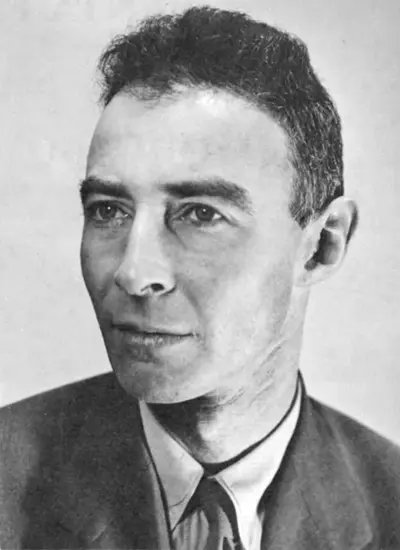
J. Robert Oppenheimer was an American theoretical physicist and professor of physics at the University of California, Berkeley. Oppenheimer was the wartime head of the Los Alamos Laboratory and is among those who are credited with being the "father of the atomic bomb" for their role in the Manhattan Project, the World War II undertaking that developed the first nuclear weapons. The first atomic bomb was successfully detonated on July 16, 1945, in the Trinity test in New Mexico.
