Charles Lindbergh Quotes
I have seen the science I worshiped, and the aircraft I loved, destroying the civilization I expected them to serve.
Lindbergh, Charles A. Of Flight and Life. Charles Scribner's Sons, 1948, p. v.

Einstein saw the war as madness but what distressed him most was that his friend and colleague, Fritz Haber, to help the war effort developed poison chlorine gas as a weapon which killed and maimed hundreds of thousands. He was a devoted pacifist thereafter. It took an even greater madman like Adolf Hitler and his Nazis to reach the mental point where he recommended to President Roosevelt that scientists develop an atomic bomb.

The Scientific Project that developed the Atomic Bomb. After the development of the atomic bomb there were great pressures on the involved scientists to downplay the dangers of nuclear weapons development. The weapons developer arm of the government was anxious not to frighten the public which might call for more oversight or even limitation of development and testing. Equally important was the scientists themselves who understood the forces that they had unleashed and were worried that if the public realized the worst of the possibilities, science and scientific research itself might be in jeopardy from a new Luddite reaction. Oppenheimer urged candor with the public. Most scientists took his advice but the Atomic Energy Commission had become politicized and when Oppenheimer went public with his and others scientific concerns they punished him by calling him a security risk and withdrawing his clearance thus cutting him off from new developments and discrediting him and his views at the same time.


Two years later he flew. That is how fast and dramatic the Wright Brothers work had gone. Once they got on the right track, everything began to fall into place. Two years earlier he had been optimistic. See {613170}.


This declaration, drafted by Russell and Einstein two days before Einstein’s death was signed by a number of other prominent scientists.


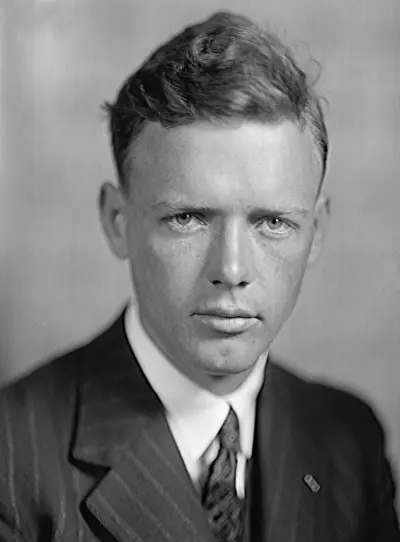
Charles Augustus Lindbergh, nicknamed Slim, Lucky Lindy, and The Lone Eagle, was an American aviator, author, inventor, military officer, explorer, and social activist. In 1927, at the age of 25, Lindbergh emerged from the virtual obscurity of a U.S. Air Mail pilot to instantaneous world fame as the result of his Orteig Prize-winning solo nonstop flight from Roosevelt Field on Long Island, New York, to Le Bourget Field in Paris, France. He flew the distance of nearly 3,600 statute miles (5,800 km) in a single-seat, single-engine, purpose-built Ryan monoplane, Spirit of St. Louis. Lindbergh was the 19th person to make a Transatlantic flight, the first being the Transatlantic flight of Alcock and Brown from Newfoundland in 1919, but Lindbergh's flight was almost twice the distance. The record-setting flight took 33 1⁄2 hours. Lindbergh, a U.S. Army Air Corps Reserve officer, was also awarded the nation's highest military decoration, the Medal of Honor, for his historic exploit. Politically, the National Hero became an active fascist supporter of Mussolini and Adolph Hitler who awarded him a Medal for Supporting Fascism, Anti-Semitism and advocating for America to allow Hitler to conquer German and the rest of Europe. After WWII he was in disgrace.
