Annie Jacobsen Quotes
You can absolutely drive through an atmospheric bomb test and not be affected.
Jacobsen, Annie. Interview by Terry Gross. Fresh Air, NPR, 17 May 2011.

Breslin was criticized in a Federal report for his alarmist news coverage of the Three Mile Island nuclear mishap:

This was a political use of sarcasm and irony. Oak Ridge was the site of the largest facility for producing fissionable material in the world as the result of the Manhattan Project. And yet the problem of what to do with the radioactive waste has never been resolved. So Oak Ridge was producing more and more radioactive uranium in the area without a resolution in sight. The “joke” was that the people in the area were immune, so production could continue without a solution to radioactive waste.


This was the first Russian atomic explosion.

Within a few months 11,021 scientists, of forty-nine countries also signed the appeal.


Morrison was then a graduate student of Oppenheimer. The quotation is important, not because it shows how quickly the “father of the atomic bomb” realized that a nuclear bomb could be made and how, but how relatively easy and rapid it was for a competent theoretical physicist could conceptually design a nuclear weapon if they first had knowledge of the Hahn / Strassmann Experiment and the Meitner / Frisch explanation of what had happened ({640924}). Note Leo Szilard’s letter at about the same time--{640925}.


The letter was actually delivered to President Roosevelt on October 11. It was the stimulus for the Manhattan Project to develop the atomic bomb. It had been drafted in large part by physicist Leo Szilard whose idea it was that Einstein sign the letter. As the world’s most prestigious scientist Einstein, Szilard felt, would make more of an impression on FDR than he, Fermi or other scientists even though Einstein was a theoretician and never did work on the development of the bomb. The military men did not understand Szilard and thought him a danger to the nation. So the two men who initiated the idea of the development of an atom bomb did not do any, of the work on it.

In 1950 a number of experiments were planned and carried out under the auspices of the Atomic Energy Commission where humans were exposed to radiation, often without their informed consent.

Any object that has been contaminated gradually loses its radioactive strength. It has a “half life”. This is the amount of time that it takes for the radiation in an object to lose half its strength. Different materials have different half lives. Nuclear waste from a power plant for example might have a half life of tens of thousands of years.

The fear of a nuclear accident is not based on the statistics or probability of death or injury. When a person chokes, it is only that person who may die. IF there is a nuclear power plant meltdown, millions of people can be injured or killed. It is the possible scale of the problem which makes most citizens fearful.

The Booklet told people that even under an atomic attack there would be many survivors and it was everyone’s job to increase the number of survivors by taking precautions like building fallout shelters and maintaining a supply of food and water at home and ducking under desks and tables if there was an atomic attack. The implication was that despite the great firepower of the then Hydrogen Bombs there would be great survivability. The suggestions for protection ranged from minimal likely effect to absurd. The Publication also bore the imprimatur of the Executive Office of the President for credibility and many people believed it.


The Scientific Project that developed the Atomic Bomb. In the development of the atomic bomb there was a hypothetical possibility that the Earth as we know it might be destroyed. Robert Oppenheimer the scientist who directed the bomb development and his staff framed the question which Oppenheimer presented to Arthur Compton. The decision was that Oppenheimer’s team would calculate every possibility and make sure that such a catastrophe was not within the realm of possibility. They did all the calculations, concluded that there was no possibility, the bomb was exploded, and the question was then finally answered in the negative.

Reflecting on the two scientists different views immediately after nuclear fission had first been demonstrated and explained--{640924}. The different “conservative” views reflect the norms and mores contrasts of the scientists and the political world. To the scientist saying something is possible before it has actually been demonstrated is unethical, and estimates of likelihood of success is not taken into account until there is evidence—that it has happened. Szilard’s conservatism was not concerned with undue optimism about something that has not yet occurred, but pragmatically it might happen and if so the political and practical implications for a world at war were so profound that preparations should be made even if a chain reaction could not be produced in the next years. In this disagreement, Szilard’s view prevailed and the two scientists led the efforts that produced the first chain reaction months later.

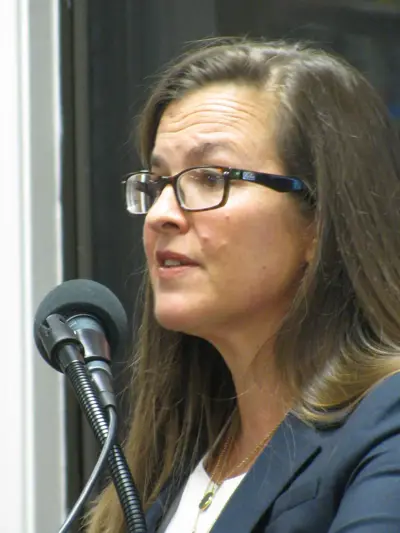
Annie Jacobsen is an American investigative journalist, author, and a 2016 Pulitzer Prize finalist. She was a contributing editor to the Los Angeles Times Magazine from 2009 until 2012. Jacobsen writes about war, weapons, security, and secrets. Jacobsen is best known as the author of the 2011 non-fiction book, Area 51: An Uncensored History of America's Top Secret Military Base, which The New York Times called "cauldron-stirring." She is an internationally acclaimed and sometimes controversial author who, according to one critic, writes sensational books by addressing popular conspiracies.
