Leo Szilard Quotes
Fermi thought that the conservative thing was to play down the possibility that a chain reaction might happen, and I thought that the conservative thing was to assume that it would happen and take all the necessary precautions.
Reflecting on the two scientists different views immediately after nuclear fission had first been demonstrated and explained--{640924}. The different “conservative” views reflect the norms and mores contrasts of the scientists and the political world. To the scientist saying something is possible before it has actually been demonstrated is unethical, and estimates of likelihood of success is not taken into account until there is evidence—that it has happened. Szilard’s conservatism was not concerned with undue optimism about something that has not yet occurred, but pragmatically it might happen and if so the political and practical implications for a world at war were so profound that preparations should be made even if a chain reaction could not be produced in the next years. In this disagreement, Szilard’s view prevailed and the two scientists led the efforts that produced the first chain reaction months later.
Leo Szilard, 1898-1964, Hungarian-American Nuclear Scientist, Quoted in Quoted in Richard Rhodes, The Making of the Atomic Bomb, 1986
Sourced by: Eigen's Political and Historical Quotations

This is one of the most momentous quotations of all time. Otto Hahn was a German Chemist who until recently had worked with Lisa Meitner in one of the most productive scientific collaborations of all time. However, Meitner was Jewish and had to flee from Germany with Hahn’s help for her life. She went to Stockholm where they were doing almost no nuclear research and although she was a famous physicist, there was no laboratory or university that could use her talents, thus her term “empty handed”. She and Hahn had conducted a series of experiments bombarding radioactive material with particles which transmuted the radioactive element to another element nearby on the Periodic Table of the elements—an element with a close atomic number. After Meitner escaped, Hahn with Fritz Strassmann assisting, bombarded uranium the heaviest element with neutrons, the heaviest particles. However, in addition to the expected results, a substantial amount of Barium remained after the bombardment. Hahn was a brilliant experimental chemist and at first he assumed that perhaps they had identified the Barium erroneously or the data was read incorrectly, or the experiment had been contaminated. There was no explanation for it. So he sent copies of all the data to Meitner a brilliant Physicist and Mathematician who was the theoretician of their team. She studied the data with her nephew, Otto Frisch who was a young up and coming mathematician. After a few days, she had figured it out. Hahn had produced the first human induced case of nuclear fission although they gave it that name a little later. She and her nephew confirmed all the data readings mathematically and proved exactly what had happened. She refers to it in the letter as “splitting” the atom. She wrote to Hahn and explained what had happened. Without any intention of doing so, he and Strassmann were the first scientists to create a real example of nuclear fission. The world has never been the same since. Hahn and Strassmann were awarded the Nobel Prize.


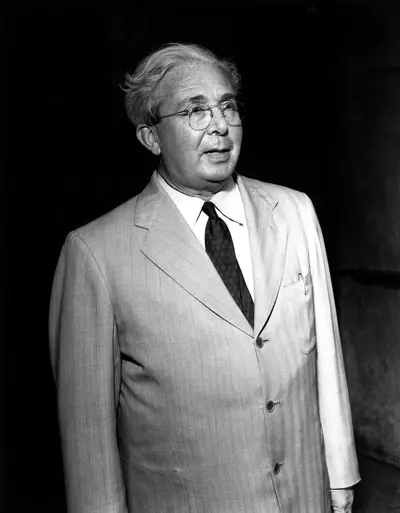
Leo Szilard was a Hungarian-American physicist and inventor. He conceived the nuclear chain reaction in 1933, patented the idea of a nuclear fission reactor in 1934, and in late 1939 wrote the letter for Albert Einstein's signature that resulted in the Manhattan Project that built the atomic bomb. According to György Marx he was one of the Hungarian scientists known as The Martians.
