Stephen King Quotes
When we blew the first atomic bomb at White Sands near the end of the war, nobody knew what was going to happen. There was a theory that the chain reaction would continue forever. And we would have created a little tiny sun out there in the desert that would burn until the end of the universe. It wasn't a widely held theory but it was a theory that nobody had a way of disproving. There were people who thought it wouldn't go off at all, that it would simply sit out there and melt and produce a great big dirty cloud of radioactivity. Nobody knew.
King, Stephen. The Stand. Doubleday, 1978.

Meitner and her nephew Frisch had been the first people to realize that the atom had been split. Meitner had described the process to her nephew and he made some drawings of the process she described. A few of these looked like a bacteria dividing. Frisch happened to meet with William A. Arnold, an American Biologist doing research in Stockholm. He asked Arnold what the biologists called it when a bacteria divided, and he replied, “fission”. Frisch told his aunt and she decided that they should use that term in the scientific article they were preparing on the splitting of the atom.

The Scientific Project that developed the Atomic Bomb. In the development of the atomic bomb there was a hypothetical possibility that the Earth as we know it might be destroyed. Robert Oppenheimer the scientist who directed the bomb development and his staff framed the question which Oppenheimer presented to Arthur Compton. The decision was that Oppenheimer’s team would calculate every possibility and make sure that such a catastrophe was not within the realm of possibility. They did all the calculations, concluded that there was no possibility, the bomb was exploded, and the question was then finally answered in the negative.

Reflecting on the two scientists different views immediately after nuclear fission had first been demonstrated and explained--{640924}. The different “conservative” views reflect the norms and mores contrasts of the scientists and the political world. To the scientist saying something is possible before it has actually been demonstrated is unethical, and estimates of likelihood of success is not taken into account until there is evidence—that it has happened. Szilard’s conservatism was not concerned with undue optimism about something that has not yet occurred, but pragmatically it might happen and if so the political and practical implications for a world at war were so profound that preparations should be made even if a chain reaction could not be produced in the next years. In this disagreement, Szilard’s view prevailed and the two scientists led the efforts that produced the first chain reaction months later.


What makes this quote important historically is to realize the assurances that he had to give the press and the public. This shows the level of anxiety about nuclear science that existed at the time and some of the absurd claims that critics and skeptics made. While it was true that there were same dangers in the nuclear testing, some of which the authorities were ignorant of, they were not of the expansive catastrophic magnitude that the critics claimed. Almost all new science and technology develops a Luddite community of opponents who want the technology stopped or at least slowed much. These opponents almost always exaggerate dangers in order to alarm public opinion via fear. At the same time, almost all the new scientific arenas eventually display and disclose problems and potential dangers of which the scientists and policy makers originally unaware. But they are almost always different from those the original critics claim. For example instead of environmental concern for radiation caused mutations in the animal life or the problem of what to do with radioactive byproducts of making atomic weapons, the warnings were that the water would flow out of the oceans and that gravity would be nullified.

This was the first Russian atomic explosion.
This is one of the most momentous quotations of all time. Otto Hahn was a German Chemist who until recently had worked with Lisa Meitner in one of the most productive scientific collaborations of all time. However, Meitner was Jewish and had to flee from Germany with Hahn’s help for her life. She went to Stockholm where they were doing almost no nuclear research and although she was a famous physicist, there was no laboratory or university that could use her talents, thus her term “empty handed”. She and Hahn had conducted a series of experiments bombarding radioactive material with particles which transmuted the radioactive element to another element nearby on the Periodic Table of the elements—an element with a close atomic number. After Meitner escaped, Hahn with Fritz Strassmann assisting, bombarded uranium the heaviest element with neutrons, the heaviest particles. However, in addition to the expected results, a substantial amount of Barium remained after the bombardment. Hahn was a brilliant experimental chemist and at first he assumed that perhaps they had identified the Barium erroneously or the data was read incorrectly, or the experiment had been contaminated. There was no explanation for it. So he sent copies of all the data to Meitner a brilliant Physicist and Mathematician who was the theoretician of their team. She studied the data with her nephew, Otto Frisch who was a young up and coming mathematician. After a few days, she had figured it out. Hahn had produced the first human induced case of nuclear fission although they gave it that name a little later. She and her nephew confirmed all the data readings mathematically and proved exactly what had happened. She refers to it in the letter as “splitting” the atom. She wrote to Hahn and explained what had happened. Without any intention of doing so, he and Strassmann were the first scientists to create a real example of nuclear fission. The world has never been the same since. Hahn and Strassmann were awarded the Nobel Prize.

Morrison was then a graduate student of Oppenheimer. The quotation is important, not because it shows how quickly the “father of the atomic bomb” realized that a nuclear bomb could be made and how, but how relatively easy and rapid it was for a competent theoretical physicist could conceptually design a nuclear weapon if they first had knowledge of the Hahn / Strassmann Experiment and the Meitner / Frisch explanation of what had happened ({640924}). Note Leo Szilard’s letter at about the same time--{640925}.


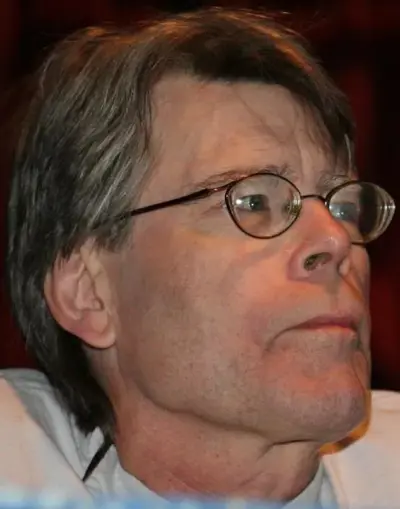
Stephen Edwin King is an American author of horror, supernatural fiction, suspense, crime, science-fiction, and fantasy novels. His books have sold more than 350 million copies, and many have been adapted into films, television series, miniseries, and comic books. King has published 62 novels, including seven under the pen name Richard Bachman, and five non-fiction books. He has also written approximately 200 short stories, most of which have been published in book collections.
