Jefferson Davis Quotes
… the admission, as a state, of California, from which we have been excluded by congressional agitation?
Note the perception of Davis, typical of Southerners at the time, that Southerners were being excluded from California. The logic was this: California had many opportunities in land, gold, and other natural resources. Since California had a Constitutional provision against slavery, no Southerner could enter the new state with his slaves without fear of their being set free. If Southerners bought land or wanted to hunt for gold, they could not bring their slaves to do the heavy work. Therefore, they were excluded from the economic growth of the state. The idea of the whites doing the heavy work themselves of traveling without their family slaves was so foreign to the aristocratic planter class, that it was never considered by them as a possibility. Therefore, they were excluded. However, many of the lower class Southerners of all races saw great opportunities in California where they could compete on an equal footing even though they had no slaves or land.
Jefferson Davis, 1808-1889, U. S. Congressman & U. S. Senator (Democrat, MS), U. S. Secretary of War, President, Confederate States of America, Senate Debate, 1850
Sourced by: Eigen's Political and Historical Quotations


During Southern slavery, the poor white of the South had almost no prospects. He was always competing against slave labor which held his wages very low. At first he could he could get by if he had a trade—a carpenter, a blacksmith, a teamster, etc. However, soon slave owners invested in training some of their slaves, so even a white Southern tradesman could not earn a high wage as a Northern tradesman did. Unfortunately, the Southern upper class persuaded the poor whites that if slaves were emancipated they would be greater competition than they were under slavery, and there never was the common interest with the Northern labor that Emerson hypothesized.


The founding fathers assumed that as the West was settled, there would be more states in the Union. However, Morris, a bit of a snob and an aristocrat, assumed that the Westerners would be a little rougher than the established Eastern States and in particular would be more inclined to use violence and engage in war. So he wanted some provision that the original “maritime” East Coast states could not be outvoted. He did not prevail and all states were treated as equal in the Senate, but he turned out to be right about the warlike propensity. Kentucky and other “Western” areas were strong advocates for the War of 1812. The Atlantic states were much more vulnerable to a British invasion and the Maritime States’ economy could be easily ruined (and was) by a naval blocade, where the Western states’ economics were not much affected by the war. The West was also more strongly for the Mexican War, the Indian Wars, and even the Mormon Wars.

This marvelous quotation gives us a picture of the essence of the conflict in conception of freedom between Southern whites and negroes. There was no way to change the large majority of whites’ opinions and it is easy to see why Jim Crow and Southern discrimination evolved as it did. The emancipated Blacks had insufficient power or resources and there was not enough effort or success at changing white attitudes and no where near enough law enforcement to impose the view on the majority of the Southern white population.

The law at that time gave a married woman almost no rights. The husband legally controlled the family assets regardless of who had earned or provided them. He aslo had absolute control of the upbringing of the children. Women could not vote and in many states were considered property of the husband.


JFK was running for the Presidency and was Roman Catholic. There was a great deal of anti-Catholic prejudice in the country with many people fearing that a Catholic President would mean Papal control of the United States. Peale was the most influential American clergyman of the day, and while he did not overtly oppose the Kennedy candidacy, he did state that he thought the election of a Catholic would profoundly change America. Kennedy won by a thin margin, but none of the events that the anti-Catholics feared, came to pass.

In 1830, President Andrew Jackson, institution one of the most unjust, immoral and outrageous policies in all of American history. He ordered that all the Indians of the Southeast, be forcibly evicted from their lands—including those protected by treaties—and at gunpoint marched by the military to the Oklahoma territory, where they were in effect jailed in reservations that were generally far inferior to the lands from which they were forced. No sooner had the ethnic cleasing of the South East been complete, than the whites took the Indian lands without paying the Indian owners at all.


Lincoln was worried about Louisiana reverting back to the slavery era. He was right to be worried, and led the fight to pass the 13th Amendment outlawing slavery forever. So the white racist elements of Louisiana used Jim Crowe discrimination instead.


After the Civil War and Reconstruction, the American nation was still bitterly divided intelelctually, socially, emotionally and poliotically. In an effort to bring more unity to America, most of the power stucture and the influentials of the nation began to avoid those issues that would divide North and South and try and promote a narrative that both sides might be able to live with. And this is what Zeitz describes in this quotation. America went through a period of Revisionist History that even in the 21st century was held by many people. It wasn't until the middle of the 20th century that the real history and narrative of the Civil War and Reconstrution emerged from the few academics who had all along criticized the fabricated narritive that did unify the country at the cost of historical accuracy and truth. Many scholars point out that the price that America paid for this unity was the Jim Crow era and a century of legalized racism. Much of the nation was built on the labor of Negro slaves and the victims of the slavery era, also bore the brunt of American unity and reconcilliation.

Ever since the Civil War, there has been an imbalance between the areas of the country with large unemployed populations and those areas where jobs were available. Even in 1870, the authorities were trying to get the unemployed to relocate but this was a hard thing to do at the time—physically, economically, and psychologically. It was not until the 2nd World War when huge numbers of Blacks migrated from areas of poor economic prospects in the South to areas of opportunity in the North. Also, note the classic welfare dilemma expressed whereby if humanitarian assistance is provided, people will not be desperate enough to move to areas with better opportunities.
The reason this historical quote is so important is not only that it provides more evidence of the anti-Asian racism that existed in America in the 1920s, but it also shows that The American Legion was one of the leaders in fomenting race hatred of Asians. The anti-Asian racism was much worse on the West Coast than on the East Coast where there was a thriving Chinese Community in New York City that was relatively un-harassed.

Chief legal officer of a Dutch town. He wanted to have a plebiscite in each town on major issues before the assembly so as to instruct the representative as to how to vote. The graphic is a painting of Adriaan van Zeebergh and his board of the Teylers Stichting.


This quotation illustrates how the racist South defeated the objectives of the Civil War and Reconstruction by the institution of Jim Crowe laws and so called “states’ rights”. It would take more than another half century for the Yankees and the vast majority of the non-Southern Americans decided that the Southerners could no longer “do as they pleased” with fellow human beings. It is hard to believe for us today that an entire section of our country could actually believe in the morality of the South but that is the tragic history of race relations in America.
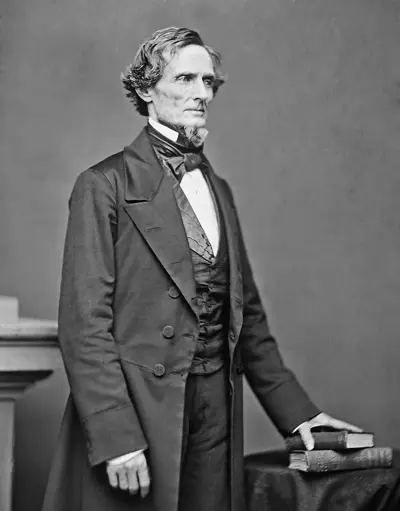
Jefferson Finis Davis was an American politician who served as the president of the Confederate States from 1861 to 1865. As a member of the Democratic Party, he represented Mississippi in the United States Senate and the House of Representatives before the American Civil War. He previously served as the United States Secretary of War from 1853 to 1857 under President Franklin Pierce.
