Gouverneur Morris Quotes
The new States will know less of the public interest than these; will have an interest in many respects different; in particular will be little scrupulous of involving the community in wars, the burdens and operations of which would fall chiefly on the maritime States. Provision ought, therefore, to be made to prevent the maritime States from being hereafter outvoted by them…. They would not be able to furnish men equally enlightened to share in the administration of our common interests. The busy haunts of men, not the remote wilderness, was the proper school of political talents. If the Western people get power into their hands, they will ruin the Atlantic interest. The back members are always most averse to the best measures…. You have no authority to throw the rights and property of this people into the 'hotch-pot' with the wild men on the Missouri, nor with the mixed, though more respectable, race of Anglo-Hispano-Gallo-Americans who bask on the sands in the mouth of the Mississippi....
The founding fathers assumed that as the West was settled, there would be more states in the Union. However, Morris, a bit of a snob and an aristocrat, assumed that the Westerners would be a little rougher than the established Eastern States and in particular would be more inclined to use violence and engage in war. So he wanted some provision that the original “maritime” East Coast states could not be outvoted. He did not prevail and all states were treated as equal in the Senate, but he turned out to be right about the warlike propensity. Kentucky and other “Western” areas were strong advocates for the War of 1812. The Atlantic states were much more vulnerable to a British invasion and the Maritime States’ economy could be easily ruined (and was) by a naval blocade, where the Western states’ economics were not much affected by the war. The West was also more strongly for the Mexican War, the Indian Wars, and even the Mormon Wars.
Gouverneur Morris, 1752-1816, U. S. Commissioner to England & U. S. Minister to France, U. S. Senator (Federalist, NY), Constitutional Convention Debate, Philadelphia, 1787
Sourced by: Eigen's Political and Historical Quotations

This is one of the broadest views of American statehood that has been advocated. Smith had written to most of the then likely Presidential candidates of both major parties asking for their position on the Mormons who were facing persecution wherever they went. None of the politicians would make any satisfactory commitments. Smith took direct action and became the only major religious official to have run for the Presidency of the United States until Pat Robertson tried and failed in 2000. Smith’s assassination shortly thereafter cut his run for the Presidency short before it made much headway but politically he had no chance to affect the race anywa.

Critics of his position observe that the Islamic fundamentalists will never allow girls to go to school even if they were built and they might blow up any school that might be constructed if the allies did not have enough troops in Iraq to protect them and suppress the terrorists. When the Taliban fundamentalists controlled Afghanistan before the coalition drove them out, neither little girls not big girls could acquire education and women were not even allowed to work.

Note the perception of Davis, typical of Southerners at the time, that Southerners were being excluded from California. The logic was this: California had many opportunities in land, gold, and other natural resources. Since California had a Constitutional provision against slavery, no Southerner could enter the new state with his slaves without fear of their being set free. If Southerners bought land or wanted to hunt for gold, they could not bring their slaves to do the heavy work. Therefore, they were excluded from the economic growth of the state. The idea of the whites doing the heavy work themselves of traveling without their family slaves was so foreign to the aristocratic planter class, that it was never considered by them as a possibility. Therefore, they were excluded. However, many of the lower class Southerners of all races saw great opportunities in California where they could compete on an equal footing even though they had no slaves or land.


His is one extremist view of Jerusalem. Most historians agree that both Jews and Arabs have lived in Jerusalem since recorded history. Extremists on both sides of the Arab Israeli debate have constructs which deny the existence of the other group. Sisalem is one. Both the Palestinians and Jews claim Jerusalem as their capital and both have reasonable historical claims, and both have shared the city for thousands of years.
The Jews and Arabs for years shared Palestine. But the Jews spread out over the world, becoming modern and Westernized in the process. When the Jews returned to Palestine as a part of the Zionist movement, they were more modern, Westernized, and culturally at odds with their old Arab cousins, whose cultures had atrophied. The Arabs resented the Westernized culture that was being introduced into the Middle East. One point of view is that had Israel not tried to introduce moderism and Western ideas into the Middle East, the Jewish State might have been more accepted. However, not only did they bring a foreign perspective (democracy), education and techmology and capitalism to the area, but they far outpassed the Arab nations in agriculture, industry, science, medicine and general standard of living. The Arab dictators and monarchs had always had the excuse for poverty that the land was so poor that it simply could not be developed, but Israel developed the worst of the land in the area with no oil or natural resources. Every day of Israeli prosperity and scientific achievement was an embarassment for the rest of the Middle East where even the rich oil countries were not improving the lot of the average citizen.


More and more whites had been encroaching on land of the Chickasaw Reservation which the United States was bound to protect. However, soldiers fighting whites was politically unpalatable and the Government came up with the idea of providing land West of the Mississippi as a new reservation in exchange for the existing reservation. The Indians expenses of moving would be paid and they would be given generous provisions in the new lands. The U. S. negotiators were surprised when the translator for the Chickasaw negotiators made this speech which was then reported to the President and Congress. Andrew Jackson was strongly in favor of Indian Removal and he had forced other tribes out of their lands. Eventually the Government upped the ante and agreed to pay the Chickasaw the large sum of $3 million to move and they Chickasaw realized that if they did not accept, they would be removed as other tribes had been, The promised payment was delayed over Congressional arguments over appropriations but eventually the Chickasaw were paid.


The Kurdish People do not have a homeland of their own but are minorities of other states—mostly in Turkey and Iraq. There was a “Kurdistan” for a few years but it did not last do to major geopolitical forces. Whereas Barzani is opposed to violence, there are other Kurds who have resorted to vicious terrorism in their quest for a homeland. Kurds represent a wide range of opinion on the best way to create a stat of Kurdistan, but they were at the time, almost unanimous on their desire for independence and the belief in their moral right to have a homeland.

Despite the fact that there were no formal political polls at the time, public opinion was very influential in curtailing what might be a tendency to use of the American military. Starting with the Cold War later, Presidents tended to use American military force regardless of public opinion or would exaggerate or lie (Vietnam and Iraq wars for example) to temporally gain some public support.

Alaska was then a territory and not yet a state. See {637486} for Eleanor Roosevelt’s then contemporaneous statement on statehood.

The United States had then only existed for about 30 years but was already a model.

Fortunately he was wrong, but the threat of a breakup of the American Union intimidated most members of Congress to avoid anything that would offend a state or group of states. Thus slavery became more and more entrenched till it exploded into the Civil War. At the time the issues of contention included the fact that Louisiana was primarily Roman Catholic and ALL other states were majority Protestant. The territory functioned under French Law—the Napoleonic Code, while all the other states operated under the English Common Law (even today this is so), and there was concern with the French and Creole language and whether the Creoles would fit into American Culture.

He was the first member of Congress who was murdered (in 1904). 8 years after his death, New Mexico attained statehood.


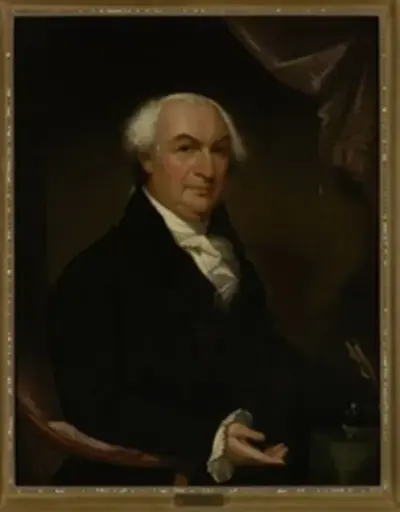
Gouverneur Morris was an American statesman, a Founding Father of the United States, and a signatory to the Articles of Confederation and the United States Constitution. He wrote the Preamble to the United States Constitution and has been called the "Penman of the Constitution." In an era when most Americans thought of themselves as citizens of their respective states, Morris advanced the idea of being a citizen of a single union of states. He was also one of the most outspoken opponents of slavery among all of those who were present at the Constitutional Convention. He represented New York in the United States Senate from 1800 to 1803.
