Norman Vincent Peale Quotes
This will be a different society if a Catholic is elected President
JFK was running for the Presidency and was Roman Catholic. There was a great deal of anti-Catholic prejudice in the country with many people fearing that a Catholic President would mean Papal control of the United States. Peale was the most influential American clergyman of the day, and while he did not overtly oppose the Kennedy candidacy, he did state that he thought the election of a Catholic would profoundly change America. Kennedy won by a thin margin, but none of the events that the anti-Catholics feared, came to pass.
Norman Vincent Peale, 1898-1993, Pastor, Marble Collegiate Church (Dutch Reformed Church), President, Reformed Church in America, 1960
Sourced by: Eigen's Political and Historical Quotations

Kennedy was a Roman Catholic and there was a great deal of anti-Catholic prejudice in the country then. Al Smith, the only Catholic who had run for the Presidency, was defeated with almost all his opposition coming from anti-Catholic forces appealing to the then popular prejudice that if a Catholic became President, the Pope and the Vatican would be running America. Richard Nixon, a master politician with few scruples, cleverly kept raising the religious question in the voters minds by saying that he would not make Kennedy’s religion and issue of the campaign. Kennedy barely won.

This was a very important historical quotation. In 1928 Al Smith, the Governor of New York, was the Democratic Candidate for President. He was the first Roman Catholic to run for the Presidency for a major party. He narrowly lost and the anti-Catholic sentiment of much of the country was one of the major reasons, Jones was one of the many Protestant religious leaders who were virulently opposed to a Roman Catholic in the White House. The analogy of a saloon on every corner was very important at the time as the United States had Prohibition, and alcohol had been Jones’ major issue beore then. The result was the election of Herbert Hoover and the subsequent Great Depression.

Kennedy was being hurt be fears that as a Catholic, he would be beholden to the Pope and the Catholic Bishops. There were many protestants who believed that the Catholic Church was antithetical to democracy and some who even believed that Catholicism was the religion of Satan. Kennedy decided to confront the issue head on.

Levy was the first Jewish naval captain of the United States Navy. He was acknowledged by the Secretary of the Navy to be qualified for promotion to Commodore, but there was much anti-Semitic opposition among the other senior officers. Levy was finally promoted to Commodore. He was so grateful for the freedom of America that he had purchased Thomas Jefferson's home Monticello and maintained it as a shrine to the author of the Declaration of Independence. See George Bancroft


Actually, there was no initial concern or protest. The New York Boards voted unanimously to approve th project, Then one woman started complaining to the media and there were a number of people who also opposed the construction of a Then Islamaphobic people joined the protest, Many politicians observed that in Saudi Arabia, the nation from which most of the 9-11 attackers came from, it is but the country, it is illegal to bring a Bible into tnot only illegal to build a Christian Church or Jewish Synagogue ANYWHERE in the nation while America already has thousands of Mosques, Most other Islamic countries make it difficult if not impossible for a non Muslims to build a place of worship. Bloomberg reminded Americans that there was no objection that the government Constitutionally could make to the proposed mosque. Although other nations may prohibit religious construction, America was unique in adopting our First Amendment, the Separation of Church and State, and while a number of countries since have emulated America, most nations have not reached the point where they have matured sufficiently to realize the importance of separation of church and state. The fact that other nations do not follow American fundamental political principles which our founding Americans adopted, certainly does not mean that we should emulate them and abandon that which has made America such a great country and an example to the world. Ironically, the Muslim Imam in charge of the building project.

1st Duke of Wellington. The prohibitions against Catholic participation dated from the time when the Pope and the Vatican tried to support Catholic insurrections in England to return it as a Catholic country which it had been until King Henry VIII had a dispute with the Pope. However, the Catholic attempt to take over England and crush the Protestant Church of England had occurred so long before that there was no practical danger to the then established Church of England. Wellington, an Irish Protestant himself, realized that the law presented no significant protection and caused not only great resentment of English and Irish Catholics, but denied the nation the benefit of their great talents in politics. England took a great step forward and passed the bill.


It took only 10 days after the First Continental Congress met for religious bigotry to arise. After hundreds of years of Catholic/Protestant strife, each sect looked upon the other, not only as theologically wrong, but dangerous to the liberty of the other. Unfortunately, the organied religions had acted so badly towards other religions, that everyone was justified in fearing the other religions. This quotation illustrates a then typical attitude of many American Protestants that the Catholic Church was a threat to national security. Ironically, in modern times, anti-Catholic bigots use this quotation to demonstrate that the United States was founded as a Christian Protestant nation—not a general Christian nation. A small, vicious anti-Catholic sentiment still exists, usually by a minority of right wing Protestant religious fundamentalists. Protestant England had just repealed the laws making Catholicism illegal, but this was regarded at that time as intolerable for the new America. This was one of the disputes which that the Founding Fathers were faced with later and one of the reasons that they were so absolute in the need for the 1st Amendment.

This book is endorsed by major religious organizations of all faiths as well as National School Boards Association, National Education Association, National PTA, National Association of Secondary School Principals, National Association of Elementary School Principals, American Association of School Administrators and others. It is used as a guideline by most schools systems in the United States.


A conservative Calvinist weekly periodical. There has always been a religious right in America.


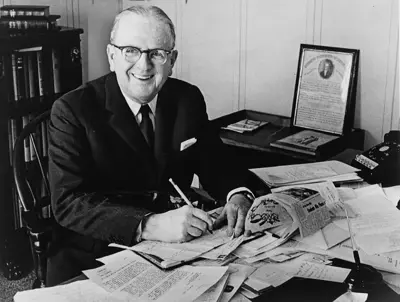
Norman Vincent Peale was an American minister and author who is best known for his work in popularizing the concept of positive thinking, especially through his best-selling book The Power of Positive Thinking. He served as the pastor of Marble Collegiate Church, New York, from 1932 until 1984, leading a Reformed Church in America congregation.
