Roger Sherman Quotes
If the Vice President were not to be President of the Senate, he would be without employment.
Roger Sherman, 1721-1793, U. S. Congressman (Connecticut), Judge of the Connecticut Superior Court, Mayor of New Haven, Connecticut Delegate to the Constitutional Convention, Debate in the Constitutional Convention, Philadelphia, 1787
Sourced by: Eigen's Political and Historical Quotations


He was Chief of Staff and was trying to calm the nation. However, he created a real problem. By saying he was in control, he alarmed many people as the Constitution did not give him any authority to be in control of anything. Many people saw this as a sign of his extreme personal ambition. Others, that he had just made a mistake.


Platt and the regular Republicans wanted to get Roosevelt out of the NY Governor’s mansion where his reforms were angering the ultra conservatives and the large business interests. They wanted to have him be the Vice Presidential nominee and when McKinley was reelected, they could be rid of Roosevelt in a position where he could do anything. Roosevelt in this quote turned the offer down. Platt however then told Roosevelt that the conservative Republicans would not support him in the next election and with only half the Republican Party supporting him, the Democratic candidate would likely win. Realizing that he was cornered, Roosevelt agreed to be vice president. But Platt and the ultra conservatives however were very sorry when President McKinley was assassinated and Roosevelt, the man they wanted out of the way, was the President of the United States. See {639175} and {639180} for more on Theodore Roosevelt’s feelings about the vice presidency.

Abraham Lincoln's election came at a time when the preservation of the United States as one nation was in question. Many, including the incumbent President, had little confidence in Lincoln's capacity to govern:


Before Theodore Roosevelt, American Presidential Candidates had to pretend that they did not seek the presidency and remain passive. However Roosevelt changed that norm and the primary elections, taking the nomination away from a few party leaders, further required Presidential aspirants to campaign. The principle Lomdes articulated was that if called upon, one was obligated to serve, but should not overtly seek the position and wait to be called by the people.
Roosevelt was then the Vice President.

Hamilton thought that the Executive Branch should be co-equal with the Judicial Branch and lifetime tenure should apply to both. This quotation is very important as we consider developing countries and emerging democracies. Some in the third world have Presidents for Life—a concept that most democracies scoff at. But the stability and the independence was important enough to some of the Founding Fathers was actually advocated and considered as we formed the American Democracy.

His role was the equivalent of the Mayor of Washington DC. Even though the Congress had generally been the most powerful branch of the government, public opinion on this was beginning to shift at the turn of the 20th century.

Upon the death of President William Henry Harrison a month after he took office, John Tyler, the Vice President, assumed the Presidency according to the Constitution. This Vice President assuming the Presidency was shocking to many.

What is interesting about this quotation is how early in America’s history the insignificance of the Vice Presidency was discussed.

Some were calling for a national referendum be taken to determine American policy regarding participating with the League of Nations or other international organizations.


_0_PostageStamp_47x47.jpg "Chairman of the Joint Chiefs of Staff Navy Adm. Mike Mullen gives an interview to John Dickerson during the CBS news program Face the Nation in Washington, D.C., July 5, 2009. During the interview, Mullen discussed the wars in Iraq and Afghanistan, North Korea's recent missile tests and his recent visit to Russia. (DoD photo by Mass Communication Specialist 1st Class Chad J. McNeeley, U.S. Navy/Released)")


Vidal, a staunch liberal held this view along with many ultra conservatives end extreme liberals. The constitution requires the Congress to declare war, but they have not done so for any of the wars since WWII. The President assumed the war power. And the only coherent budgets began.

This letter was written shortly after the Constitution had been signed by the convention delegates. This difference between Adams and Jefferson would be at the heart of the first great partisan struggle in American history. Adams, as the second President, tried to increase and use the power of the Presidency. Jefferson opposed him, especially when Adams tried to run for a second term. The Adams-led Federalists were pitted against Jefferson’s Democratic Republicans in the first, and perhaps still the most bitter partisan struggle in American political history. The Jeffersonians accused Adams and the Federalists of trying to unravel the American Revolution and revert to a monarchy. The people not only sided with the Democratic Republicans, ousting Adams, but also turned out most of the Federalists. It was the end of the Federalist Party, and a new conservative party—without monarchial tendencies—the Whigs became the new opposition party.

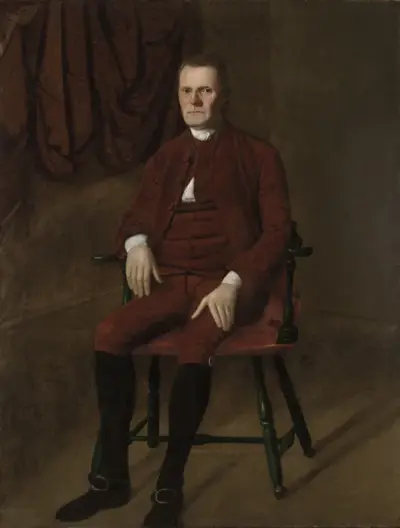
Roger Sherman was an early American statesman and lawyer, as well as a Founding Father of the United States. He is the only person to have signed all four great state papers of the United States: the Continental Association, the Declaration of Independence, the Articles of Confederation, and the Constitution.
