Woodrow Wilson Quotes
A Vice President’s only significance consists in the fact that he may cease to be Vice President.
Woodrow Wilson, 1856-1924, 28th President of the United States (Democrat, NJ), Quoted in Smithsonian, July / August 2012
Sourced by: Eigen's Political and Historical Quotations


He was Chief of Staff and was trying to calm the nation. However, he created a real problem. By saying he was in control, he alarmed many people as the Constitution did not give him any authority to be in control of anything. Many people saw this as a sign of his extreme personal ambition. Others, that he had just made a mistake.


JFK bested LBJ for the 1960 Democratic presidential nomination. Clare Booth Luce asked LBJ if he would consider the second spot on the ticket. Shortly thereafter Johnson became Kennedy's running mate and was elected. At the inaugural ball, Luce reminded LBJ of his earlier conviction.

President Jimmy Carter had little use for diplomatic protocol. JKF’s Chief of Protocol tried to persuade him to give more attention to it. When Carter explained that he just didn’t see how it would help him achieve his objectives, the Ambassador observed: The President never sought Biddle’s advice again.


President Carter had just held Israeli Prime Minister Menachem Begin and Egyptian President Anwar Sadat at Camp David for thirteen days, until they reached an agreement on governing Sinai, the West Bank, and the Gaza Strip. Califano wrote this to Carter in his note the following day.


Upon the death of President William Henry Harrison a month after he took office, John Tyler, the Vice President, assumed the Presidency according to the Constitution. This Vice President assuming the Presidency was shocking to many.

Joking about the "incompetence" of Vice President Dan Quayle. Kerry later apologized for the joke.

Platt and the regular Republicans wanted to get Roosevelt out of the NY Governor’s mansion where his reforms were angering the ultra conservatives and the large business interests. They wanted to have him be the Vice Presidential nominee and when McKinley was reelected, they could be rid of Roosevelt in a position where he could do anything. Roosevelt in this quote turned the offer down. Platt however then told Roosevelt that the conservative Republicans would not support him in the next election and with only half the Republican Party supporting him, the Democratic candidate would likely win. Realizing that he was cornered, Roosevelt agreed to be vice president. But Platt and the ultra conservatives however were very sorry when President McKinley was assassinated and Roosevelt, the man they wanted out of the way, was the President of the United States. See {639175} and {639180} for more on Theodore Roosevelt’s feelings about the vice presidency.


This quotation perhaps was the most critical in Roosevelt’s political career. After winning the presidential election in his own right, that evening at a press conference he called, he not only committed to serving only two terms—then a custom and not law as it would be after WWII—but he also committed that his first three and a half years where he was not elected but assumed the presidency upon McKinley’s assassination would count as a full elected term. He therefore in 1908 could not run again even though the public wanted him to, and he might have liked another term. More important historically was 1912. Roosevelt had chosen his close friend and colleague William Howard Taft to succeed him and with Roosevelt’s support he was elected in 1908. But Taft’s wife who had always been his closest political advisor and reviewer of all his policies and speeches, had a stroke shortly after Taft was elected. Taft’s performance as President was very disappointing to Roosevelt, and he ran against Taft in the 1912 Republican nominating campaign. The very conservative Republicans were against Roosevelt, but many of those who liked him were distressed that he was reneging on his pledge not to run for a 3rd term. Roosevelt lost, and famously started the Bull Moose Party and ran against Taft and Wilson. He outpolled Taft but with the split Republican vote, Woodrow Wilson won the Presidency. This pledge haunted Roosevelt for the rest of his life.

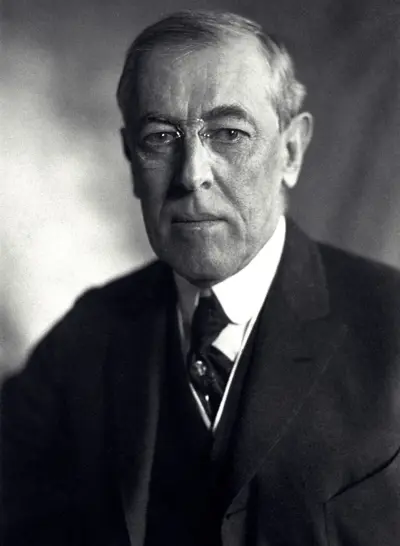
Thomas Woodrow Wilson was an American politician and academic who served as the 28th president of the United States from 1913 to 1921. A member of the Democratic Party, Wilson served as the president of Princeton University and as the 34th governor of New Jersey before winning the 1912 presidential election. As President, Wilson led the United States into World War I in 1917. He was the leading architect of the League of Nations, and his progressive stance on foreign policy came to be known as Wilsonianism. Scholars have generally ranked Wilson in the upper tier of U.S presidents, although he has been criticized for supporting racial segregation and white supremacy.
