John Quincy Adams Quotes
In upwards of half a century, this is the first instance of a Vice President's being called to act as President of the United States, and brings to the test that provision of the Constitution which places in the Executive chair a man never thought of for that office by anybody.
Upon the death of President William Henry Harrison a month after he took office, John Tyler, the Vice President, assumed the Presidency according to the Constitution. This Vice President assuming the Presidency was shocking to many.
John Quincy Adams, 1767-1848, 6th President of the United States (Independent, MA), April 4, 1841
Sourced by: Eigen's Political and Historical Quotations


The issue of how to address the President and Vice President was very controversial. To much respect and the President would appear to be a monarch; to little and he might not be taken seriously enough. See {586768}.


Although the Jacksonian Democrats were the political successors to the Jeffersonian Democratic Republicans, Jefferson found Jackson wanting as a potential president. Although Jefferson had made this statement during the 1824 Election, it did not become public until the Election of 1828 — Jackson’s second term. At that time Edward Coles, Formerly James Madison’s Secretary, disclosed the quotation.


He was Chief of Staff and was trying to calm the nation. However, he created a real problem. By saying he was in control, he alarmed many people as the Constitution did not give him any authority to be in control of anything. Many people saw this as a sign of his extreme personal ambition. Others, that he had just made a mistake.

Jefferson thought that the possibility that a man could become President even though more Americans voted for his opponent was undemocratic and a great flaw in our Constitution. It has actually happened several times and each time the Electoral College debate renewed, but there has never been enough concern to produce a Constitutional Amendment.

Hamilton thought that the Executive Branch should be co-equal with the Judicial Branch and lifetime tenure should apply to both. This quotation is very important as we consider developing countries and emerging democracies. Some in the third world have Presidents for Life—a concept that most democracies scoff at. But the stability and the independence was important enough to some of the Founding Fathers was actually advocated and considered as we formed the American Democracy.


This is rarely discussed by journalists—namely that the Constitutions which gives them so much immunity and freedom from regulation, allows anyone to call him/herself a journalist, and there are no qualifications other than what individual organizations choose to impose. The same incidentally is true of politicians.

The amendment was pushed by the Republicans in reaction to FDR's four terms, but its practical effect was to limit presidents Eisenhower and Reagan, both Republicans, to 2 terms while they each could have won a third term. Roosevelt had won 4 terms and traumatized the Republicans prompting them to term limit the American Presidency.

This led to the addition of the Vice Presidency.


This concept of Presidential powers greatly expanded the traditional power of the Presidency. To one degree or another this became the view of every president who followed until George W. Bush who went one large step further. He maintained that the President could do that which was specifically prohibited by law if the purpose was to perform a Constitutional duty.


Conason was refuting the argument of Presidential Press Secretary Ari Fleischer {618120} who had used the secrecy of the Constitutional Convention in 1789 to justify the Vice President’s secret meetings with energy businessman to make government energy policy.
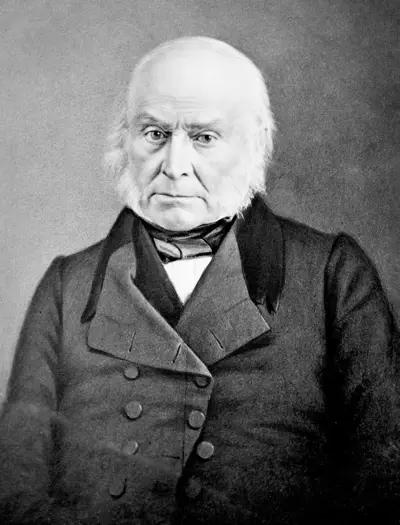
John Quincy Adams was an American statesman, diplomat, lawyer, and diarist who served as the sixth president of the United States, from 1825 to 1829. He previously served as the eighth United States Secretary of State from 1817 to 1825. During his long diplomatic and political career, Adams also served as an ambassador, and as a member of the United States Senate and House of Representatives representing Massachusetts. He was the eldest son of John Adams, who served as the second U.S. president from 1797 to 1801, and First Lady Abigail Adams. Initially a Federalist like his father, he won election to the presidency as a member of the Democratic-Republican Party, and in the mid-1830s became affiliated with the Whig Party.
